
Introduction: The Billing Gap in Service Operations
Enterprises that rely on ticketing systems—such as service desks, maintenance platforms, or customer support tools—often face a critical operational gap:
Service delivery and billing are disconnected.
Typical workflow:
- A ticket is created
- Work is completed
- Data is manually transferred to ERP
- Invoice is generated
This leads to:
- Delayed billing
- Revenue leakage
- Manual errors
- Poor financial visibility
The root cause?
Lack of integration between ticketing systems and ERP platforms.
This is where a modern API integration platform becomes essential.
And more importantly, where ConnectorHub enables enterprises to automate invoice and billing integration by seamlessly connecting ticketing systems with ERP platforms.
Why Ticketing-to-ERP Integration Is Critical
1. Revenue Accuracy
Without integration:
- Billing depends on manual input
- Errors lead to revenue loss
2. Faster Invoice Generation
Delays in billing:
- Impact cash flow
- Increase DSO (Days Sales Outstanding)
3. Operational Efficiency
Manual processes:
- Increase workload
- Reduce productivity
4. Real-Time Financial Visibility
Disconnected systems:
- Limit reporting
- Delay insights
Challenges in Connecting Ticketing Systems to ERP
1. Different Data Structures
Ticketing systems track:
- Service requests
- Work logs
ERP systems track:
- Financial transactions
- Invoices
Mapping these is complex.
2. Lack of API Standardization
Different platforms:
- Use different APIs
- Require custom integration
3. Workflow Complexity
Billing depends on:
- Ticket status
- Approval workflows
- Pricing rules
4. Scalability Issues
As operations grow:
- Integration complexity increases
The Modern Solution: API Integration Platform + Orchestration
To solve this, enterprises are adopting:
1. API Integration Platforms
Enable:
- Seamless connectivity
- Real-time data exchange
2. Enterprise Integration Platforms
Provide:
- Centralized orchestration
- Workflow automation
3. Invoice and Billing Integration Workflows
Automate:
- Ticket-to-invoice conversion
- Data synchronization
ConnectorHub: Automating Ticketing to ERP Billing
ConnectorHub is designed to:
- Connect operational systems with financial systems
- Automate billing workflows
- Eliminate manual processes
How ConnectorHub Enables Automated Billing
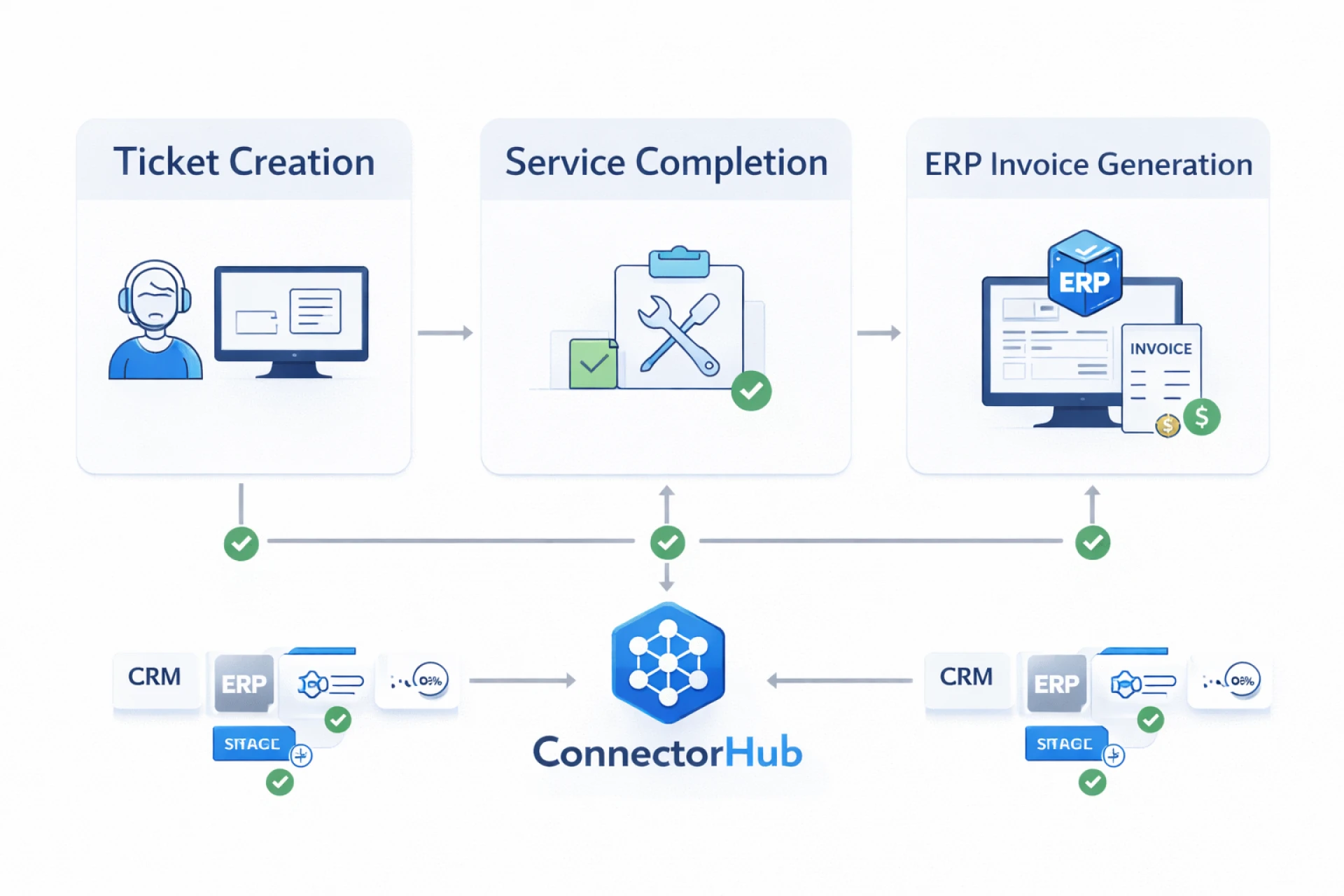
1. End-to-End Workflow Automation
ConnectorHub enables:
- Ticket creation →
- Work completion →
- Approval →
- Invoice generation
All automated.
2. Real-Time Data Synchronization
ConnectorHub ensures:
- Ticket data flows instantly to ERP
This enables:
- Immediate invoice creation
3. Advanced Data Mapping and Transformation
ConnectorHub:
- Maps ticket fields to ERP fields
- Handles pricing logic
- Supports custom billing rules
4. Conditional Workflow Logic
ConnectorHub supports:
- Rule-based billing
Examples:
- Bill only after approval
- Different pricing for service types
5. Multi-System Integration
ConnectorHub connects:
- Ticketing systems
- ERP platforms
- CRM systems
Key Use Cases
1. Service Desk Billing Automation
Problem:
- Manual invoice creation
ConnectorHub enables:
- Automatic invoice generation from tickets
2. Maintenance and CMMS Billing
Problem:
- Work orders not linked to billing
ConnectorHub enables:
- CMMS → ERP billing workflows
3. Field Service Operations
Problem:
- Delayed billing after service completion
ConnectorHub enables:
- Real-time billing triggers
4. Subscription and Usage-Based Billing
Problem:
- Complex billing models
ConnectorHub enables:
- Automated pricing calculations
ConnectorHub vs Traditional Integration Approaches
CapabilityManual ProcessCustom IntegrationConnectorHubSpeed❌ Slow⚠️ Medium✅ FastAccuracy❌ Low⚠️ Medium✅ HighScalability❌ Low⚠️ Medium✅ HighAutomation❌ None⚠️ Limited✅ FullMaintenance❌ High❌ High✅ Low
Step-by-Step: How Integration Works
Step 1: Ticket Creation
- Service request is logged
Step 2: Workflow Trigger
- Integration platform detects event
Step 3: Data Mapping
- Ticket data is transformed
Step 4: Approval Process
- Conditional logic applied
Step 5: ERP Integration
- Invoice is generated
Step 6: Status Sync
- Updates reflected across systems
Business Impact of Automated Billing
1. Faster Revenue Recognition
Invoices generated instantly
2. Reduced Errors
Automated data flow
3. Improved Cash Flow
Faster billing cycles
4. Operational Efficiency
Less manual work
5. Better Customer Experience
Accurate and timely invoices
Best Practices for Implementation
1. Define Billing Rules
Understand pricing logic
2. Standardize Data Models
Align ticket and ERP data
3. Use Real-Time Integration
Avoid batch processing
4. Monitor Workflows
Track performance
ConnectorHub supports all these practices.
Future of Billing Automation
The future will include:
- AI-driven pricing
- Predictive billing
- Real-time financial insights
Integration platforms will:
- Enable these capabilities
ConnectorHub is positioned to:
- Support this evolution
Conclusion
Connecting ticketing systems to ERP for automated billing is essential for modern enterprises.
By leveraging:
- API integration platforms
- Enterprise integration platforms
Organizations can:
- Automate billing workflows
- Improve accuracy
- Accelerate revenue
ConnectorHub takes this further by enabling:
- End-to-end automation
- Real-time synchronization
- Scalable integration
From invoice and billing integration to enterprise-wide automation, ConnectorHub transforms billing from a manual process into a seamless, automated workflow.