
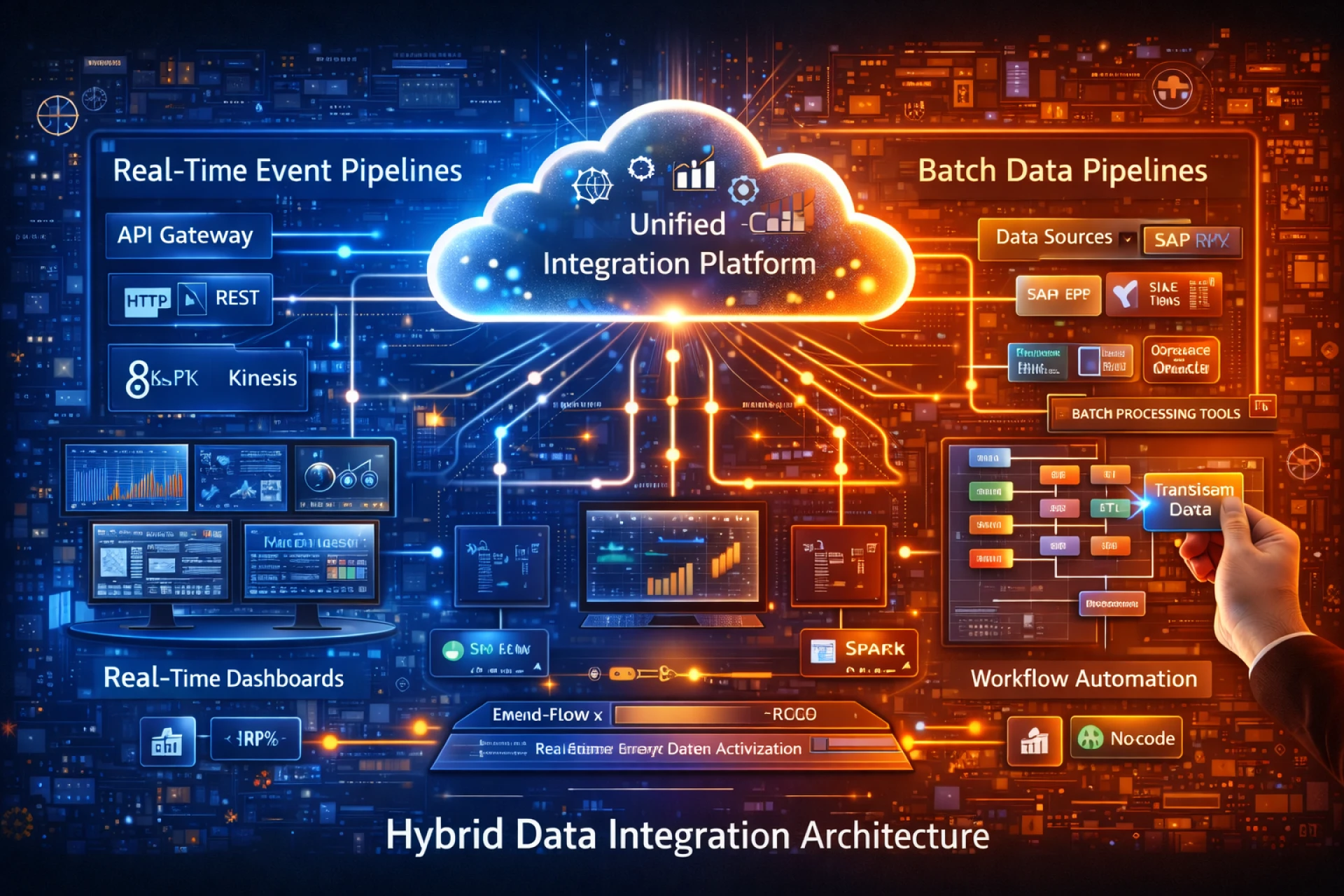
Enterprises today operate in hybrid data environments—where some processes require instant, real-time responses, while others depend on scheduled, high-volume batch processing.
For example:
- A maintenance alert in a facility must trigger real-time action
- Financial reconciliation across systems can run as a batch process overnight
To handle both efficiently, organizations need a modern software data integration platform that supports dual-mode data processing—without complexity.
ConnectorHub is designed precisely for this need, enabling seamless data integrations across real-time and batch workflows within a unified architecture.
Understanding Batch vs Real-Time Data Integration
1. Real-Time Data Integration
Real-time integration processes data instantly as events occur.
Characteristics:
- Event-driven (webhooks, APIs)
- Low latency
- Immediate execution
Use Cases:
- IoT alerts in smart buildings
- Tenant request processing
- Live CRM updates
2. Batch Data Integration
Batch integration processes data in chunks at scheduled intervals.
Characteristics:
- Time-based execution (hourly, daily)
- Handles large data volumes
- Optimized for efficiency
Use Cases:
- Financial reporting
- Data warehousing
- Historical analytics
A modern api data integration platform must combine both approaches into a unified system.
Key Capabilities for Supporting Hybrid Integration
1. Event-Driven Architecture for Real-Time Processing
A platform must support:
- Webhooks and API triggers
- Streaming data pipelines
- Event-based workflows
ConnectorHub Advantage:
ConnectorHub enables real-time API data integration, allowing systems like CMMS and ERP to react instantly to events (e.g., maintenance alerts).
2. Scheduled Workflow Engine for Batch Processing
A robust platform must also provide:
- Cron-based scheduling
- Bulk data processing
- Retry and checkpointing mechanisms
ConnectorHub Advantage:
ConnectorHub supports scheduled workflows for batch processing—ideal for CMMS ERP data integration such as syncing financial or operational data periodically.
3. Unified Workflow Automation Platform
The key is not just supporting both modes—but managing them in one system.
Required Capabilities:
- Combine real-time triggers with batch steps
- Orchestrate multi-step workflows
- Provide centralized control
ConnectorHub Advantage:
ConnectorHub’s no-code workflow automation platform allows users to design hybrid workflows where:
- Real-time triggers initiate processes
- Batch steps handle bulk updates
- Everything is managed visually
4. Data Consistency and Synchronization Mechanisms
Hybrid systems must ensure:
- No data duplication
- No data loss
- Consistent state across systems
Techniques:
- Idempotent processing
- Change data capture (CDC)
- Version control
ConnectorHub Advantage:
ConnectorHub ensures consistent data integrations with built-in safeguards for synchronization across batch and real-time flows.
5. Scalable Infrastructure for Variable Loads
Workloads vary significantly:
- Real-time = high frequency, low volume
- Batch = low frequency, high volume
ConnectorHub Advantage:
As a cloud-native platform, ConnectorHub dynamically scales to handle both workloads efficiently—making it ideal for enterprise-grade software data integration.
6. Monitoring and Observability Across Both Modes
A unified platform must provide:
- Real-time monitoring dashboards
- Batch job tracking
- Alerts for failures or delays
ConnectorHub Advantage:
ConnectorHub offers centralized monitoring for all workflows—ensuring visibility across both real-time and batch processes.
7. Advanced Data Transformation for Both Pipelines
Both integration modes require:
- Data mapping
- Transformation
- Validation
ConnectorHub Advantage:
ConnectorHub enables seamless data transformation within workflows, ensuring compatibility across systems like ERP, CMMS, and CRM.
Real-World Example: CMMS ERP Data Integration
Scenario:
- A maintenance issue is reported in CMMS → triggers real-time workflow
- Work order is created and assigned instantly
- At the end of the day → batch process syncs all work orders to ERP for billing
Outcome:
- Immediate operational response
- Efficient financial processing
ConnectorHub Advantage:
ConnectorHub seamlessly orchestrates both workflows in a single platform—eliminating the need for separate tools.
Why ConnectorHub Is Built for Hybrid Integration
ConnectorHub is designed to unify all integration needs:
Key Differentiators:
- Supports both real-time and batch processing natively
- No-code workflow builder for hybrid orchestration
- API-driven and event-based architecture
- Scalable cloud infrastructure
- Advanced monitoring and data consistency controls
Unlike traditional tools that specialize in one approach, ConnectorHub delivers a complete data integration platform.
Conclusion
Modern enterprises cannot choose between batch and real-time—they need both.
A robust software data integration platform must:
- Process events instantly
- Handle large data volumes efficiently
- Maintain consistency across systems
- Provide unified workflow orchestration
ConnectorHub achieves this by combining real-time API data integration with scalable batch processing in a single platform.
For organizations managing complex CMMS ERP data integration and enterprise workflows, ConnectorHub provides a future-ready solution that balances speed, efficiency, and scalability.