A retailer blocks every request that looks like a bot and still loses six figures a month to fraud. That's not a contradiction — it's a sign that bot detection was treated as the whole strategy instead of one layer of it.
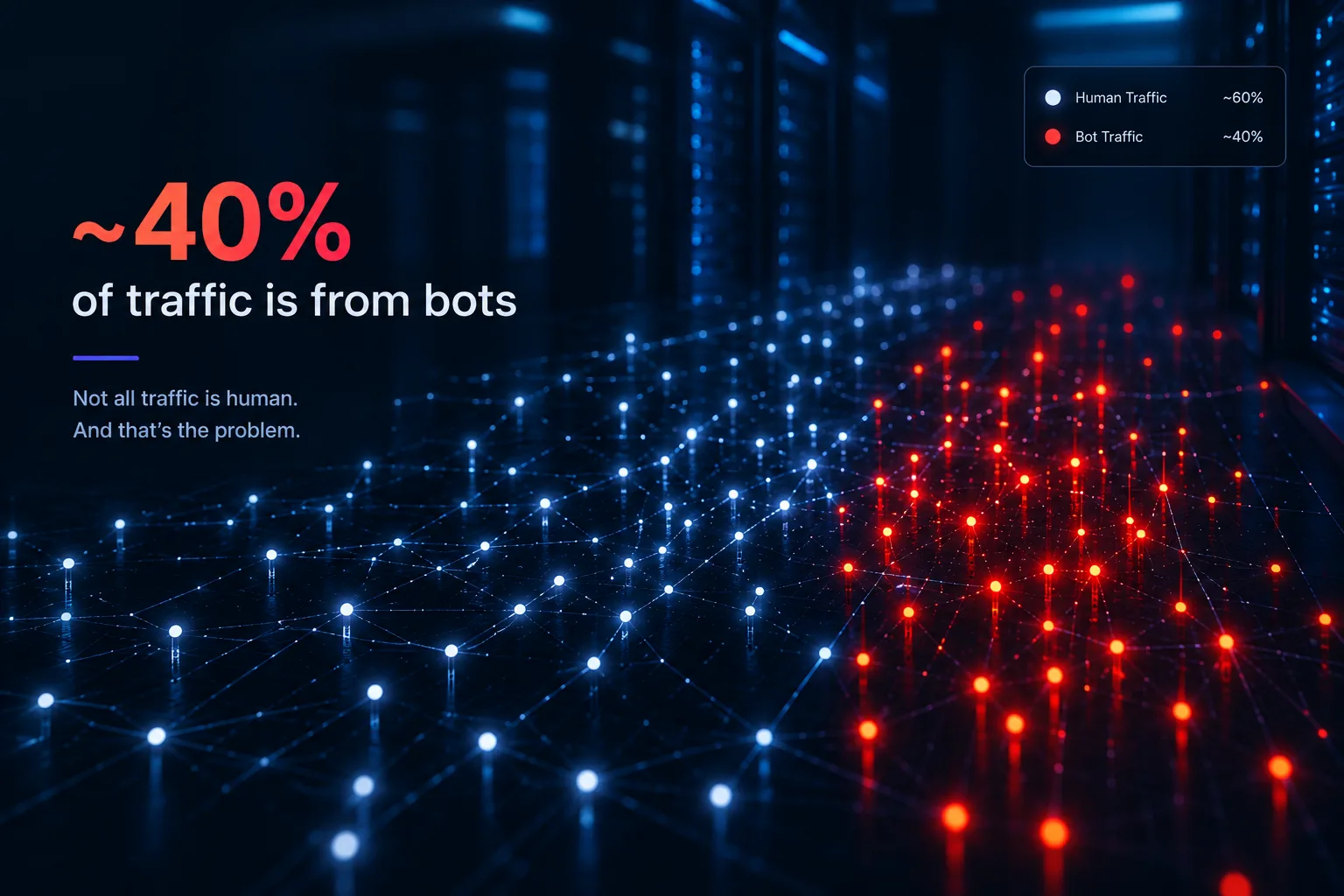
Automated traffic isn't a side issue anymore. According to Thales's 2026 Bad Bot Report, bots now account for more than half of all internet traffic, and roughly 40% of that is malicious — up from 37% the year before. Human activity has fallen to about 47% of total web traffic. That shift changes what "fraud prevention" even means. If nearly half of your traffic isn't human, the question isn't just "is this a bot," but "what is this bot trying to do, and does it matter?"
Why Bot Detection Alone Leaves Gaps
Bot detection answers one question well: is this session automated? It's good at spotting headless browsers, emulators, scripted traffic, and device farms. What it doesn't do on its own is tell you why the automation is happening or how much risk it actually carries.
Two sessions can look identically "bot-like" at the network layer and mean completely different things:
- A price-comparison bot scraping your product pages for a legitimate aggregator.
- A credential-stuffing script testing thousands of stolen username-password pairs against your login form.
Block both and you lose useful visibility and possibly a partner relationship. Miss both and you're exposed to scraping losses on one side and account takeover on the other. Thales's data also points to a fundamental shift in the nature of internet traffic itself, which means static rules written a year ago are already stale.
This is where a lot of fraud programs get stuck: they buy a bot detection tool, block the obvious stuff, and assume the problem is solved. It isn't. Bot detection is a signal source, not a decision engine.

Where Bot Detection Actually Fits in the Stack
A mature fraud prevention strategy usually has three layers, and bot detection sits at the bottom of all of them, feeding information upward.
1. Signal collection
This is where bot detection lives — device fingerprinting, behavioral biometrics (mouse movement, typing cadence, scroll patterns), emulator and jailbreak detection, and network-level signals like proxy or VPN usage. On its own, each signal is a data point. Together, they start to describe a session's identity and intent.
2. Risk scoring
Signals get combined into a single risk score, usually weighted by context. A flagged device attempting a login looks different from the same device browsing a product catalog. Good scoring engines also factor in velocity — how many accounts has this device touched in the last hour, how many failed logins came from this IP range, has this fingerprint appeared under five different email addresses this week.
3. Response and enforcement
This is the layer most teams underbuild. A risk score is useless if the only response options are "allow" or "block." Mature systems support graduated responses: step-up verification for medium-risk sessions, rate limiting for suspicious-but-not-confirmed bots, silent monitoring for sessions you want more data on before acting, and hard blocks reserved for confirmed automation with clear malicious intent.
Bot detection feeds all three layers, but it's not the whole system. Treating it as one input among several — alongside identity verification, transaction monitoring, and behavioral analytics — is what turns a detection tool into an actual fraud program.

What This Looks Like Against Real Attack Patterns
Account takeover. Credential stuffing relies on automation to test stolen credentials at scale. Bot detection catches the automation; risk scoring catches the pattern (many login attempts, one device, rotating usernames); step-up verification stops the takeover without locking out the legitimate user who happens to share a login pattern with an attack.
Promo abuse. Coupon and referral abuse often comes from device farms — dozens or hundreds of emulated devices creating new accounts to claim the same offer repeatedly. Device fingerprinting spots the farm; the fraud layer decides whether to block, cap redemptions per fingerprint, or flag for manual review.
Scalping and inventory hoarding. Bots that snap up limited inventory (event tickets, sneaker drops, GPUs) rely on speed and scale. Detecting headless browser signatures and abnormal checkout velocity lets a system slow down suspicious sessions with friction — a CAPTCHA, a queue, a delay — without punishing genuine customers who are just fast.
In each case, bot detection supplies the "this is automated" flag. The fraud strategy decides what that flag should trigger, and that decision depends on business context a detection engine can't infer by itself.
Getting Bot Detection and Fraud Teams on the Same Page
A surprising amount of fraud loss happens not because detection failed, but because the bot detection tool and the fraud/risk team operate as separate silos with separate dashboards, separate thresholds, and no shared feedback loop.
A few practical fixes close that gap:
- Route bot signals into the same case management system fraud analysts already use, instead of a separate bot-only dashboard nobody checks.
- Set thresholds jointly. Security teams tend to optimize for blocking automation; fraud and growth teams worry about false positives hurting conversion. Neither should set thresholds alone.
- Review false positives on a schedule. A device farm signature that misfires against a shared corporate network, for example, can quietly cost real revenue for months if nobody's watching for it.
- Treat bot detection as a living signal, not a one-time integration. Attack patterns shift constantly — the jump in AI-enabled bot attacks over the past year is a clear example of how fast tooling evolves — so scoring models need regular retuning, not a set-and-forget deployment.
The Takeaway
Bot detection tells you whether a session is automated. Fraud prevention decides what to do about it — and that decision needs risk scoring, business context, and a graduated response system that bot detection alone can't provide. Vendors building this kind of layered detection, including device intelligence platforms like DeepID's bot detection tools, design specifically for that handoff between signal and decision.
Treat bot detection as your fraud program's foundation, not its ceiling. The organizations getting hurt right now aren't the ones without bot detection — they're the ones who stopped building once they had it.