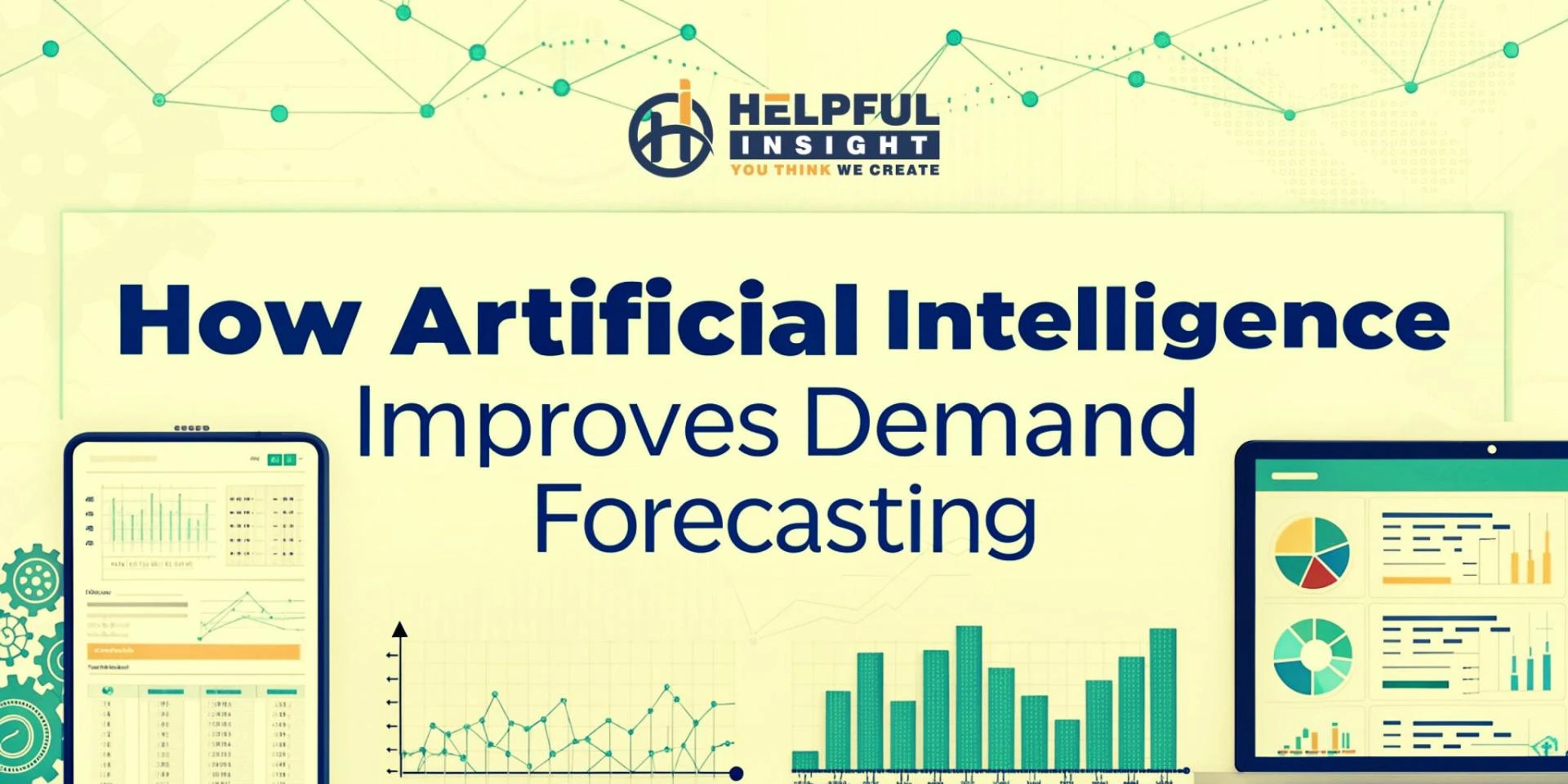
Accurate demand forecasting is now a key element for the success of operations in the highly competitive, data, driven business world of today. Companies of different industries like retail, manufacturing, logistics, healthcare, and eCommerce depend on demand predictions for inventory management, supply chain optimization, cost reduction, and customer satisfaction improvement. Despite their frequent use, traditional forecasting methods are often unable to meet the needs of large, scale data processing, fast, changing market conditions, and volatile consumer behavior, which results in their poor performance.
The advent and application of Artificial Intelligence (AI) are bringing radical changes to the scenario. AI, powered solutions have been instrumental in revolutionizing the way organizations use their historical data to predict future demand with incredible precision. AI has changed the rules of the game in modern demand forecasting by empowering organizations through the use of cutting, edge algorithms, machine learning models, and real, time data processing.
Understanding Demand Forecasting in the AI Era
Demand forecasting is basically the process of anticipating the future needs of customers for certain goods or services by looking at the past data, trends in the market, and considering various external factors.
Traditional models have mainly depended on statistical methods combined with manual entries which makes them stand very still and quite susceptible to mistakes. However, AI, based demand forecasting systems are capable of learning from new data, updating themselves with the latest information, and improving their predictions with time.
When it comes to AI demand forecasting, companies are no longer limited to static spreadsheets and rule, based systems but rather get access to dynamic, self, learning forecasting models. These models can handle both structured and unstructured data from a variety of sources such as sales records, customer behavior, weather conditions, economic indicators, social media trends, and major global events.
How AI Enhances Forecast Accuracy
One of the most important benefits of AI in demand forecasting is its capability to process complex data. AI models have the capability to detect patterns that are not possible with traditional models. For instance, AI models have the capability to detect the impact of regional weather changes on purchasing decisions or the impact of online search trends on product demand.
In addition, AI in demand forecasting allows for real-time updates. This means that instead of making forecasts on a monthly or quarterly basis, businesses can make rolling forecasts that adjust instantly to changes in demand.
AI-Powered Demand Forecasting Tools and Technologies
Demand forecasting tools that are powered by modern AI typically combine machine learning, deep learning, natural language processing, and predictive analytics. These tools automatically collect data, clean and normalize the datasets, and use intelligent models to come up with highly accurate forecasts.
Key capabilities of AI-based tools include:
- Automated demand sensing using real-time data
- Scenario planning and “what-if” analysis
- Multi-level forecasting across products, locations, and channels
- Continuous model optimization through feedback loops
By using ai based demand forecasting, organizations gain a holistic view of demand drivers and can proactively respond to market shifts instead of reacting after losses occur.
Demand Forecasting Using AI Across Industries
An AI, enabled demand prediction system in retail and e, commerce helps businesses to keep the right stocks, thus, minimizing overstocking and stockouts. Manufacturing companies can leverage AI, powered demand forecast to not only plan their production schedule better but also to efficiently procure raw materials. Transportation and logistics businesses can forecast customer demand, communication and decision making through the optimized use of data and strategic AI application, therefore, creatively automate shipping routes and vehicle allocation by using AI models.
AI forecasting models in healthcare are instrumental in predicting patient demand, which in turn enables the hospital to utilize the staff, equipment, and supplies in the best possible way. AI, based demand models provide the energy and finance industries with instrumental means for planning and risk management as well.
Cost Reduction and Operational Efficiency
Cost reduction is perhaps the most quantifiable advantage of AI in forecasting. Accurate demand forecasts help prevent overstocking, save on storage costs, and cut down on waste. The clues given by AI also facilitate supplier negotiations and purchasing strategies as they align buying decisions with the forecasted demand.
Besides that, AI is able to take over the repeating forecasting jobs which leave human analysts with more time to concentrate on strategy formulation. This synergy of productivity and smartness turns AI into a worthwhile asset for companies looking to grow.
The Strategic Advantage of AI-Driven Forecasting
Besides operational efficiencies, AI, driven prediction offers a strategic edge too. Companies are able to foresee the changes in the market, be more responsive to customer demands, and introduce new items with surety, thanks to the leverage of AI. AI further breaks down the silos by offering one, thoroughly data, supported, demand insight between teams.
An enterprise working with the Best AI Development Services obtains customized prediction tools matching their particular business objectives. Opting for the right AI Development Services guarantees a smooth transition with the company's current infrastructure and provides growth potential for the future.
Choosing the Right AI Partner
The implementation of AI forecasting solutions demands the involvement of skilled professionals in data engineering, machine learning, and domain, specific knowledge. Working with a dependable AI Development Company, your business can get assistance in the designing, deployment, and optimization of AI, based demand forecasting systems.
If your organization has unconventional operational needs, then you can choose to Custom AI Development Services which provide tailor, made, industry, specific solutions that are not only more accurate but also yield a better ROI than the readily available tools.
Future of Demand Forecasting with AI
With the continuous advancements of AI technologies, demand forecasting will get more accurate and less dependent on humans. Breakthroughs in generative AI, reinforcement learning, and edge computing will facilitate hyper, local, real, time forecasts that change immediately in response to global and regional disruptions.
One day, AI will go beyond just forecasting demand and will also figure out the best course of actions like changing prices, shifting inventory, or tweaking production schedules, thus, resulting with fully autonomous demand planning ecosystems.
Conclusion
Demand forecasting is changing on a fundamental level because of Artificial Intelligence (AI), making it more intelligent, quicker, and with higher accuracy. AI has evolved from just being a luxury to becoming a necessity as it helps in increasing forecast accuracy, cutting costs, and improving decision, making at the strategic level. Companies leveraging AI in demand forecasting now will have the advantage of being able to handle market fluctuations effectively, be a step ahead of their competitors, and continue growing in a healthy way even after several years.