Asset tokenization is changing how ownership, investment, settlement, and financing can work across traditional markets. Instead of representing an asset through paper certificates, fragmented databases, or conventional account records alone, tokenization creates a digital representation of an asset or an enforceable claim on a blockchain or other distributed ledger. Depending on the structure, a token can represent direct ownership, a security, a fund interest, a debt claim, or a beneficial interest in an underlying asset.
The market is still developing, but its growth has become measurable. CoinGecko reported that the market capitalization of tokenized real-world assets excluding stablecoins increased from $5.42 billion at the beginning of 2025 to $19.32 billion by March 31, 2026, a 256.7% increase. Tokenized Treasuries remained the largest category, while tokenized commodities also expanded rapidly.
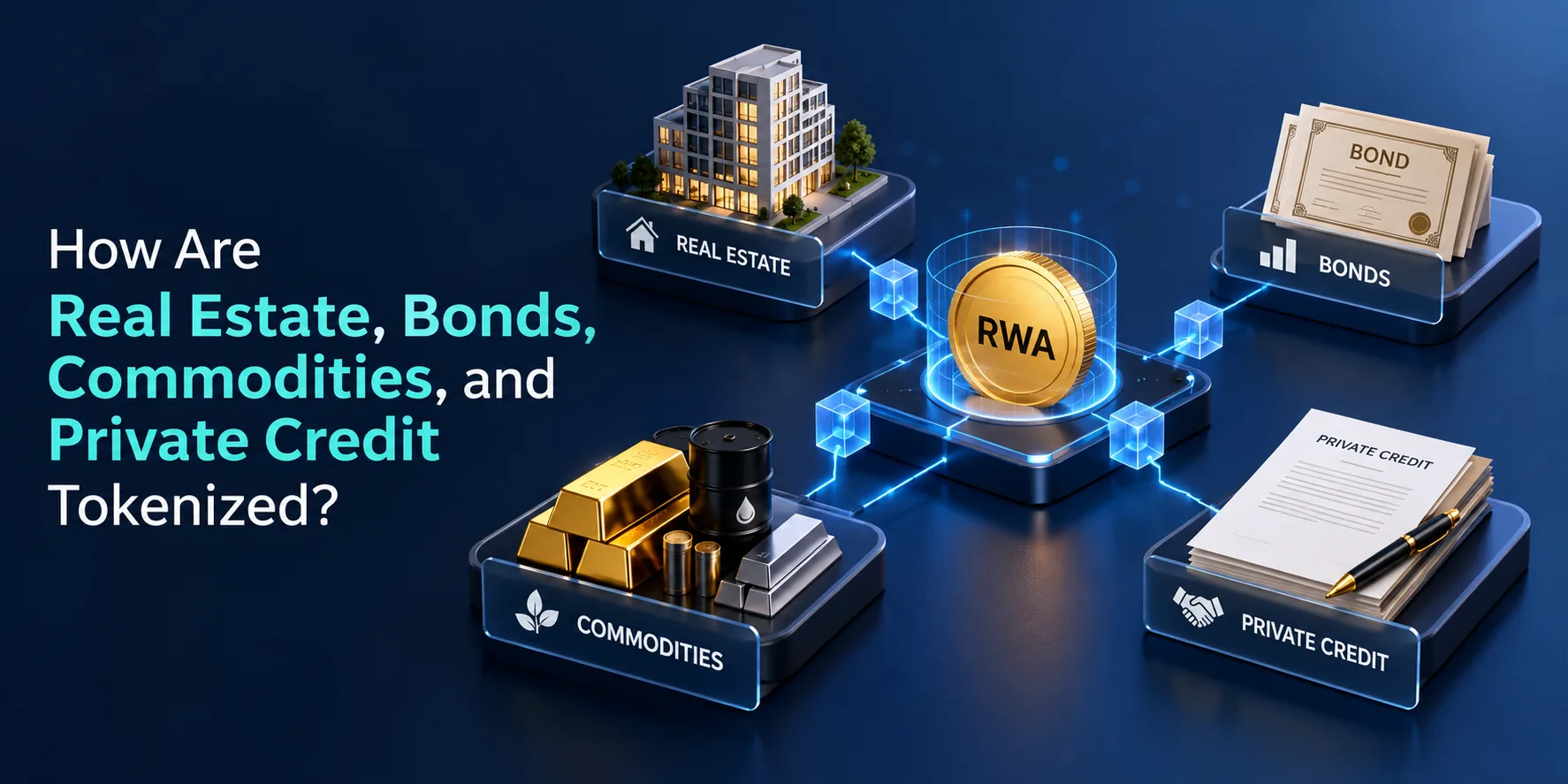
Real estate, bonds, commodities, and private credit are particularly interesting because each has different ownership structures, regulatory requirements, valuation methods, and liquidity characteristics. Consequently, tokenization is not a single technical process. The underlying asset determines how the token is designed, what rights it provides, who can hold it, and how transactions are settled.
Understanding the Basic Tokenization Model
At its simplest, tokenization involves connecting an off-chain asset or financial claim to a digital token. However, creating a token does not automatically transfer legal ownership of a physical asset. The legal structure must establish what the token represents and how token holders' rights are recognized.
A typical tokenization process begins with asset selection and due diligence. The issuer identifies the property, bond, commodity, loan, fund, or other asset and verifies its ownership, valuation, documentation, and legal status. A suitable legal structure is then created. Depending on the jurisdiction and asset, this may involve a special-purpose vehicle, trust, fund, custodian, issuer, or another legal entity.
The next stage involves designing the token. Developers establish the token's supply, transfer rules, investor rights, compliance restrictions, redemption mechanisms, and other characteristics through smart contracts. The token is then issued on a selected blockchain or distributed ledger.
The final layer connects the blockchain with real-world operations. Oracles, custodians, registries, banks, property managers, auditors, valuation providers, and other service providers may be required to keep the digital representation synchronized with the underlying asset.
This connection between blockchain records and legal ownership is one of the most important parts of tokenization. The SEC's 2026 statement on tokenized securities similarly distinguishes tokenized securities according to how they are structured and emphasizes that securities laws continue to apply when traditional securities are represented through crypto assets.
Real Estate Tokenization: Turning Property Rights Into Digital Interests
Real estate is one of the most discussed applications because individual properties are generally expensive, geographically fixed, and comparatively difficult to divide or trade. Tokenization can introduce fractional interests by dividing an ownership or economic interest into multiple digital units.
The process usually begins with property selection and due diligence. Developers or issuers examine the property's title, valuation, existing liabilities, rental income, ownership structure, and regulatory status. Rather than simply placing a building's address on a blockchain, the issuer establishes a legal entity or structure that holds the property or the relevant economic interest.
Tokens are subsequently issued to represent defined rights in that structure. For example, an investor might hold tokens representing an interest in a special-purpose vehicle that owns an apartment building. Depending on the legal design, token holders could receive rental income, capital appreciation, voting rights, redemption rights, or another contractual benefit.
Smart contracts can automate several operational functions. Rental distributions can potentially be calculated and distributed according to predefined rules. Investor eligibility can be checked before transfers. Ownership records can be updated automatically, while transaction histories can remain visible on the relevant ledger.
Research from the Bank for International Settlements provides an important real-world perspective. Its research using U.S. tokenized-property data from 2019–2025 found that tokenized real estate can address some liquidity gaps, although the liquidity benefits depend on platform structures such as buyback mechanisms. The research also identified increased insolvency risk associated with those mechanisms.
This illustrates why Real Estate Tokenization Solutions, Real Estate Asset Tokenization Platform development involves more than blockchain programming. The system must connect property ownership, legal agreements, investor onboarding, compliance, custody, payments, valuation, and potentially secondary-market transactions.
For example, suppose a commercial property is valued at $10 million. A project could establish a legally compliant structure around that property and issue 1 million tokens representing defined interests. An investor could then acquire a smaller number of tokens instead of purchasing the entire property. The economic and legal result, however, depends entirely on the structure established by the issuer and applicable regulations.
How Bonds Are Tokenized
Bonds are already highly digitized financial instruments, so their tokenization is less about converting paper into blockchain records and more about changing the infrastructure used for issuance, ownership, settlement, and servicing.
A conventional bond involves multiple participants, including issuers, arrangers, custodians, depositories, brokers, clearing systems, and settlement institutions. Tokenization can place some or all of these functions onto distributed ledger infrastructure.
The issuer first defines the bond's terms, including principal amount, maturity date, coupon rate, payment schedule, investor eligibility, and redemption conditions. A tokenized representation is then created using a smart contract or another blockchain-based mechanism. Investor ownership is recorded on the ledger, subject to the legal and operational framework governing the security.
Smart contracts can automate coupon calculations and payments. They can also encode transfer restrictions and corporate actions. In a more integrated model, the payment asset and bond token can settle together, reducing the time between delivery of the security and payment.
The BIS reported in 2025 that more than $8 billion of tokenized bonds had been issued at that point. Its analysis found that tokenized bonds had lower bid-ask spreads than conventional bonds in the sample while showing comparable issuance costs.
The development is also moving beyond experiments. In September 2026, India's RBI and SEBI launched the “Demat 2.0” pilot to test tokenized corporate bonds using distributed ledger technology and India's central bank digital currency. The pilot involved major market infrastructure institutions and banks, demonstrating how tokenized securities can be connected with established financial systems rather than operating independently.
However, tokenization does not remove credit risk. If a bond issuer fails to repay principal or interest, putting the bond on a blockchain does not change the issuer's financial condition. Blockchain can improve infrastructure, but it cannot eliminate the fundamental economic risks of the underlying security.
Tokenizing Commodities
Commodity tokenization creates a digital representation of ownership or a claim associated with physical commodities such as gold, silver, agricultural products, or other resources.
Gold provides one of the clearest examples. A tokenization provider may hold physical gold with a custodian and issue digital tokens representing specified quantities or claims against that gold. The system requires reliable custody records, audits, redemption procedures, and mechanisms connecting token supply to the underlying reserves.
The basic model can be represented as:
Physical commodity → Custodian → Legal claim → Token issuance → Digital transfer → Redemption
The custodian is particularly important. If 1 million tokens supposedly represent 1 million units of an underlying commodity, investors need confidence that the physical reserves actually exist and that the legal structure gives them an enforceable claim.
Commodity tokenization has experienced significant growth. CoinGecko reported that tokenized commodities increased from approximately $1.4 billion to $5.5 billion during the period leading to the end of Q1 2026, with gold-backed tokens accounting for much of the growth. It also reported $90.7 billion in spot trading volume for tokenized gold during Q1 2026.
The model can potentially improve transferability and accessibility, but it introduces dependencies on custodians, auditors, commodity storage facilities, redemption procedures, and regulatory frameworks. Therefore, blockchain transparency should not be confused with proof that an underlying physical commodity exists. Independent verification remains essential.
How Private Credit Is Tokenized
Private credit differs from publicly traded bonds because it generally involves privately negotiated loans that are not traded through highly standardized public markets.
The tokenization process typically begins with an underlying loan or portfolio of loans. A lender, private credit fund, or special-purpose vehicle holds the relevant credit assets. A digital token is then created to represent an ownership interest, fund interest, debt claim, or other contractual right associated with those assets.
The structure can make traditionally fragmented loan information more programmable. Investor records, distributions, transfer restrictions, reporting, and compliance checks can potentially be integrated into the digital infrastructure.
Private credit is especially relevant because the global market is substantial. The World Economic Forum's 2025 asset-tokenization report cited the global private credit market as exceeding $3 trillion in assets under management and noted that private-debt market participants viewed the asset class as a potentially important candidate for tokenization.
Consider a private credit fund holding loans made to several businesses. Instead of maintaining investor ownership entirely through conventional fund administration systems, the fund could issue compliant tokens representing interests in the vehicle. Smart contracts could help manage ownership records and distributions, while the underlying loan agreements remain legally binding off-chain documents.
The major challenge is credit assessment. Investors still need information about borrowers, collateral, repayment history, loan covenants, defaults, and portfolio concentration. A blockchain can make ownership records easier to manage, but it cannot independently determine whether a borrower will repay.
The Role of Smart Contracts and Compliance
Across all four asset classes, smart contracts act as programmable infrastructure. They can define who is allowed to receive tokens, how tokens can be transferred, when payments occur, and what conditions must be satisfied before transactions are completed.
Compliance is therefore increasingly being incorporated into token architecture. A platform may connect identity verification, KYC, AML screening, investor accreditation requirements, jurisdiction restrictions, and transfer controls with the token itself.
This approach is important because unrestricted transferability is not always appropriate. A token representing a regulated security may need to be transferred only between eligible investors. Similarly, a property investment token may have jurisdiction-specific restrictions.
The World Economic Forum identifies shared records, programmability, flexible custody, fractional ownership, and composability as major potential advantages of tokenization. At the same time, it highlights legacy infrastructure, regulatory fragmentation, interoperability, and liquidity as continuing challenges.
Why Tokenization Does Not Automatically Create Liquidity
One of the most common assumptions about tokenization is that putting an asset on blockchain automatically makes it liquid. That is not necessarily the case.
Liquidity requires active buyers and sellers, appropriate market infrastructure, reliable pricing, regulatory permission, custody arrangements, and sufficient demand. A tokenized building can still be difficult to sell if there are no buyers. A tokenized private loan can remain illiquid if investors are unwilling or unable to trade it.
This distinction is particularly important for real estate and private credit. Tokenization can reduce the minimum investment size and make ownership records easier to transfer, but market liquidity ultimately depends on the ecosystem surrounding the token.
The BIS has similarly emphasized that tokenization can create benefits while also introducing trade-offs involving operational complexity, liquidity, and regulatory uncertainty.
Key Challenges Across Asset Classes
Despite its potential, tokenization requires careful coordination between technology and traditional financial infrastructure. The major challenges include:
- Legal enforceability: The token must represent clearly defined rights under applicable law.
- Asset verification: Physical assets require reliable custody, valuation, and auditing.
- Regulatory compliance: Securities, property interests, funds, and private loans can face different regulatory requirements.
- Custody: Investors need secure methods for holding and transferring tokens.
- Interoperability: Different blockchains and financial systems must be able to communicate.
- Cybersecurity: Smart-contract vulnerabilities and compromised private keys can create significant risks.
- Liquidity: A digital token does not automatically create a secondary market.
- Oracle reliability: Off-chain information such as property values, commodity reserves, and loan performance must reach the blockchain accurately.
The SEC has emphasized that tokenization does not change the underlying nature of a security. In its 2025 statement, Commissioner Hester Peirce noted that tokenized securities remain securities and must therefore be considered within the applicable securities-law framework.
What the Future of Asset Tokenization Could Look Like
The long-term significance of tokenization may extend beyond fractional ownership. Its greater potential could come from connecting issuance, ownership, payments, collateral, compliance, and settlement within a shared programmable infrastructure.
A tokenized property could potentially be used as collateral. A tokenized bond could settle alongside digital payment assets. A private-credit position could potentially interact with automated portfolio systems. Commodity tokens could move between investors while custody and reserve information remain connected to the underlying asset.
This is why financial institutions increasingly view tokenization as an infrastructure development rather than simply another form of cryptocurrency. The BIS has proposed that tokenized central bank reserves, commercial bank money, and government bonds could eventually operate within a more integrated tokenized financial system.
Nevertheless, adoption will depend on legal certainty, institutional participation, technical standards, investor protection, and market demand. The strongest implementations are likely to be those where blockchain solves a specific operational problem rather than being added simply because an asset can technically be represented as a token.
Conclusion
Real estate, bonds, commodities, and private credit can all be tokenized, but each requires a different combination of legal structuring, custody, asset verification, compliance, smart contracts, and market infrastructure. Real estate tokenization can divide economic interests in properties, bonds can use blockchain for issuance and settlement, commodities can connect digital tokens with verified physical reserves, and private credit can turn ownership interests in loan portfolios into programmable digital instruments. As the market develops, tokenization is increasingly being tested within regulated financial environments rather than existing solely as a blockchain experiment. For businesses planning these systems, Blockchain App Factory provides best services by supporting blockchain development and tokenization-focused infrastructure tailored to different real-world asset requirements.
FAQs
1. What is real-world asset tokenization?
Real-world asset tokenization is the process of representing ownership, economic interests, or contractual claims connected to physical or traditional financial assets through blockchain-based digital tokens.
2. Can real estate be fully owned through tokens?
It depends on the legal structure and jurisdiction. Tokens may represent direct ownership, beneficial ownership, shares in an entity holding property, or another contractual economic interest.
3. Are tokenized bonds safer than traditional bonds?
Tokenization does not automatically reduce the credit risk of a bond. The issuer's ability to repay remains a fundamental consideration regardless of how ownership is recorded.