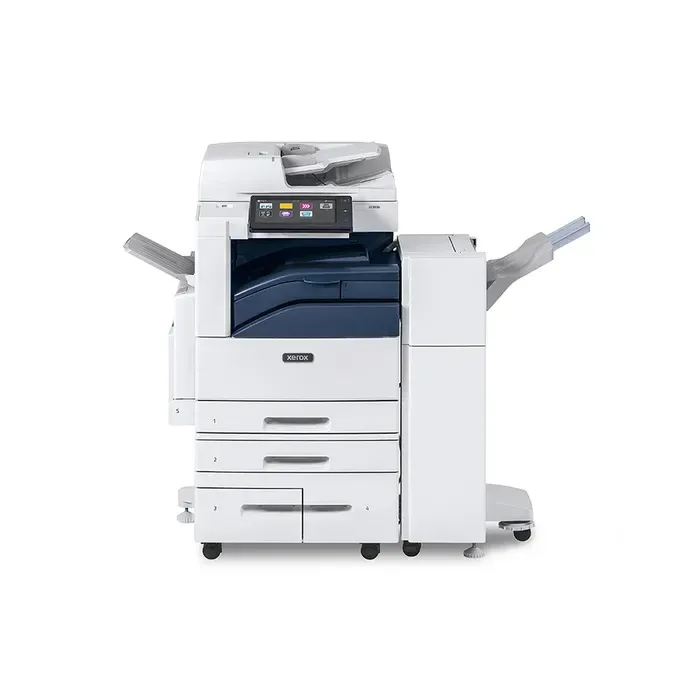
In the modern fast-paced corporate environment, business operational efficiency heavily dictates overall profitability, agility, and employee satisfaction. While cloud storage and digital collaboration platforms dominate discussions regarding organizational transformation, physical and digitized document management remains a crucial backbone of daily corporate workflows.
The hardware driving these workflows plays a silent yet foundational role in workplace productivity. Among these tools, the All-in-One (AIO) printer—or Multifunction Printer (MFP)—stands out as a critical asset for modern infrastructure. By integrating printing, copying, scanning, and faxing capabilities into a single cohesive system, AIO printers do far more than clear physical desk space. They eliminate operational bottlenecks, accelerate documentation lifecycles, and streamline technical administration, ultimately transforming how information moves across an organization.
1. Elimination of Hardware Silos and Workflow Bottlenecks
Historically, office floors were cluttered with single-function legacy hardware. Employees had to print an agreement at a standalone printer, walk across the department to a dedicated scanner to digitize signed copies, and use a separate fax machine or terminal to distribute it to legal teams. Each machine introduced a point of friction: varying interfaces, unique connection delays, and independent print queues.
An All-in-One printer breaks down these technical silos by centralizing the complete document processing cycle into a single node. Employees can execute complex, multi-stage workflows—such as scanning a physical invoice, modifying it via an integrated touchscreen panel, and instantly distributing it to multiple email addresses or secure cloud directories—without moving between disparate workstations. Minimizing these physical intervals directly reduces context switching, keeping employees focused on high-value tasks rather than mechanical logistics.
2. Advanced Cloud Integration and Seamless Digitization
Modern business demands a hybrid framework where physical paper and digital data interact seamlessly. Advanced AIO printers bridge this divide through native cloud compatibility and sophisticated optical character recognition (OCR) engines. Instead of routing scans through a local PC, contemporary MFPs connect directly with institutional enterprise resource planning (ERP) platforms and standard cloud repositories like Google Drive, Microsoft SharePoint, OneDrive, and Dropbox.
This deep integration speeds up data entry and document indexing. Employees scan a physical contract at the device, and the built-in software automatically reads textual layers via OCR, indexes the file with relevant metadata, and saves it directly to a secure shared corporate cloud directory. This automated pipeline ensures that remote workers and onsite teams gain instant access to identical, updated documentation, accelerating cross-department collaboration and shortening transaction lifecycles.
3. Automated Document Maintenance and Smart Features
Device downtime is an absolute productivity killer. Standard, unmanaged printer networks often suffer from unexpected component failures, empty toner cartridges during critical financial reporting cycles, and complicated maintenance procedures that pull internal IT personnel away from vital tasks.
Enterprise-grade AIO units prevent these disruptions with smart diagnostics and automated maintenance systems. Equipped with internet-of-things (IoT) sensors, these machines constantly monitor their internal mechanical health and consumables status. When toner supplies drop below operational thresholds or an internal roller approaches its wear limit, the system automatically dispatches supply requests to authorized vendors or alerts IT teams with exact diagnostic codes. This shift from reactive, emergency troubleshooting to predictive maintenance minimizes unexpected device outages and preserves workflow continuity.
4. Consolidated IT Overhead and Simplified UI
From an administrative standpoint, managing a sprawling fleet of mixed, single-function devices is a complex IT headache. Every distinct brand and unit requires specific device drivers, dedicated network configurations, routine firmware patches, and unique security settings.
Standardizing on a unified fleet of AIO printers minimizes this technical footprint. IT teams manage a single driver suite across the corporation, vastly simplifying mass updates and troubleshooting. Furthermore, a unified fleet means employees encounter a consistent user interface across all office floors. A worker moving from marketing to finance does not have to learn a brand-new control scheme; the intuitive, smartphone-style touchscreen interface remains identical, reducing operator errors and eliminating user frustration.
5. Enhanced Document Security and Governance
Data breaches involving physical print outputs are a major risk for modern businesses. Abandoned confidential reports on output trays frequently cause internal information leaks and compliance violations. Modern AIO devices address these security concerns with robust endpoint protocols.
Through pull-printing and secure user authentication (via corporate ID badges, PINs, or biometric scanners), a print job is held securely in an encrypted virtual queue. It only prints when the requesting employee physically authenticates at the device, preventing sensitive documents from sitting exposed on open trays. Centralized digital logging tracks every print, copy, and scan across the network, providing comprehensive audit trails crucial for meeting regulatory standards like GDPR, HIPAA, or CCPA.
Conclusion: The Infrastructure Foundation for High Output
Maximizing workplace productivity requires auditing and refining every operational asset. All-in-One printers prove that document infrastructure is a dynamic tool for operational optimization. By unifying disparate functions, integrating with cloud systems, simplifying IT maintenance, and securing workflows, AIO printers eliminate everyday friction points. Investing in robust multifunction hardware creates a smoother, faster workflow, enabling teams to operate with peak agility and focus on driving core business growth.