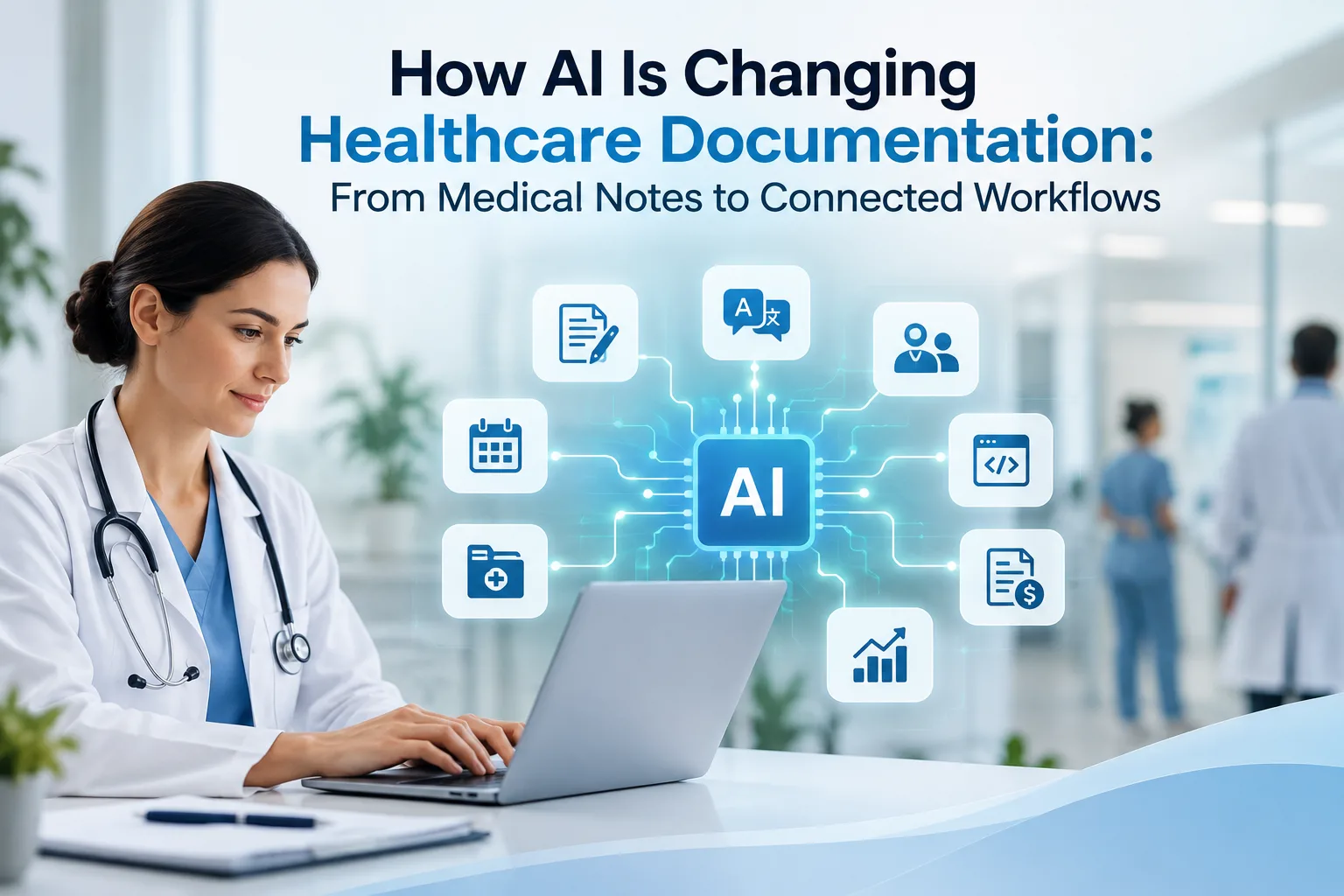
Healthcare documentation has always been an important part of patient care, but it is also one of the most time-consuming responsibilities for clinicians. Physicians and other healthcare professionals must document patient encounters, review medical histories, complete notes, and make sure information is available for coding, billing, and future care.
As healthcare organizations look for ways to reduce administrative burden, AI medical scribe software and other forms of artificial intelligence are changing how clinical documentation is created and managed.
The biggest shift is that AI is moving documentation from a manual task toward a more connected healthcare workflow.
What Is AI Clinical Documentation Software?
AI clinical documentation software uses artificial intelligence to help capture, organize, and structure information from healthcare encounters.
Instead of requiring clinicians to manually write every detail of a visit, an AI system can assist by processing conversations and identifying relevant clinical information. The technology can then generate a structured draft that the healthcare professional can review and edit.
This does not eliminate the clinician's responsibility. Human review remains important because medical documentation needs to be accurate, appropriate, and consistent with the actual patient encounter.
The value of AI is primarily in reducing repetitive documentation work and helping clinicians spend less time on administrative tasks.
The Rise of the Artificial Intelligence Medical Scribe
An artificial intelligence medical scribe is one of the most visible applications of AI in clinical documentation.
Traditional documentation often requires physicians to divide their attention between the patient and the computer. This can involve typing notes during appointments or completing documentation after the patient has left.
AI medical scribe technology can help capture relevant information during the encounter and organize it into a clinical note.
For healthcare organizations, this can create a more efficient documentation process while allowing clinicians to focus more directly on patient conversations.
However, the larger opportunity is not simply generating notes faster. It is connecting those notes with the next steps in the healthcare workflow.
From Documentation to the EHR
Clinical documentation does not exist in isolation.
Once a patient encounter is completed, information may need to move into an electronic health record (EHR), support coding, contribute to charge capture, and eventually become part of the billing and claims process.
This is where healthcare workflow automation becomes increasingly important.
When documentation systems can connect with other healthcare technologies, information can move through the workflow with less manual duplication.
For example, information captured during a patient encounter may support:
- Clinical documentation
- EHR updates
- Coding workflows
- Charge capture
- Billing processes
- Claims preparation
- Patient communication
- Follow-up activities
The objective is not simply to automate one task. It is to reduce unnecessary friction between connected tasks.
AI Can Support More Connected Healthcare Workflows
Healthcare organizations often use multiple systems for different parts of the patient journey. A patient may interact with scheduling, registration, clinical staff, physicians, EHR systems, coding teams, billing departments, and patient communication tools.
When these systems operate independently, staff may need to enter or transfer information multiple times.
A broader healthcare AI platform can help connect different parts of this workflow.
For example, AI can support clinical documentation while other technologies help with patient communication, translation, coding, billing, and EHR integration.
This approach can help healthcare organizations think beyond standalone software tools and toward connected healthcare workflows.
Improving Communication Between Patients and Providers
Documentation is also closely connected to communication.
Healthcare providers serve patients who may speak different languages or have different communication needs. AI-powered language technologies can help support communication during healthcare encounters.
When translation and documentation capabilities work together, relevant information can be captured while the conversation is taking place.
This can be particularly useful in healthcare environments serving diverse communities.
The broader goal is to create a patient journey where communication, documentation, and follow-up are better connected rather than treated as separate processes.
AI and the Future of Healthcare Operations
The impact of AI medical documentation extends beyond physicians.
Healthcare administrators and practice managers are also looking at ways to improve operational efficiency across the organization.
Administrative work can include documentation, coding, billing, patient communication, insurance-related processes, and other tasks surrounding patient care.
This means the future of healthcare AI may involve multiple connected capabilities rather than a single application.
A modern healthcare operations platform can potentially bring together clinical and administrative workflows so that information can move more efficiently from one stage to another.
The result is a more connected approach to healthcare operations.
Why Integration Matters
Integration is one of the most important considerations when evaluating AI healthcare technology.
A tool that generates a clinical note but requires staff to manually copy information into multiple systems may solve only part of the problem.
By contrast, integrated healthcare technology can connect documentation with existing EHRs and downstream workflows. This is why EHR integration and interoperability are becoming increasingly important as healthcare organizations adopt AI.
The question is no longer only, "Can AI create a medical note?"
It is also, "What happens to that information after the note is created?"
The Role of AI Medical Scribe Software in Modern Healthcare
AI medical scribe software can be an important starting point for reducing documentation burden, but its potential becomes greater when it is part of a broader healthcare workflow.
Documentation is connected to coding. Coding is connected to billing. Billing is connected to reimbursement. Patient communication is connected to documentation and follow-up. EHRs connect information across the care journey.
These processes are not independent.
AI can help connect them by reducing repetitive work and allowing information to move more efficiently between different stages of healthcare operations.
What Should Healthcare Organizations Consider?
Before adopting AI for healthcare documentation, organizations should consider more than the ability to generate notes.
Important considerations include:
- Accuracy of generated documentation
- Human review and editing
- EHR integration
- Data security and privacy
- Workflow compatibility
- Support for different specialties
- Language and communication needs
- Coding and billing workflows
- Scalability across healthcare teams
Organizations should evaluate how an AI solution fits into the complete workflow rather than looking at documentation as a standalone task.
Looking Beyond the Medical Scribe
AI is changing healthcare documentation, but the larger transformation is happening across the patient journey.
The next generation of healthcare technology is likely to focus increasingly on connected workflows where clinical documentation, patient communication, EHRs, coding, billing, and administrative processes can work together.
AllayAI HELIX is one example of a healthcare AI platform built around this connected approach, bringing together capabilities across documentation, translation, patient engagement, EHR integration, coding, and billing.
To learn more about connected healthcare workflows and the HELIX platform, visit AllayAI HELIX.