
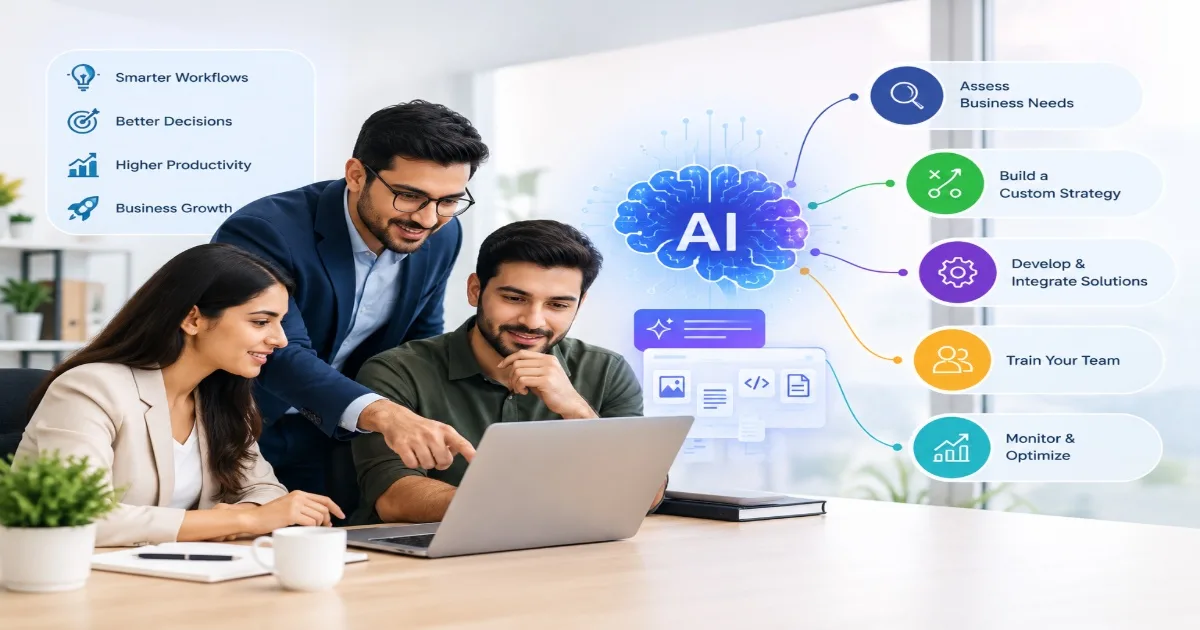
Generative AI is changing how businesses manage customer support, process information, create content, and automate everyday tasks. Adopting this technology requires more than just picking an AI tool. Businesses must spot use cases, get their data ready, pick the right models, and blend AI with existing systems.
Without planning, Generative AI projects can face problems such as inaccurate responses, data privacy risks, high implementation costs, and poor employee adoption. Working with an AI Consulting Services Company in the USA can help businesses tackle these challenges and create an implementation strategy.
AI consultants help organizations see where Generative AI can deliver value, choose technologies, and roll out solutions that support measurable business goals. This article shows how AI consulting services help businesses move from AI experimentation to implementation.
What Is Generative AI and How Does It Work?
Generative AI is a category of AI that generates new content from patterns it has learned from data. This can create content, provide document summarization, respond to inquiries, help with code, and more for a variety of business processes.
Many generative AI applications are based on large language models (LLMs). These models take an instruction from a user and give a response based on their training and the context they have. AI models can be accessed via APIs by businesses, or they can be tailored to fit their specific needs and integrated into their own processes and data.
For instance, an e-commerce firm might use generative AI to respond to product inquiries, or a manufacturing company might use it to assist employees in locating information in technical documents.
Generative AI is different from traditional automation, which typically relies on a set of rules; generative AI can read the request in natural language and generate a response that is flexible. It still needs to be tested, protected, and monitored by people for critical decisions, however.
Why Do Businesses Need AI Consulting Services for Generative AI?
Implementing AI without a clear plan can lead to wasted money and solutions that do not solve real business problems. An experienced consulting partner helps companies look at their needs before spending on development.
Identifying the Right AI Use Cases
Not every business process needs AI. Consultants look at workflows to find tasks that happen over and over, places where information gets stuck, and chances to make work faster.
For example, a sales team might get help from automated meeting summaries, while a customer support team may need an AI assistant that answers questions using information the company has approved. Focusing on the use cases helps businesses make real improvements instead of using AI just because it is popular.
Selecting the Right AI Technologies
Companies have to decide if they want to use existing AI platforms, third-party APIs, open-source models, or custom solutions. The best choice depends on what the application needs, how sensitive the data is, how it needs to fit with systems, the budget, and how well it should work.
An AI Consulting Services Company in the USA can look at these choices. Suggest a way that matches business goals and the technology available.
Managing Data Privacy and Security
Generative AI tools might work with customer records, financial documents, internal reports, or private business information. Handling data the wrong way can cause security issues and problems with rules and regulations.
Consultants help companies set up rules about who can access data, how to manage information, what to ask from vendors, and how to have people check the work. They also help decide what information should be given to AI systems and how to keep data safe.
Controlling Implementation Costs
AI projects can cost a lot if companies start building without knowing what they need. Checking if something is possible, trying projects, and setting clear goals help companies see what the costs and benefits might be before making things bigger.
How AI Consulting Services Help Implement Generative AI
A structured implementation process helps businesses connect AI technology with practical business requirements.
Step 1: Assess Business Needs and AI Readiness
The first step is to evaluate current operations, technology infrastructure, data availability, and business challenges. Consultants work with stakeholders to understand where delays occur and which tasks consume significant employee time.
They then identify suitable opportunities and establish measurable objectives, such as reducing response times, improving document processing, or helping employees retrieve information faster.
Step 2: Develop a Generative AI Strategy
After identifying potential use cases, consultants create an implementation roadmap. This includes prioritizing projects, estimating resources, defining timelines, and selecting performance indicators.
Businesses should usually begin with a focused use case that offers clear value and manageable risk. A successful pilot can provide evidence for expanding AI adoption across additional departments.
Step 3: Prepare and Integrate Business Data
AI applications often need access to reliable business information to provide useful responses. Consultants evaluate relevant documents, databases, knowledge bases, and existing applications.
Depending on the use case, data may need to be cleaned, organized, indexed, or connected through APIs. Retrieval-augmented generation (RAG) can help an AI application retrieve relevant information from approved company sources before generating a response.
Proper access controls are essential to ensure users receive only the information they are authorized to access.
Step 4: Select and Customize AI Models
The next step is selecting an AI model that meets the project's requirements. Consultants consider response quality, latency, cost, privacy, supported capabilities, and integration options.
Solutions can be configured through prompts, connected to business knowledge using RAG, or fine-tuned when the use case justifies it. Not every project requires custom model training; using an existing model with appropriate data and integrations may be sufficient.
Step 5: Develop and Integrate AI Applications
Once the technical approach is established, developers build the required application and connect it with existing business systems.
Examples include AI chatbots, document-processing assistants, internal knowledge tools, and intelligent workflow applications. Integration with CRM, ERP, customer support platforms, or other software allows AI to work within established business processes.
Businesses may require custom AI development services when standard tools cannot meet their specific functional or integration requirements.
Step 6: Test, Deploy, and Monitor Performance
Before deployment, AI applications should be evaluated for accuracy, relevance, security, reliability, and response consistency. Testing should include realistic user requests, difficult scenarios, and attempts to retrieve restricted information.
Businesses can begin with a limited rollout, collect user feedback, and address identified issues before expanding access. After deployment, ongoing monitoring helps teams track operating costs, user satisfaction, error rates, and business outcomes.
Human oversight should remain in place for sensitive tasks and decisions with significant consequences.
Business Applications of Generative AI
Generative AI can support different departments when implemented around clearly defined needs.
Customer Support and AI Chatbots
AI chatbots can answer common questions, explain product information, summarize conversations, and guide customers through routine processes. When integrated with approved knowledge sources and business systems, they can provide more relevant responses and help support teams handle complex inquiries.
Marketing and Content Creation
Marketing teams can use generative AI to prepare content drafts, summarize research, develop campaign ideas, and adapt messaging for different audiences. Human review remains important for accuracy, brand consistency, and originality.
Document Processing and Knowledge Management
Businesses can use AI to summarize reports, extract relevant information, and help employees search large collections of internal documents. These applications can reduce manual information retrieval and make organizational knowledge easier to access.
Sales and CRM Automation
Generative AI can summarize customer interactions, prepare follow-up drafts, and help sales representatives review account information. Connecting AI with CRM systems can reduce administrative work while allowing sales teams to focus more on customer relationships.
Software Development and IT Operations
Development teams can use AI to assist with code generation, debugging, technical documentation, and internal knowledge searches. Appropriate testing and security reviews remain necessary before AI-generated code is used in production environments.
Common Generative AI Implementation Challenges and Solutions
Businesses should prepare for several challenges when introducing generative AI.
- Inaccurate responses: Use relevant data sources, structured evaluations, and human review for critical outputs.
- Poor data quality: Organize and validate information before connecting it to AI applications.
- Privacy concerns: Apply access controls and establish clear data-handling policies.
- High costs: Start with a focused pilot and measure actual business value.
- Integration difficulties: Assess existing systems, APIs, and technical dependencies early.
- Low employee adoption: Provide training and explain how AI supports existing workflows.
Addressing these issues during planning can reduce implementation risks and improve the long-term usefulness of AI solutions.
How to Choose the Right AI Consulting Services Company in USA
Selecting the right consulting partner is important for businesses planning to implement generative AI. Consider the following factors:
- Relevant experience: Look for experience with AI applications similar to your business requirements.
- Technical capabilities: Evaluate expertise in LLMs, APIs, data integration, RAG, and custom AI development.
- Security practices: Ask how the provider approaches access controls, data privacy, testing, and governance.
- Business understanding: Choose a partner that connects technical recommendations with measurable business objectives.
- Ongoing support: Confirm whether the provider can assist with monitoring, maintenance, optimization, and future improvements.
A reliable partner should explain the benefits and limitations of proposed solutions rather than promising guaranteed results. Comparing providers based on their approach, technical fit, and implementation plan can help businesses make better decisions.
Why Choose Vision Infotech for Generative AI Implementation?
Vision Infotech helps businesses explore AI-driven solutions that align with their operational requirements and technology goals. Organizations evaluating generative AI can benefit from a structured approach that starts with business challenges and progresses toward practical implementation.
Through its AI Consulting Services, Vision Infotech can help businesses evaluate AI opportunities, plan suitable solutions, and identify implementation requirements. Depending on the project, related capabilities may include custom AI development, API integration, AI chatbot development, and workflow automation.
The objective is to connect AI capabilities with real business needs instead of introducing technology without a clear purpose. By defining requirements, assessing integration options, and planning for testing and ongoing support, businesses can build a more informed path toward AI adoption.
Conclusion
Generative AI offers businesses opportunities to improve productivity, support customers, process information, and streamline everyday operations. However, successful implementation requires a clear strategy, reliable data, appropriate technology, secure integration, and continuous evaluation.
An experienced AI Consulting Services Company in USA can help businesses identify valuable use cases, select suitable AI models, manage implementation risks, and build solutions around measurable objectives.
Rather than automating everything at once, organizations should start with a specific business problem, test a practical solution, and expand based on the results.
Ready to explore generative AI for your business? Contact Vision Infotech to discuss your requirements and discover how AI consulting can help you plan your next implementation.
Frequently Asked Questions
What do AI consulting services include?
AI consulting services can include business assessments, AI strategy development, use-case identification, technology selection, data preparation, integration planning, implementation guidance, testing, and ongoing optimization.
How can AI consultants help businesses implement generative AI?
AI consultants assess business needs, recommend suitable models, help prepare data, plan application development, and guide integration with existing systems. They can also help establish testing, security, and performance-monitoring practices.
How much does generative AI implementation cost?
Costs depend on project complexity, model usage, data preparation, integration requirements, security needs, and maintenance. A feasibility assessment and focused pilot can help businesses estimate costs before committing to a larger implementation.
How long does generative AI implementation take?
A focused pilot may take several weeks, while complex enterprise implementations can take several months or longer. Timelines depend on data readiness, integrations, testing requirements, and project scope.
Is generative AI suitable for small and medium-sized businesses?
Yes. Small and medium-sized businesses can start with targeted applications such as customer support assistants, document summarization, and internal knowledge search. Starting with a manageable use case helps them evaluate value before expanding.