Your air conditioner has been running nonstop for hours, yet your house feels like a sauna. The compressor sounds like it's working harder than usual, maybe even making concerning noises. Your energy bill just arrived, and it's shockingly high. Before you panic and call for an expensive replacement, there's a good chance you're dealing with a blocked condenser coil causing excessive head pressure.
This problem sneaks up on homeowners and building managers alike. It's insidious because it doesn't announce itself with dramatic failures—instead, it quietly destroys efficiency and slowly kills your equipment. Let's break down exactly what's happening inside your system and why that dirty coil outside is causing so much trouble.
The Head Pressure Basics
First, we need to talk about what head pressure actually means in your AC system.
Head pressure refers to the pressure of refrigerant on the discharge side of your compressor—essentially, the high-pressure side of your refrigeration cycle. When everything's working correctly, refrigerant leaves the compressor as a hot, high-pressure gas, flows through the condenser coil where it releases heat and condenses into a liquid, then moves through the rest of the system.
Normal head pressure varies depending on your specific system and outdoor temperature, but it typically ranges between 200-275 PSI for most residential units. When pressure climbs significantly above these normal ranges, your system is experiencing high head pressure, and that's when problems multiply fast.
Think of it like blood pressure in the human body. A little elevation might not cause immediate problems, but sustained high pressure damages everything it touches. Same concept applies to your AC system.
The Condenser Coil's Critical Job
The AC condenser coil sits in that big metal box outside your house, and it has one crucial mission: reject heat from your refrigerant into the outdoor air.
This coil is essentially a long tube bent into a series of fins and loops, maximizing surface area contact with outside air. Hot refrigerant gas from the compressor flows through these tubes while a fan blows outdoor air across the fins. Heat transfers from the refrigerant to the air, allowing the refrigerant to cool down and condense back into liquid form.
When this heat rejection process works efficiently, refrigerant pressure drops as it moves through the condenser. The refrigerant enters hot and leaves cool, having successfully dumped its thermal energy into the atmosphere. Everything flows smoothly, pressures stay within normal ranges, and your AC hums along happily.
But when that coil gets blocked—even partially—the entire process breaks down.
How Blockages Happen?
Condenser coils don't fail overnight. They accumulate problems gradually through everyday exposure to outdoor elements.
Dust and dirt are the primary culprits. Every time that condenser fan runs, it's pulling in outdoor air along with whatever particles are floating around. Pollen during spring, dust from nearby construction, general environmental particulates—all of this gets sucked toward those coil fins.
The fins on your condenser coil are incredibly close together, often separated by just a few millimeters. This tight spacing is great for heat transfer but terrible for debris accumulation. Dirt builds up on the fin surfaces, gradually creating an insulating layer that blocks airflow and inhibits heat transfer.
Cottonwood seeds, grass clippings, and leaves add to the problem, especially if your condenser sits near vegetation. These larger debris items can actually mat together on the coil surface, creating a fuzzy blanket that chokes off airflow almost completely.
Pet hair is another frequent offender in homes with outdoor cats or dogs. That fur gets drawn into the coil and weaves itself between the fins, creating blockages that are surprisingly difficult to remove.
Even in relatively clean environments, simple oxidation and corrosion can reduce coil efficiency over time. The aluminum fins can develop a chalky coating that impedes heat transfer, while the copper tubes themselves might corrode if exposed to certain chemicals or salt air in coastal regions.
The Physics of Rising Head Pressure
Here's where things get technical, but understanding this relationship is crucial.
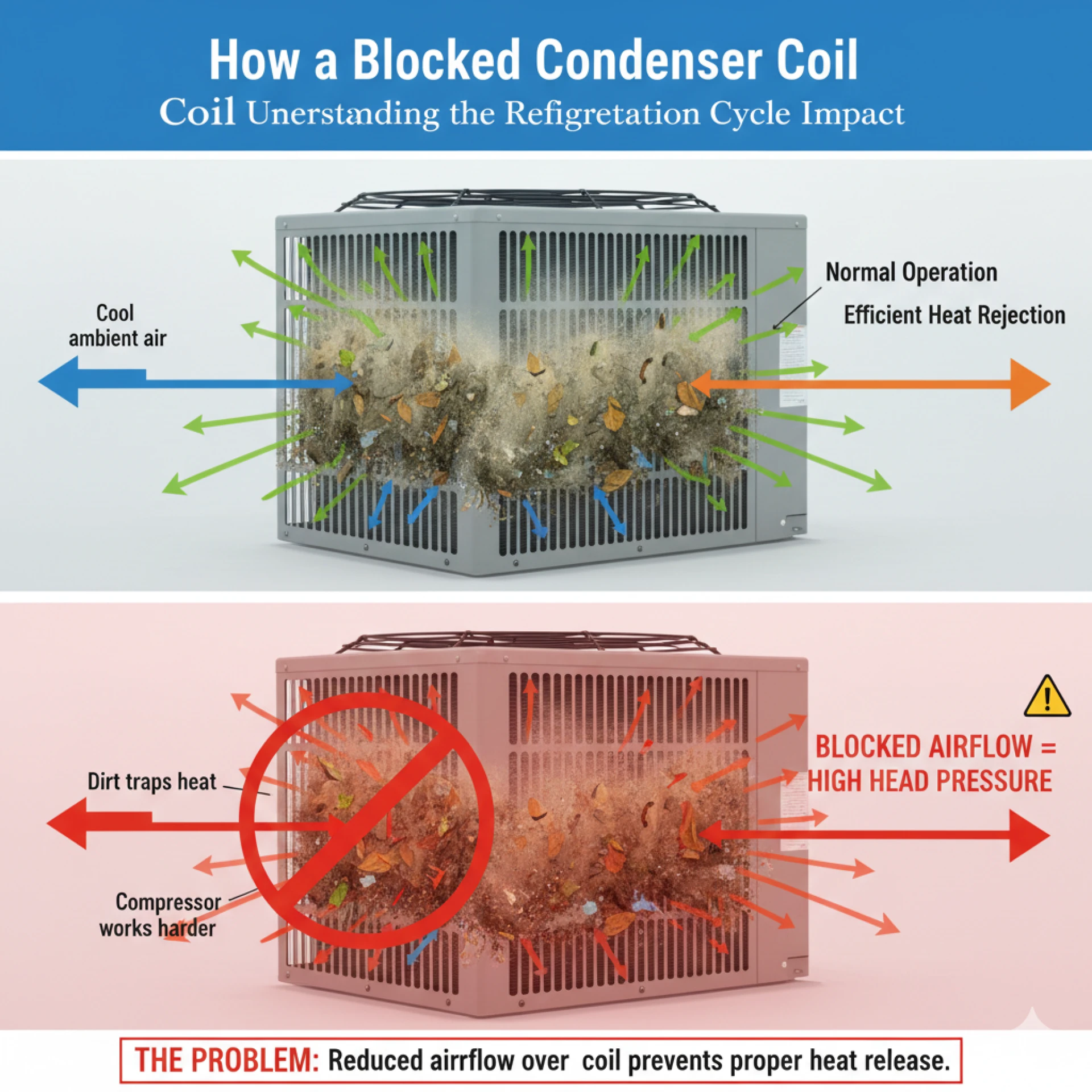
When your condenser coil is blocked, airflow across those fins drops dramatically. Less air moving across the coil means less heat removal from the refrigerant. The refrigerant can't cool down efficiently, so it stays hotter longer as it moves through the condenser.
Hot refrigerant that hasn't properly condensed means higher pressure. Remember, pressure and temperature are directly related in refrigeration systems. As temperature rises, pressure rises right along with it.
Your compressor keeps pumping refrigerant into the condenser, but that refrigerant isn't condensing back into liquid as quickly as it should. This creates a backup effect. Refrigerant accumulates on the high-pressure side of the system, unable to efficiently move through the condenser and continue its journey through the expansion valve and evaporator.
The compressor responds to this situation by working harder, trying to overcome the elevated pressure. It's like trying to force water through a partially clogged pipe—you need more pressure to maintain flow. The compressor ramps up, temperatures climb, and head pressure soars.
This creates a vicious cycle. Higher pressure means higher temperature, which means even less efficient heat transfer at the condenser, which means even higher pressure. Without intervention, this cycle accelerates until something fails.
The Domino Effect of High Head Pressure
High head pressure doesn't just affect one component—it cascades through your entire system causing multiple problems simultaneously.
Your compressor bears the worst of it. These components are designed to operate within specific pressure ranges. Force them to work against excessively high pressure for extended periods, and they overheat, wear out faster, and eventually fail. Compressor replacement is one of the most expensive AC repairs you can face, often approaching or exceeding the AC coil price of replacing the condenser itself.
Energy consumption skyrockets when head pressure runs high. Your compressor is working harder, running longer, and consuming more electricity to achieve less cooling. Those elevated utility bills aren't random—they're a direct result of your system's inefficiency caused by the blocked coil.
The AC cooling coil inside your house—technically called the evaporator coil—suffers too. When head pressure runs high, less refrigerant flows through the expansion valve into the evaporator. This means reduced cooling capacity even though your system is running constantly. You're paying more to stay less comfortable.
Temperature-activated safety switches might start tripping, shutting down your system to prevent damage. These nuisance shutdowns are your AC's way of screaming for help, yet many people simply reset the system without addressing the underlying problem.
Refrigerant itself can break down under extreme heat and pressure conditions. Some refrigerants degrade chemically when exposed to sustained high temperatures, forming acids that corrode metal components from the inside. This contamination can damage your entire system, requiring complete refrigerant replacement and system flushing.
Comparing Cooling Methods
Interestingly, some industrial facilities use adiabatic cooling systems that pre-cool air before it reaches condenser coils, improving efficiency in hot climates. This technology sprays fine water mist into incoming air, using evaporative cooling to drop temperatures before the air contacts the coil surface.
While most residential systems don't employ adiabatic cooling, the principle highlights an important point: condenser performance is hugely dependent on the temperature and flow of air across the coil. Anything that restricts airflow or reduces heat transfer efficiency—like blockages—has dramatic effects on system operation.
Prevention and Solutions
The good news? Preventing blocked condenser coils is relatively straightforward.
Regular cleaning is your primary defense. Most systems benefit from professional coil cleaning annually, though this frequency increases if you live in dusty areas or near vegetation. A qualified technician can chemically clean coils, removing buildup that simple hosing won't touch.
Between professional cleanings, you can gently spray your condenser coil with a garden hose from the inside out, pushing debris away from the fins rather than deeper into them. Never use a pressure washer—the force can bend those delicate fins, creating permanent damage.
Keep vegetation trimmed back at least two feet from your condenser unit. This reduces the amount of organic debris that gets pulled into the coil and improves overall airflow around the unit.
Replace or clean any filters on your outdoor unit if equipped. Some systems have protective screens that catch large debris before it reaches the coil. These screens need regular attention too.
Monitor your system's performance. If you notice reduced cooling, longer run times, or unusual noises from the outdoor unit, check that condenser coil before the problem escalates into expensive repairs.
The Bottom Line
A blocked condenser coil creates high head pressure, and high head pressure destroys AC systems from the inside out. This isn't a minor maintenance issue you can ignore—it's a serious problem that compounds over time.
Your condenser coil needs to breathe. Give it clean air, regular maintenance, and a bit of attention, and it'll reward you with efficient operation and years of reliable service. Neglect it, and you're looking at costly repairs, uncomfortable summers, and an AC system that dies young.
Check your condenser coil today. Those five minutes might save you thousands tomorrow.