
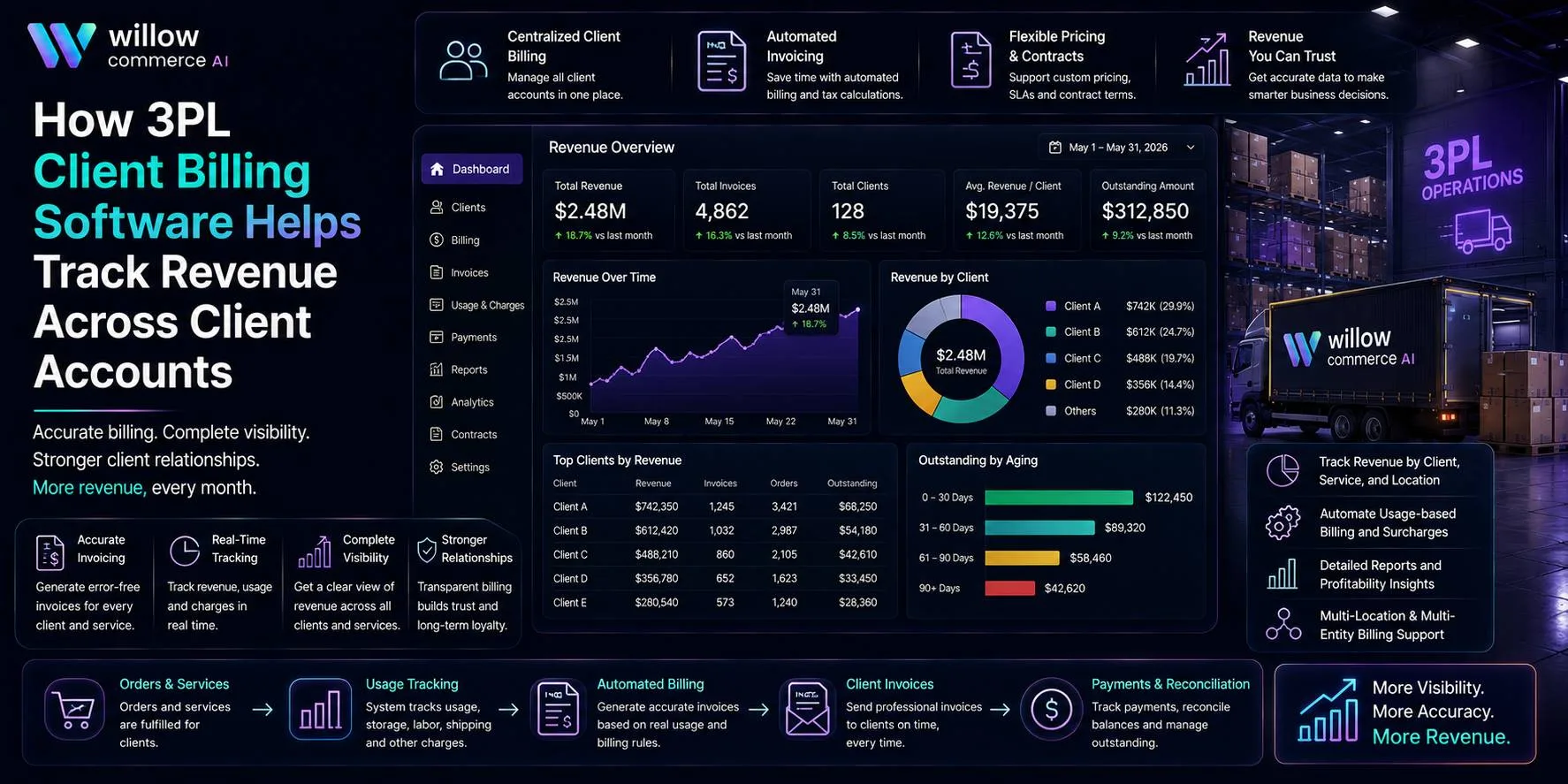
How much revenue gets missed when warehouse work and billing live in different places? For many 3PL operators, that question appears only after the client list starts growing. One account pays by pallet. Another pays by cubic foot. A third has separate rates for picks, returns, labeling, or special handling. The work gets done, but the charge does not always follow it cleanly.
That is where 3PL client billing software becomes useful. It connects warehouse activity with the commercial rules attached to each account. 3PL client portal software adds another layer by giving customers access to invoices, payment details, and service records without forcing the account team to answer every billing question manually.
Why Multi-Client Billing Gets Messy Fast
A 3PL can run a smooth warehouse and still struggle with billing. Each customer contract has its own pricing logic.
One account may use pallet-based storage pricing. Another may pay by bin or cubic foot. Pick-and-pack rates can run per order or per item. Receiving, kitting, returns, shipping markups, and project work add more moving parts.
3PL client billing software helps organize those rules before finance has to reconstruct them later. Billing starts closer to the warehouse event itself. Revenue tracking becomes more reliable when the system knows which account created the charge, what service triggered it, and which rate applies.
Willow Commerce takes that approach by tying fulfillment activity, stored inventory, printed labels, and configurable service fees into the billing workflow.
How Activity-Based Billing Protects Revenue
Missed revenue often comes from small tasks. A return gets processed. The warehouse completes a relabeling job. A pallet stays in storage longer than expected. None looks serious alone, but the value adds up across many accounts.
Instead of relying on someone to remember every service at month-end, the provider can create billable records as operational events happen. 3PL client portal software then gives the customer a clearer view of what appeared on the invoice and why.
That connection also helps finance teams spot unusual patterns. If an account uses more return handling or special projects than usual, those charges become easier to identify. The discussion moves away from vague invoice totals and toward specific warehouse work.
What Reusable Billing Templates Fix
Billing templates do not make every customer contract identical. They give the provider a consistent way to apply different rules.
A template can cover storage, picking, receiving, shipping, returns, or custom services. Once the structure exists, teams can reuse it without rebuilding the same logic each billing cycle.
The benefits are practical:
- Finance does not end up duplicating existing invoice logic each billing period.
- Account teams can review charges against agreed terms before the issue of invoices.
- Manual handoffs can be eliminated from warehouse activity to billing.
- New accounts can be added through a defined process (not another spreadsheet).
- The revenue by account is easier to review as the fee categories remain the same.
A structured billing platform gives the operation more control without forcing every customer into the same pricing arrangement.
Why Client Portals Make Billing Easier To Defend
Invoice accuracy matters, but clarity does too. A correct charge still creates friction when the customer cannot tell what it covers.
3PL client portal software gives customers one place to review invoice history, service charges, payment information, and account records. That self-service access cuts routine requests for copies, explanations, or old billing documents.
Willow Commerce also separates client data across inventory, orders, settings, and portal access. For a provider handling several brands, that separation helps keep one account’s billing records away from another account’s information.
Role-based access has a practical use as well. Finance may need invoice details. Operations may care about orders and inventory. Senior managers may only need a broader account view. Different permissions keep the portal useful without giving every user the same level of access.
How Revenue Tracking Changes Management Decisions
Total revenue can hide weak accounts. One customer may generate strong sales but require heavy manual work, frequent returns, special receiving, or long payment cycles. Another may look smaller but produce a cleaner margin.
3PL client billing software gives management a better base for reviewing billed revenue, unpaid balances, fee mix, and margin by customer. It also makes pricing discussions more grounded. If one service keeps consuming labor without producing enough revenue, managers can see that pattern earlier.
At the same time, 3PL client portal software reduces administrative noise. Customers can retrieve records, review charges, and manage payment details without pulling staff into every small request. Account teams can then spend more time reviewing commercial performance rather than searching for invoice copies.
Conclusion: A Better Way To Read Client Revenue
Revenue tracking improves when billing starts with the work that happened in the warehouse, not with a spreadsheet built after the fact. A stronger model connects service activity, account-specific rates, invoices, payment records, and customer access in one flow.
3PL client billing software supports that financial structure, while 3PL client portal software gives customers a clearer way to review service costs. Providers looking to review their billing structure should track where billable events are starting, how each billable event gets to the invoice, and how many billable events they're generating for the work they're doing.