3D scanning technology captures the geometry of physical objects and transforms them into digital 3D datasets, including point clouds and meshes. Put simply, a 3D scanner repeatedly takes distance measurements across an object’s surface; dedicated software then converts these readings into usable 3D geometric data.
In short: 3D scanning samples real‑world surfaces to generate digital 3D data (point cloud → mesh → texture).
Two typical application scenarios: close‑range high‑detail capture (structured light / laser triangulation) and large‑scale scene scanning (LiDAR: time‑of‑flight / phase‑shift).
Common misconception: more points ≠ higher accuracy.
Key insight: quality scan results rely on proper workflow, not a single‑click operation.
Workflow: Plan → Prepare → Calibrate → Capture → Register → Mesh → QA → Export

While 3D scanning can appear complex, its underlying principle remains straightforward: the scanner repeatedly measures distances to an object’s surface, and software translates those measurements into usable 3D geometric data. Different scanning technologies primarily vary in their distance‑sensing methods. This accounts for the differences in scanning range, detail resolution, scanning speed, and performance on challenging surfaces such as glossy or transparent materials.
3D scanning ultimately converts real-world surfaces into measurable 3D data, but in practice, results depend more on how the workflow is executed than on the sensor itself.
For small, high-detail objects, triangulation-based systems (structured light or laser) are usually the best choice. For large environments, LiDAR provides better coverage and higher efficiency.
If you only remember one rule, remember this: choose the right technology based on object size and tolerance requirements, and focus on controlling the key workflow variables such as calibration, capture strategy, and registration.
If you would like to learn more knowledge about 3D scanners, visit VoxMeta.

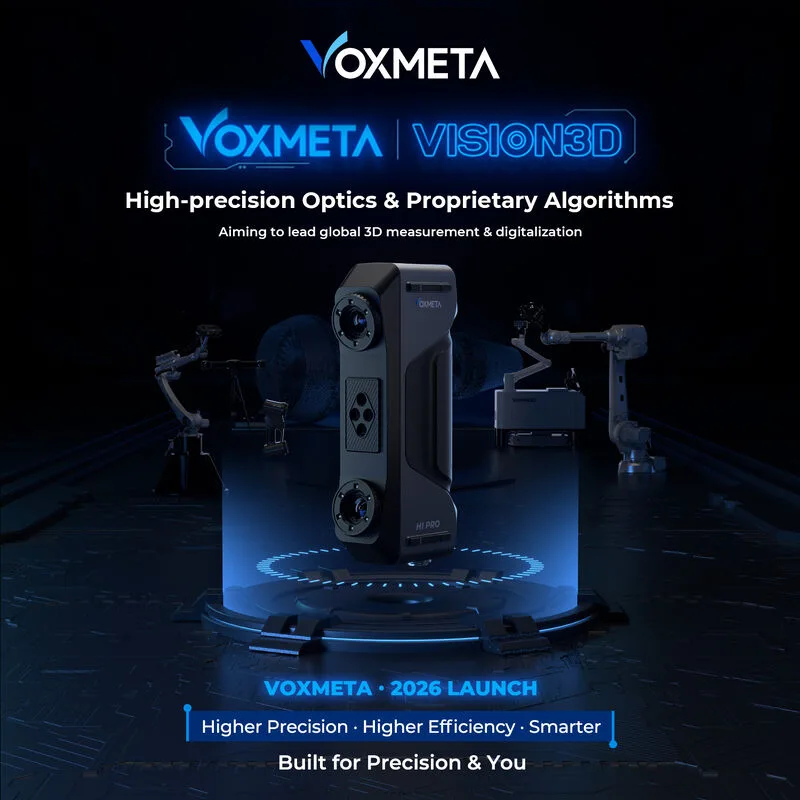
3D scanner launched by VoxMeta
VoxMeta is powered by Vision3D, a company with extensive expertise in 3D digitalization hardware and software technologies. It possesses fully independent intellectual property rights for its core 3D measurement algorithms and has established a comprehensive technological barrier spanning hardware to platform solutions. Inheriting Vision3D’s innovative capabilities and advanced technologies, VoxMeta empowers customers to advance toward higher precision, greater efficiency, and smarter solutions, pushing the boundaries of 3D scanning technology applications.
Based on Vision3D’s core technologies, VoxMeta will integrate high-precision optical scanning and independent algorithms, providing reliable 3D solutions to empower customers’ industrial upgrading and digital innovation.
We are committed to be a global leader in 3D measurement & digitalization, expand application scenarios, set new industry standards, and lead 3D technology to empower the digital economy.