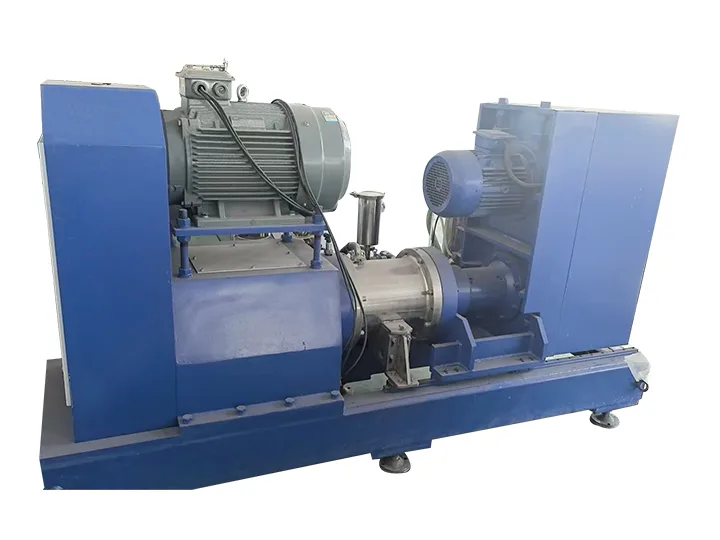
Choosing a horizontal nano sand mill for a laboratory is easy. Choosing one for a plant is not, because at production scale the mill stops being a standalone machine and becomes part of a grinding train whose throughput is set by its slowest element.
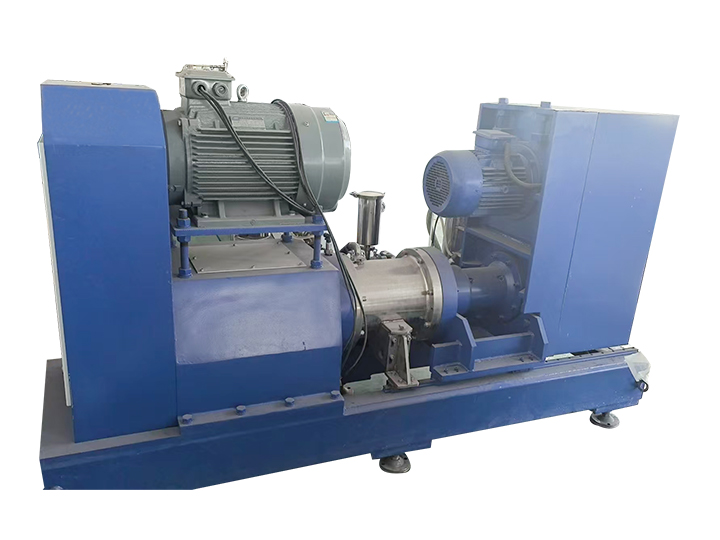
SMTC dual power nano sand mill
This article is a planning guide: how to convert a formulation into a capacity requirement, how many passes you will actually need, how to lay out a train, and what drives running cost. Model figures come from Wuxi Xinyang Equipment Technology Co., Ltd., a sand mill manufacturer in Yixing, Wuxi, Jiangsu, China.
Start From Litres per Batch, Not Litres per Hour
The first number a production planner needs is not chamber volume. It is the time to process one batch.
A mill's quoted throughput assumes ideal viscosity and a single pass. Real production involves filling, circulating, sampling, adjusting and discharging. In practice, plan on 60 to 70 per cent of the nominal figure.
Three inputs set the requirement:
• Batch volume — litres per batch, from the mixing tank
• Batches per shift — how many times the tank turns over
• Energy requirement — the kWh per tonne your formulation needs to reach target
The third number is the one most often missing. It is best obtained from a laboratory trial: run the formulation on a 0.3L or 1L mill, record the specific energy at which you hit target D50, then scale.
How Many Passes?
Nano targets are rarely reached in a single pass. The number of passes is a function of target fineness and the energy the chamber can deliver per pass.
| Target D50 | Typical passes (circulation) | Practical note |
| 1–2μm | 1–2 | Often a single-pass disc mill is enough |
| 300–800nm | 3–5 | Circulation through an external tank |
| 100–300nm | 5–10 | Rod pin mill, 0.1–0.3mm media |
| Below 100nm | 10+ | Small media, tight temperature control |
More passes means more pumping, more cooling and more time. Where the pass count climbs above about six, it is usually cheaper to add a second mill in series than to keep circulating through one.
Building a Grinding Train
A production nano line normally has four elements: a disperser or mixer, a circulation tank, the mill (or mills), and a cooling circuit.
| Configuration | Layout | Best for |
| Single mill, circulation | Mill + tank, product recirculates | Medium batches, moderate fineness |
| Two mills in series | Mill A feeds Mill B, then to tank | Fine targets at high volume |
| Mill plus disperser | Disperser feeds mill continuously | High-throughput, low-viscosity products |
| Parallel trains | Two independent lines | Product changeover without stopping |
Xinyang Equipment manufactures the upstream mixing and dispersing equipment as well as the mills, so a train can be specified as a matched set rather than assembled from three vendors. The NT-X turbine mill, for example, can be connected in series with mixers under PLC control to run cyclic grinding automatically.
Automation and Repeatability
At production scale, repeatability matters more than peak performance. A mill that produces an outstanding batch once and an average batch the next time is worse than a slightly slower machine that hits the same D50 every time.
What to look for:
• PLC control with recipe storage, so operators load a program rather than adjust valves
• Automatic temperature protection that stops or slows the mill before the product degrades
• Flow and pressure monitoring, since a change in either usually signals a separator problem before quality drops
• Data logging, so a customer complaint can be traced back to actual process conditions
Xinyang's NT-X and dual-power SMTC ranges are supplied with PLC automation control as standard, with the option to link several units.
Maintenance and Uptime
Nano mills run tight clearances and small media, so wear parts are a real line item.
| Wear item | Typical concern | Planning action |
| Separator | Clogging, gap drift | Choose a design that can be cleaned without major dismantling |
| Shaft seal | Leakage under pressure | Specify a seal design suited to your solvent |
| Grinding media | Bead wear and contamination | Match bead grade to hardness requirement |
| Rotor and chamber liner | Abrasive wear | Select steel, ceramic or polymer per product |
| Cooling circuit | Scale and fouling | Include water treatment in the plan |
Xinyang machines carry a one-year after-sales service period and are designed for at least three years of service life. Spare part availability and lead time should be confirmed at order stage, not at first breakdown.
What Drives Cost of Ownership
Purchase price is typically a minority of the five-year cost. The larger drivers are:
1. Specific energy — kWh per tonne, which depends on rotor geometry and how hard you have to run
2. Media consumption — smaller beads wear faster and cost more per kilogram
3. Uptime — every hour of unplanned downtime costs the full line rate
4. Rejects — batches that miss the specification, usually caused by temperature or separator issues
When comparing quotes from different suppliers, ask each one for the specific energy figure on your material. It is the only number that makes two machines comparable.
Xinyang Equipment Production Nano Mills
Wuxi Xinyang Equipment Technology Co., Ltd. builds horizontal nano sand mills from 0.3L laboratory units to 300L production machines, with wet grinding fineness down to 50 nanometres and grinding media from 0.05mm. The company's sand grinding and dispersion division provides equipment and engineering services for lithium battery, ceramic ink, coatings, pesticide, pharmaceutical and magnetic material producers, with a customer list that includes several large Chinese battery and coating manufacturers.
Let Us Size Your Line
Send batch volume, batches per shift, target D50 and viscosity to shen@xinyang-mill.com or call +86 18051935350. Xinyang Equipment will propose a chamber size, a pass count and a train layout, and can run a laboratory trial on your material before any capital commitment.