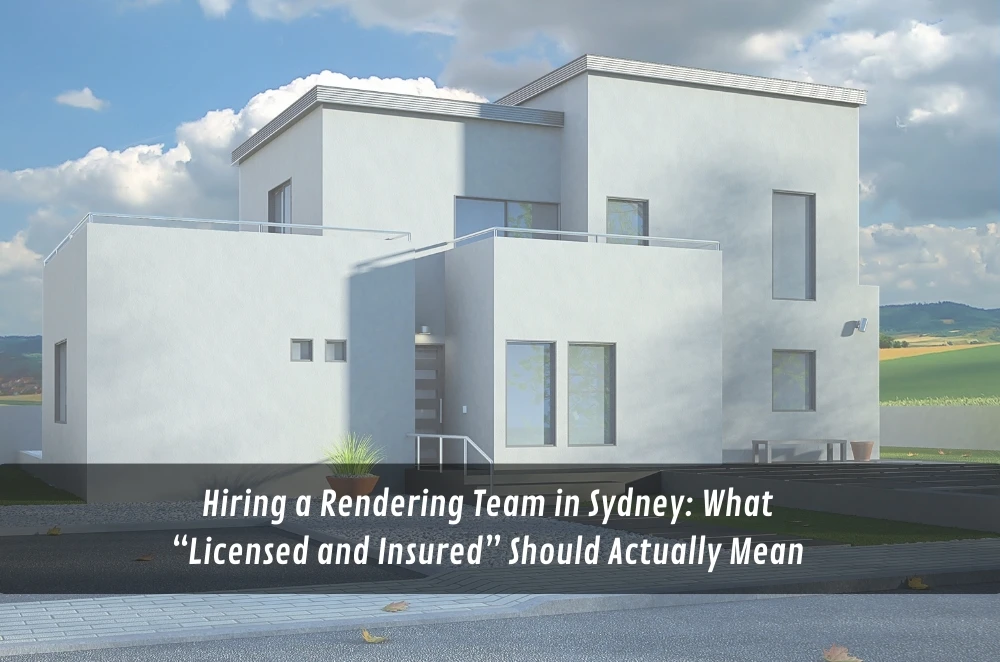
Rendering can lift a façade fast, but it’s also one of those trades where the “finish” you see is only the final layer of a much bigger risk picture.
In Sydney, most costly rendering problems don’t start with the topcoat—they start with unclear scope, poor substrate prep, unmanaged moisture, and assumptions about who is responsible for what.
This guide explains what to check when someone says they’re licensed and insured, how to write a scope that protects you, and how to plan the next two weeks so you’re not deciding under time pressure.
Why “licensed and insured” matters on a rendering job
On a typical render project, the biggest risks are not the bag of render or the texture choice—it’s access, adhesion, movement cracking, water pathways, and what happens when something goes wrong.
Insurance is about what happens if there’s property damage, an incident on site, or defects that require rectification, and the right cover can be as important as the workmanship.
Licensing (where applicable) and proper business details help you confirm you’re dealing with a real operator who can be held accountable if a dispute arises.
For strata, facilities, and commercial sites, these checks matter even more because public access and shared assets raise the stakes.
What to ask for (without turning it into a legal exam)
You don’t need to play detective, but you do need clarity in writing.
Ask for the contractor’s legal business name, ABN, and the name on the insurance documents, and check that it matches the entity you’re signing with.
Request a current certificate of currency for relevant insurance (commonly public liability; sometimes additional cover depending on the work and site requirements).
If the project involves higher-risk access (scaffold, EWPs, work over public areas), ask how access will be managed, who supplies it, and how the site will be made safe.
If a licence is claimed, ask which licence category applies to the scope, and confirm it’s current and relevant to the work being quoted.
Scope beats promises: the core idea that prevents disappointment
Most rendering disputes come down to scope ambiguity: what prep was included, what defects were excluded, what “acceptable finish” means, and who pays when the wall reveals surprises.
A clear scope doesn’t just compare quotes—it forces the right conversation before anyone starts.
If you can’t explain the scope to a colleague in 60 seconds, it’s probably too vague for a contract.
Common mistakes people make when hiring a rendering team
The first mistake is choosing on price before defining the scope, which rewards under-allowing for prep and protection.
Another mistake is assuming all “rendering” quotes include the same steps, when one may include priming and reinforcement and another may not.
People also skip sample patches and sign-off, then argue later about texture, joins, and colour variation under daylight.
A big one is ignoring moisture clues—staining, bubbling paint, damp garden beds against walls—then expecting render to solve it.
Finally, many projects fail at handover: no written maintenance notes, no record of products used, and no plan for touch-ups in high-wear zones.
Decision factors that separate a good choice from a lucky one
Start by treating rendering as a system job (substrate + prep + detailing + finish), not a cosmetic skim.
1) Substrate reality
What’s the wall actually made of, what’s on it now, and what condition is it in?
2) Moisture and water management
If gutters, flashings, downpipes, penetrations, or garden beds are sending water where it shouldn’t go, address that first or the render will wear the blame later.
3) Movement and crack strategy
Ask how cracks will be treated, where joints are expected, and what the plan is for corners, openings, and long runs.
4) Access, protection, and neighbours
Sydney sites often have tight side access, shared driveways, and footpath considerations that change both cost and sequencing.
5) Finish control
Define the sample patch process, acceptance criteria, and how joins and transitions will be handled so the “look” is agreed early.
If you’re shortlisting providers and want a quick prompt for the right checks and scope questions, licensed and insured rendering team in Sydney can help keep your decision focused on risk and clarity, not just price.
What to include in a rendering scope so quotes are comparable
A one-page scope can be enough if it forces specifics.
Include the areas to be rendered (marked-up photos help), and note any known substrate conditions like old paint layers, patchy repairs, or crumbling sections.
State prep expectations plainly: cleaning method, removal of loose material, bonding/priming assumptions, and how hollow or unstable areas will be handled if discovered.
Define crack treatment approach, and make it clear what happens if structural movement or significant water ingress is identified mid-job.
Set finish expectations: texture type, corner details, junction treatment, and whether coatings/topcoats are included and compatible with the system.
Require a sample patch (size, location, sign-off), plus protection/masking for windows, paving, gardens, signage, and adjacent finishes.
Call out access assumptions (scaffold/EWP/ladder limits), working hours, dust controls, and safe paths for occupants or customers if relevant.
A simple 7–14 day plan to hire with confidence
Day 1–2: Walk the site and take photos in different light; mark cracks, staining, bubbling paint, and impact zones.
Day 3–4: List constraints in writing: access points, neighbour boundaries, trading hours (if commercial), parking/loading, and any strata approvals.
Day 5–6: Get at least one inspection-based recommendation that names likely prep steps and flags moisture or movement risks rather than just describing the finish.
Day 7: Draft a one-page scope with areas, prep assumptions, crack strategy, sample sign-off, protection, and access requirements.
Week 2: Collect quotes against that same scope, then choose based on clarity, sequencing, and risk management as much as cost.
Operator Experience Moment
On real Sydney sites, the job rarely goes wrong because someone “can’t apply render.”
It goes wrong because the wall was damp, unstable, or moving—and the scope didn’t force those issues into the open early.
When sample approval, protection, and crack strategy are agreed before work starts, the finish becomes repeatable instead of arguable.
Local SMB Mini-Walkthrough (Sydney, NSW)
A Sydney café wants to refresh its street-facing wall without closing for works.
They choose low-traffic hours for noisy prep and schedule around deliveries.
They approve a sample patch near the entry under midday and late-afternoon light.
They include signage masking and footpath safety barriers in the written scope.
They keep one entrance open and clearly marked at all times.
They finish with a simple touch-up plan for corners that get bumped by prams and bins.
Practical Opinions
Clarity in the scope is more valuable than confidence in the quote.
Sample patches prevent the most common finish disputes.
If water is involved, fix the water pathway first.
Key Takeaways
- “Licensed and insured” should translate into verifiable documents that match the entity you’re contracting with.
- Rendering outcomes depend on substrate prep, moisture control, and movement detailing more than texture choice.
- Comparable quotes come from a shared scope that defines prep, crack strategy, access, protection, and sample sign-off.
- A 7–14 day plan helps you avoid rushed decisions and variation-heavy projects.
Common questions we hear from businesses in Sydney, NSW
Q1) What insurance should we expect a renderer to have for a commercial site?
Usually you’ll want current public liability insurance at a level appropriate for the site risk, plus any additional cover required by the building, centre management, or strata. A practical next step is to request a certificate of currency and confirm the named insured matches the business you’re contracting with. In most cases in Sydney, footpath exposure, tight access, and neighbouring shopfronts make “who is covered” as important as “how much cover.”
Q2) How can we tell if a quote includes proper preparation?
It depends on whether the quote lists prep steps in plain language rather than bundling everything into a single line item. A practical next step is to ask the contractor to specify cleaning, removal of loose material, priming/bonding assumptions, and how unstable areas will be handled if discovered. In most cases around Sydney, older painted masonry and patch repairs demand more prep than people expect, and vague quotes hide that.
Q3) Do we need a sample patch on a small job?
In most cases yes, if the wall is prominent, gets strong afternoon light, or involves a texture change across large areas. A practical next step is to nominate one visible location for a sample patch and agree in writing what “acceptable finish” looks like before the full application begins. Usually in Sydney, cracked wall repair service daylight variability and mixed substrates make small differences look bigger than they do on a sample board.
Q4) What’s the best way to reduce disruption while works are happening?
Usually disruption drops when access, protection, and staging are decided upfront rather than improvised on day one. A practical next step is to write site rules into the scope: working hours, safe entry paths, dust controls, and where materials and waste will be stored. In most cases in Sydney, coordinating footpaths, shared driveways, and neighbour boundaries is the difference between a smooth job and daily friction.