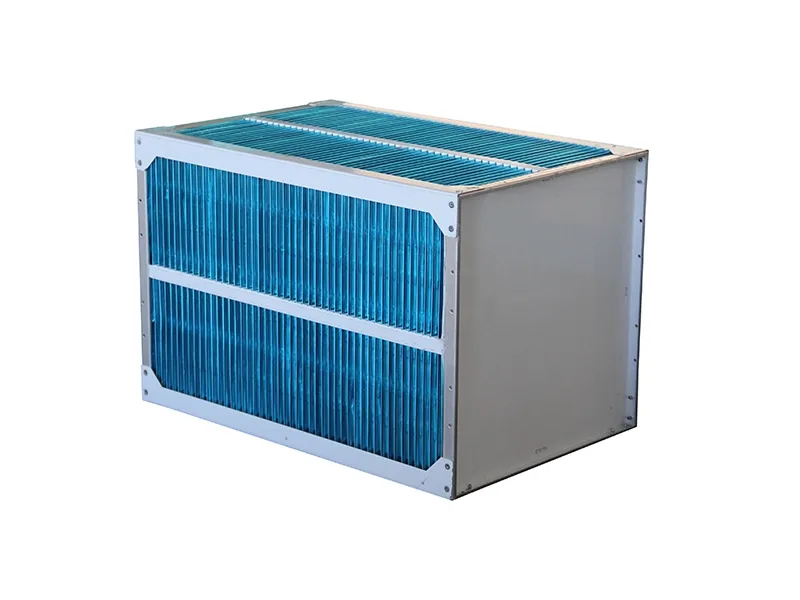

A heat recovery ventilator is priced primarily on airflow, static pressure and heat recovery type — not on model name. ROTER's published range runs from 200 m³/h single-flow fresh air systems for residential scale up to 80,000 m³/h modular air handling units for commercial and industrial projects, with recovery efficiency of 68–76% measured at GB/T 21087 conditions. Because the same model family covers a 40-fold airflow range with several core and frame options, the only accurate price is one calculated against your duty.
What drives heat recovery ventilator price?
Heat recovery ventilator price drivers
FactorOptionsEffect on priceNoteAirflow (m³/h)200 (single-flow) to 80,000 (modular AHU)Dominant driver. Cost scales with core area and fan sizeFix this first — everything else follows from itHeat recovery typeSensible, total heat, rotaryTotal heat and rotary cost more than sensible plateSee the ERV vs HRV comparisonStatic pressure (Pa)120–400 Pa published across the CXH rangeHigher pressure needs a heavier frame and more fan powerMatch the design point, not the maximumCore typePlate (cross / counter / cross counter-flow), rotary wheel, heat pipeRotary adds a motor and drive; heat pipe adds a refrigerant circuitCompare on exhaust duty, not unit priceFiltrationG4 / F7 / F9 grade, or HEPA on requestModerate; HEPA adds a housing and pressureDriven by the process requirementEnclosureGalvanised steel, stainless steelStainless is the largest non-core increaseOnly where the environment demands itControlsOn/off, differential pressure sensor, CO₂ demand control, BMS/BACnet integrationLow relative to the unit, high value for paybackCO₂ control usually pays back fastestConfigurationSingle unit, or modular building-block AHUModular scales more economically above ~10,000 m³/hAsk for the modular option on large projectsQuantity and deliverySingle unit to full projectVolume discount; shipping cost scales with sizeInclude the full project schedule in the request
Published ERV specification data
Medium ceiling-mounted total heat recovery unit (CXH series)
CXH series — published performance
ModelAirflow m³/hStatic pressure PaMotor power kWEfficiency %Noise dB(A)Weight kgCXH-10DA10001200.447261140CXH-25DA25002001.106859210CXH-50DA50002702.747063350CXH-100DA100004007.007172670CXH-150DA1500040011.07075780
Full 14-model range on the medium ceiling-mounted total heat recovery unit page. Test conditions (GB/T 21087): summer — outdoor dry bulb 33°C, RH 80%, indoor 26°C, RH 50%; winter — outdoor 0°C, RH 30%, indoor 20°C, RH 60%. For reference only.
Vertical total heat recovery unit — sensible vs total efficiency
CHX-L series — published performance
ModelAirflow m³/hStatic pressure PaMotor power kWSensible eff. %Total eff. %Weight kgCHX-15L15001580.507558133CHX-100L100003406.007670650CHX-150L1500046011.07670780
Single-flow fresh air system (residential and small commercial scale)
RS series — published performance
Model rangeAirflow m³/hStatic pressure PaNoise dB(A)Weight kgRS-20-A02 to RS-100-A02200–1000120–1404512–16RS-20J-A02 to RS-50J-A02 (with electric heating)200–500120–1404512–16
The J series adds an electric heating element and is used where the supply air set point must be maintained at very low outdoor temperatures.
What we need from you to quote
Airflow — supply and exhaust, m³/h
Static pressure — design point, Pa
Heat recovery type — sensible or total; rotary if the exhaust is dirty, hot or high-pressure
Supply air conditions — target temperature and relative humidity, and the design outdoor conditions
Installation detail — ceiling, wall or ducted; electrical supply; any controls or BMS integration requirement
Send those and ROTER returns a sizing calculation, a model selection with the recovery efficiency computed at your conditions, a drawing and a quotation — normally within 24 hours. Compare the range against the full product index or see all published specification tables.
Frequently asked questions
How much does a heat recovery ventilator cost?
Price is dominated by airflow, then by static pressure, heat recovery type and enclosure material. ROTER's published range spans single-flow units at 200 m³/h through to modular air handling units at 80,000 m³/h, so the cost range across the catalogue is wide. For a specific duty, the figure comes from a sizing calculation — send us airflow, static pressure and supply air conditions and the quotation comes back within 24 hours.
Is a heat recovery ventilator worth the cost?
In a commercial building with a meaningful cooling load, yes. ROTER's documented case in a 200 m² Beijing room measured approximately 1,112 kWh saved in winter and about 1,427 kWh in summer — roughly 42.3% annual saving at ¥0.48/kWh. The reason the saving is large in commercial rather than residential buildings is that a total heat recovery unit also removes latent load, which is often the larger half of the air-conditioning energy bill.
What is the difference between a plate and a rotary heat recovery ventilator?
Plate exchangers have no moving parts and completely separate the two air streams, which makes them the default for clean exhaust and any application where cross-contamination control matters. Rotary exchangers handle higher duct static pressure, suit larger ductwork and, with the ECW high-temperature rotor, tolerate exhaust temperatures up to 300°C. Compare the full characteristics in the ERV comparison table.
What efficiency should I expect from a commercial ERV?
Across the published ROTER range, total heat recovery efficiency is 68–76% measured at GB/T 21087 conditions. Sensible heat efficiency is higher — the CHX-L series publishes 75–76% sensible against 58–70% total for the same units. Efficiency figures always depend on the conditions, so ask for the efficiency calculated at your own design outdoor and indoor conditions rather than accepting the catalogue number.
How long does an energy recovery ventilator take to deliver?
Lead time is confirmed in the quotation against the current production load. Catalogue units are typically the shortest, and modular building-block AHUs for large projects take longer because they are assembled to order. If the project has a hard commissioning date, state it in the inquiry so the production slot can be reserved.
Do you supply CE-marked units and test reports for Western submittals?
Yes. ROTER holds ISO 9001, ISO 14001 and ISO 45001 certification and CE certification for rotary wheel heat recovery units. Published efficiency figures are stated at GB/T 21087 conditions, and equivalent calculations at EN 308, EN 16798-3 or ASHRAE 220 conditions can be provided together with the relevant test report and the submittal package. See corporate honours and certifications.
Can I get a sample or a single unit to test before a project order?
Yes. Catalogue models can be ordered as a single unit with the published test data for that model, so the performance can be verified on site before a project quantity is committed.
How do I request a quotation?
Submit the airflow, static pressure, supply air conditions and installation detail through the contact page. ROTER responds within 24 hours with a sizing calculation, model selection and quotation.