Healthcare is moving beyond diagnosis alone. Today, hospitals and care teams need technology that can help them detect risk early, manage patient follow-up, and reduce delays between scan findings and clinical action. This is where healthcare ai solutions are becoming highly relevant, especially in medical imaging workflows where speed, accuracy, and coordination can directly influence patient outcomes.
Qure.ai’s US webpage focuses on this exact shift. Its positioning is built around the idea of moving from image to intervention, with AI-enabled tools that support lung nodule care, CT analysis, patient tracking, and clinical follow-up. The company’s solutions are backed by multiple FDA clearances and are used for disease areas including lung cancer, tuberculosis, pediatric TB, and stroke.
Why AI Matters in Medical Imaging
Medical imaging is one of the most important areas where AI can support healthcare teams. Radiologists and clinicians often work with large scan volumes, time-sensitive findings, and complex patient pathways. In lung nodule care, the challenge is not only identifying a suspicious finding, but also ensuring that the patient receives the right follow-up at the right time.
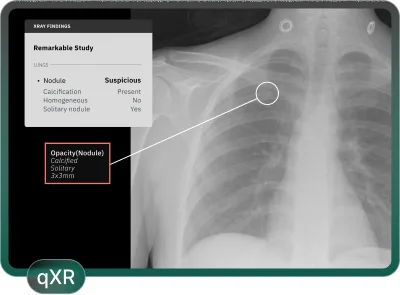
Qure.ai’s approach addresses this by combining imaging intelligence with workflow support. Its qXR solution helps identify and localize lung nodules on chest X-rays, while qCT LN Quant supports advanced lung nodule analysis on CT scans. Qure.ai has described qCT LN Quant as part of its AI-powered lung cancer care continuum, which includes identifying, measuring, managing, and monitoring lung health.
AI Healthcare Solutions for Lung Nodule Care
One of the strongest use cases on Qure.ai’s US page is lung nodule management. Lung nodules may be detected during routine imaging, but without structured follow-up, some patients may fall through the cracks. This creates a gap between detection and treatment.
Qure.ai’s ai healthcare solutions aim to close this gap by supporting multiple stages of the care pathway. qXR can help flag suspicious lung findings on chest X-rays, qCT can support measurement and analysis on CT scans, and qTrack can help manage follow-up and patient tracking. This makes the platform useful not only for radiologists, but also for pulmonologists, emergency physicians, and care coordination teams.
From Scan Findings to Clinical Action
A key value of healthcare AI is its ability to support faster clinical decision-making. For hospitals, this does not mean replacing doctors. Instead, AI can act as a decision-support layer that helps highlight findings, prioritize review, and organize next steps.
Qure.ai’s lung nodule management page explains that its qXR-LC solution supports screening programs and incidental screening for early lung cancer detection using AI. The page also highlights the importance of early-stage lung cancer detection and the role of AI algorithms in pulmonary imaging.
Supporting Follow-Up and Reducing Care Gaps
Detection is only the first step. In real-world healthcare settings, follow-up gaps can occur due to communication delays, manual tracking, missed reports, or fragmented workflows. Qure.ai’s own blog on lung nodule follow-up notes that many health systems lack dedicated staff or integrated technology for tracking nodules, which can make follow-up inconsistent.
This is why AI-powered patient tracking and workflow coordination are important. A connected system can help teams monitor findings, prioritize cases, and support timely intervention. For healthcare providers, this can improve operational efficiency while also helping patients move through the care pathway more smoothly.
The Future of AI in Healthcare Workflows
The future of healthcare AI will not be limited to single-point detection tools. The bigger opportunity lies in platforms that connect imaging, risk identification, reporting, follow-up, and care coordination. Qure.ai’s US positioning reflects this broader direction by focusing on the complete image-to-intervention journey.
As hospitals continue to adopt healthcare ai solutions, the most valuable platforms will be those that integrate into existing clinical workflows and help teams act faster with confidence. Qure.ai’s ai healthcare solutions show how medical imaging AI can support earlier detection, smarter follow-up, and more coordinated patient care across lung nodule pathways.