
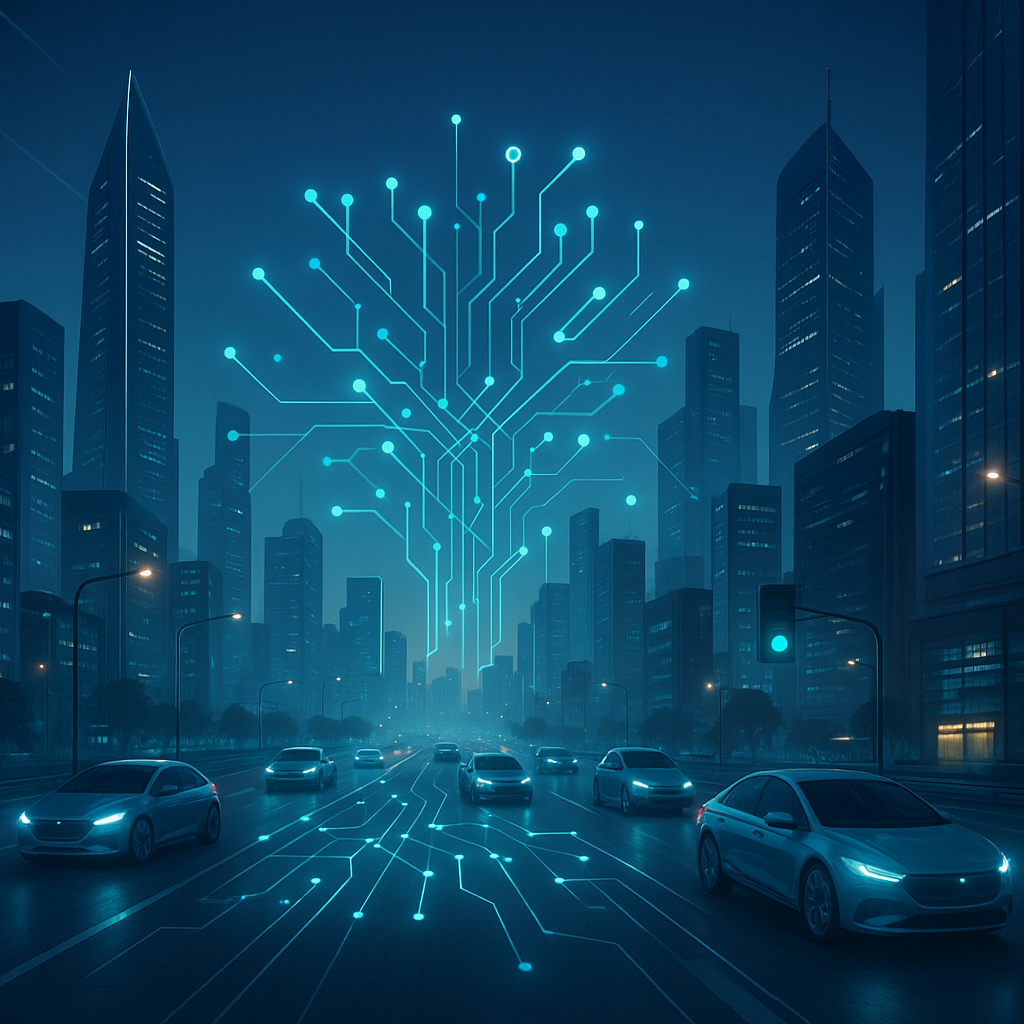
Urban V2I Communication: A Complex Challenge
Urban vehicle-to-infrastructure (V2I) communication systems are foundational for enabling intelligent transportation and smart city ecosystems. These systems rely on efficient and reliable wireless links between vehicles and roadside units (RSUs) to transmit safety messages, traffic updates, and infotainment data. However, the dense urban environment presents formidable challenges to signal propagation, primarily due to the phenomenon known as path loss. Path loss — the reduction in signal power over distance — is notoriously difficult to predict accurately in urban settings because of multipath reflections, shadowing by buildings, foliage, and dynamic obstacles like moving vehicles and pedestrians.
Accurate path loss prediction is critical for V2I systems to optimize link adaptation, resource allocation, and handover decisions. Traditional empirical or deterministic models such as the COST 231-Walfisch-Ikegami or the ITU-R models have been the backbone of engineering efforts, but their limitations become glaring in the face of real-world urban complexity. These models often fail to capture the spatial heterogeneity and temporal dynamics that characterize city landscapes, leading to suboptimal network performance and degraded quality of service.
To address these limitations, researchers and industry innovators have pivoted towards leveraging machine learning (ML) techniques, capitalizing on their ability to learn complex nonlinear relationships from large datasets without explicit physical modeling assumptions. This article explores how machine learning is transforming path loss prediction in urban V2I communication systems in 2026, highlighting the latest developments, challenges, and future directions.
From Traditional Path Loss Models to Machine Learning: The Evolution
The journey to improve path loss prediction has evolved significantly over the past two decades. Early models like Okumura-Hata and COST 231 provided empirical formulas based on extensive measurement campaigns, offering reasonable accuracy for certain urban scenarios. Despite their widespread use, these models suffer from rigidity and lack adaptability to varying urban morphologies.
Deterministic ray-tracing models introduced more physical realism by simulating electromagnetic wave propagation paths, including reflections, diffractions, and scattering. Yet, their computational cost and requirement for detailed environmental data restrict their scalability and real-time applicability.
Machine learning entered the radar in the late 2010s and early 2020s as datasets from urban wireless measurements became increasingly available. Early ML models employed simpler algorithms such as decision trees and support vector machines trained on limited features like distance, frequency, and basic terrain type. Progressively, deep learning architectures and ensemble methods began to dominate, integrating richer input features derived from geographic information systems (GIS), 3D building models, traffic density, and weather conditions.
By 2026, the integration of ML with high-resolution spatial data and real-time sensor inputs enables unprecedented accuracy and adaptability in path loss prediction. This transformation aligns with broader AI trends discussed in How Machine Learning Is Redefining Intelligence and Industry in 2026. The ability to dynamically update models with streaming data reflects a paradigm shift from static to adaptive wireless network planning.
Core Machine Learning Techniques Empowering Urban V2I Path Loss Prediction
Machine learning for path loss prediction in urban V2I systems involves several key algorithmic approaches. These methods vary in complexity, interpretability, and required training data volume.
- Gradient Boosting Machines (GBMs): GBMs have shown strong performance due to their ability to model nonlinear interactions and handle heterogeneous feature sets. They can incorporate features like building density, road topology, and local weather data to predict path loss with high fidelity.
- Deep Neural Networks (DNNs): Convolutional neural networks (CNNs) and graph neural networks (GNNs) especially excel at processing spatial data. CNNs analyze aerial imagery and 3D city maps to extract relevant propagation features, while GNNs model the urban environment as graphs connecting infrastructure points, capturing topology-driven signal behaviors.
- Reinforcement Learning (RL): RL algorithms can optimize path loss prediction models by interacting with live network feedback, adjusting parameters to minimize prediction errors in real time, which is critical for dynamic urban scenarios.
- Hybrid Models: Combining deterministic physics-based models with ML components yields hybrid approaches that leverage domain knowledge alongside data-driven adaptability, improving generalization in unseen environments.
Feature engineering remains a cornerstone. High-dimensional feature vectors may include:
- 3D building height and material data
- Traffic density and vehicle speed patterns
- Weather conditions such as rain intensity and humidity
- Time-of-day and seasonal variations affecting foliage
- Road geometry and line-of-sight obstructions
These comprehensive features allow ML models to capture the multifaceted influences on signal propagation. According to industry reports, models utilizing GNNs trained on multi-source urban datasets have reduced mean absolute error in path loss prediction by up to 35% compared to legacy models.
“Machine learning’s ability to fuse complex urban data streams fundamentally changes how we predict wireless signal behavior, enabling smarter V2I communications that adapt in real time.” — Dr. Lina Mendez, Lead Researcher, Urban Wireless Systems Lab
2026 Breakthroughs and Current Industry Implementations
The year 2026 marks significant strides in deploying ML-enhanced path loss prediction in commercial and municipal V2I networks. Several metropolitan areas worldwide have launched pilot programs integrating these advanced models into their smart transportation infrastructure. For instance, the city of Singapore’s Land Transport Authority deployed a hybrid ML-path loss prediction system that dynamically adjusts RSU transmission power and beamforming parameters, resulting in a 27% increase in communication reliability during peak traffic hours.
Meanwhile, automotive OEMs and telecommunication providers collaborate closely to embed ML-driven path loss modules into vehicle communication units. These embedded solutions enable on-the-fly link quality estimation and adaptive modulation schemes, crucial for safety-critical applications like collision avoidance and emergency vehicle prioritization.
Key advancements fueling these implementations include:
- Ubiquitous high-resolution urban digital twins providing accurate environment representations
- Edge computing infrastructure facilitating low-latency model inference at RSUs and vehicles
- Federated learning frameworks enabling privacy-preserving model training across vehicles and infrastructure
- Integration of 5G Advanced and emerging 6G radio technologies that generate richer channel state information datasets
These innovations have been covered extensively by telecommunications analysts and highlighted in Unlocking Intelligence: How Algorithms, Robotics, and Machine Learning Shape Our Future. The synergy between AI, edge computing, and next-generation wireless standards is setting new benchmarks for urban V2I communication performance.
“The fusion of machine learning with digital twin technology and edge AI is turning cities into intelligent ecosystems where vehicle communication becomes seamless and resilient.” — Rajiv Patel, CTO, UrbanComm Solutions
Industry Impact and Expert Perspectives
Experts emphasize that improved path loss prediction via machine learning is not merely a technical upgrade but a catalyst for broader systemic benefits in urban mobility and infrastructure management. Enhanced prediction accuracy directly impacts network efficiency, reducing retransmissions and latency, which are critical for time-sensitive V2I applications.
Moreover, telecommunication operators report significant operational cost savings through optimized network planning and reduced need for costly physical site surveys. ML-driven models also facilitate better spectrum utilization by enabling more precise interference management in dense urban deployments.
From a regulatory standpoint, agencies are increasingly recognizing the importance of AI in wireless communication standards. The International Telecommunication Union (ITU) now includes guidelines for AI-based channel modeling in its latest recommendations, reflecting growing acceptance and trust in these methods.
Industry leaders urge continued interdisciplinary collaboration among AI researchers, urban planners, and vehicular technology developers to mature these models. They advocate for open data initiatives to accelerate innovation and validate ML models across diverse urban environments.
- Automotive Sector: Faster and more reliable V2I communications improve autonomous vehicle safety and traffic flow management.
- Telecom Providers: Enhanced models underpin the rollout of 6G and beyond, offering differentiated service quality.
- Urban Authorities: Data-driven infrastructure optimization supports sustainability goals and reduces traffic congestion.
These perspectives underscore a holistic impact that extends well beyond radio propagation engineering.
Looking Ahead: Future Trends and Strategic Takeaways
As we look toward the next five years, several trends promise to further elevate ML-powered path loss prediction in urban V2I systems. The proliferation of AI-augmented digital twins combined with ubiquitous sensing will enable continuous real-time model refinement. Advances in explainable AI (XAI) will address concerns over model transparency, boosting stakeholder confidence in automated network decisions.
Quantum machine learning is also on the horizon, offering potential breakthroughs in processing enormous spatial-temporal datasets that currently challenge classical algorithms. Additionally, the convergence of satellite-based augmentation systems with terrestrial V2I networks will enrich datasets, improving prediction robustness in complex urban canyons.
For practitioners and policymakers, key action points include:
- Invest in integrated AI and wireless communication research to maintain technological leadership.
- Promote open urban data ecosystems to foster collaborative ML model development and benchmarking.
- Adopt federated and privacy-preserving learning techniques to balance innovation with data security.
- Encourage standardization bodies to incorporate AI-driven path loss prediction into official wireless communication frameworks.
Implementing these measures will ensure path loss prediction and V2I communications evolve in tandem with the increasingly complex urban mobility landscape.
For those interested in the broader implications of machine learning innovations, TheOmniBuzz offers in-depth analysis in Harnessing Time to Elevate Machine Learning Performance, which highlights temporal dynamics critical to urban wireless environments.
In conclusion, machine learning is no longer a theoretical prospect but a practical necessity for mastering path loss prediction in urban V2I systems. Its capacity to integrate multifaceted data, adapt to environmental changes, and operate in real time is reshaping wireless communication architectures. As cities grow smarter and vehicles become increasingly connected and autonomous, ML-driven path loss prediction stands as a cornerstone technology ensuring these systems operate efficiently, safely, and sustainably.