
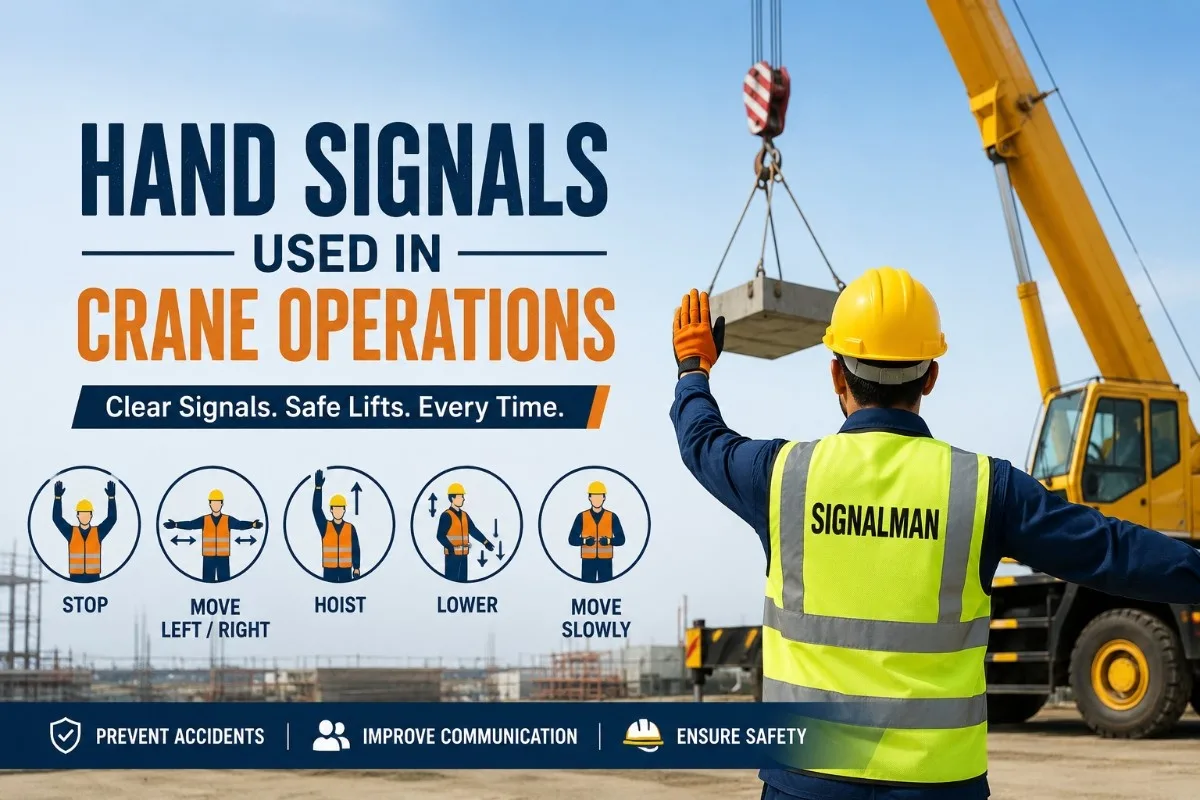
Cranes are used in construction sites, shipyards, warehousing, and other industrial facilities to ensure the safe and efficient lifting and transportation of materials. However, regardless of their heavy-lifting capabilities, cranes are only as good as the people who operate them. Moreover, the job of a crane operator is made harder by the fact that they cannot see heavy lifting around them when lifting goods. Hence, it is necessary to employ the help of signalmen.
Signalmen are the eyes of the crane operator, and their job is to communicate instructions through hand signals to ensure the safe lifting of materials. Hand signals are critical safety measures in crane operations because they ensure safe operation of the crane, minimize hazards to both the workers and the surroundings, and ensure smooth functioning of the lifting operation. In other words, mistakes during communication can cause property damage, equipment malfunction, personal injury, and even death.
Hand Signals Used in Crane Operations
Crane operators cannot see everything around them when lifting materials. Consequently, it is critical for them to have signals from the signalman. The following hand signals are commonly used when working with cranes.
Hoist
This signal is given by raising one’s forearm perpendicularly to the body and rotating the hand clockwise in a circular motion. This notifies the crane operator that they should raise the load.
Lower
This signal is similar to the ‘hoist’ signal, except that the signalman points their arms downwards signifying that the operator should lower the load.
Stop
The ‘stop’ signal entails raising one’s arm horizontally so that the palm is facing the operator. The signalman gives this signal to signify that the operator should stop all forms of crane movement.
Emergency
The ‘emergency’ signal is given by raising both arms horizontally so that the palms are facing the operator. This notifies the operator to stop all forms of crane movements immediately due to an unsafe hazard.
Swing
The swing signal involves the signalman pointing in the desired direction of the swing of the crane boom while making sure that all obstacles are clear. Similarly, the operator must ensure that the direction is clear of obstacles before swinging the boom.
Boom up & Boom down
These signals entail raising or lowering the boom using the arms to indicate the desired direction while making sure that the load being carried is not at risk of falling.
The signalman plays a crucial role in ensuring the smooth lifting of materials because they can communicate instructions to the crane operator, who cannot see everything around them. The following hand signals are commonly used in lifting operations: hoist, lower, stop, emergency, swing left or right, boom up, and boom down.
The Role of Designated Signalman in Crane Operations
Ideally, there should be one designated signalman for the crane operator unless in case of an emergency, where any worker can give the stop signal. The role of the designated signalman is to maintain constant communication between the lifting supervisor and the crane operator. It is critical for the signalman to have the operator’s full attention throughout the lifting operation.
However, the following factors can impede on the ability of the signalman to communicate effectively with the operator:
- Poor lighting at night.
- Long distance between the two workers.
- Poor visibility due to weather conditions such as rain, fog, and dust.
- Obstacles blocking the line of sight of the operator.
- Noise hindering the ability of the operator to hear the signalman.
When the signalman is unable to relay instructions to the operator effectively due to these factors, it is advisable to employ the use of radios for communication while ensuring that hand signals are maintained as the primary form of communication.
Common Mistakes Likely to Cause Accidents During Communication
Most lifting-related accidents are primarily caused by mistakes during communication between the signalman and the crane operator. Some of the common errors that can lead to accidents during communication include the following:
- Incorrect signal methods,
- working too far away from the operator,
- failing to give clear instructions,
- miscommunication due to simultaneous giving of instructions by multiple signalmen,
- working too close to the operator,
- failing to stop lifting operations when the view is obstructed.
Lifting operations also require regular practice of the communication techniques and training to prevent such mishaps.
Crane Operation: Communication During Lifting Activities
Various communication methods can be employed during lifting operations to ensure they are carried out smoothly without causing damage to property, injury to workers, equipment malfunction, and other related mishaps. However, the following procedures should be followed when communicating during lifting operations:
- Use of standard signals.
- The signalman should always maintain a clear view of the operator.
- A pre-lift briefing should be conducted to go through the communication procedures and ensure that everyone has a clear understanding.
Before carrying out any lifting operations, it is advisable to conduct a check on the communication devices and make sure that they are functional. If the connection between the signalman and the operator is lost at any point during lifting operations, it is advisable to halt the operation and identify the problem.
Before lifting the load, the signalman should inspect the worksite and make sure that it is free from hazards. At the same time, they should remain constantly aware of the workers and equipment around them to ensure that they avoid putting them at risk while swinging the boom.
In short, it is essential to put into place effective communication measures when conducting lifting operations because they reduce the likelihood of causing damage to property, injury to workers, equipment malfunction, and other related mishaps.
Why Training is Necessary to Ensure Proficiency with Hand Signals
- Although hand signals appear simple, learning them from a chart may not be sufficient.
- The communication methods can only be mastered through experience and practice.
Moreover, experience enables the signalman to be familiar with lifting operations, materials handling, and other related activities, thus enabling them to communicate more proficiently with the operator. Additionally, workers who have received professional training have the skills and confidence to identify and navigate the risks associated with lifting operations. With such skills, they can help ensure that lifting operations take place smoothly while minimizing the chances of causing damage to property, injury to workers, equipment malfunction, and other related mishaps.
Workers who are involved in lifting activities in Singapore should consider enrolling in the WSQ Perform Rigger and Signalman Task (PRST) course to gain practical knowledge about the field.
The course is ideal for workers who want to acquire knowledge to perform rigging and signaling tasks in accordance with the applicable standards to ensure operational safety. Some of the key areas that the course covers include the following: introduction to rigging, standard signals and communication procedures, and lifting operations and materials handling. By enrolling in the course and gaining a better understanding of the various aspects of crane operations and the use of hand signals for communication, workers can enhance their proficiency in the field and gain practical experience that will enable them to conduct lifting operations safely.
Conclusion
It is critical for signalmen to communicate effectively with the crane operator using hand signals because the operator may not have a clear view of the worksite. Hand signals promote smooth lifting operations and increase safety because they reduce the likelihood of causing damage to property, injury to workers, and equipment malfunction. As a result, it is essential to invest time in mastering the communication techniques and acquiring professional skills by enrolling in professional training programs.