
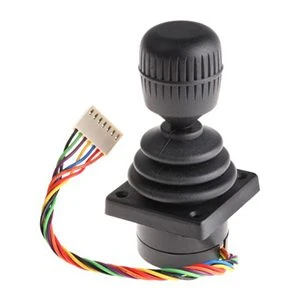
The way a joystick senses movement has a direct influence on how a machine responds, how predictable control feels, and how often adjustments are needed over time. While both traditional contact-based joysticks and Hall effect designs can perform well at startup, they tend to age very differently once vibration, temperature changes, and real duty cycles are introduced. Understanding that difference helps engineers choose a solution that remains stable long after commissioning.
A Hall Effect Joystick approaches position sensing without relying on physical electrical contact. Instead of sliding across a resistive surface, movement is detected through changes in a magnetic field. That difference changes how signals behave as hours accumulate and explains why some systems feel the same years later, while others slowly lose consistency.
How Traditional Joysticks Behave in Real Operation
Traditional joysticks typically rely on potentiometers or similar contact-based components to convert handle movement into an electrical signal. When new and correctly installed, these designs often feel smooth and responsive. Early commissioning checks usually confirm clean output and stable behavior across the working range.
Over time, normal use begins to influence performance. Electrical contact surfaces wear gradually, and small changes in resistance can show up as noise or drift, especially near neutral. In environments with vibration, dust, or temperature swings, this process can accelerate. These changes are often subtle at first, but they can affect fine control and lead to more frequent recalibration during service.
How Hall Effect Sensing Changes Long-Term Behavior
A Hall Effect Joystick avoids physical contact at the sensing point, which removes one of the main sources of signal change over time. Because there is no wiper or resistive track involved in measurement, repeated motion does not alter the electrical characteristics in the same way. As a result, output behavior tends to stay closer to its original baseline for a longer portion of the machine’s life.
This stability shows up most around neutral and during slow movements, because that is where small signal changes have the biggest effect on control. When the output stays smooth in that zone, the controller can hold a steady command without hunting, and operators feel the same response every time. Over longer service intervals, that steady behavior means fewer recalibration visits and a more consistent machine feel.
Accuracy, Resolution, and Control Consistency
Accuracy in joystick control is not only about nominal resolution. It is also about whether the same handle position produces the same electrical output today as it did months earlier. Contact-based designs can deliver good initial resolution, but effective accuracy may shift as wear alters the contact surface.
With a Hall Effect Joystick, the relationship between position and output tends to remain more stable because the sensing method does not change with use. This consistency helps maintain scaling and deadband behavior that were established during commissioning. For machines that rely on steady low-speed input or precise directional control, that stability supports smoother operation and more reliable repeatability.
Environmental and Mechanical Influences
Industrial environments place steady demands on joystick assemblies. Exposure to dust, moisture, vibration, and thermal cycling can affect both mechanical feel and signal quality. Contact-based designs can be more sensitive to contamination, especially when fine electrical tracks are involved.
Hall effect designs generally tolerate these conditions more effectively because the sensing elements are sealed and isolated from wear surfaces. Proper enclosure design, mounting stability, and strain relief still matter, but the sensing method itself removes one variable that commonly drives long-term signal change in traditional designs.
Commissioning and Service Over the Equipment Lifecycle
Commissioning practices play an important role regardless of joystick type. Neutral behavior, endpoint output, and smooth response through the working range should be verified and recorded as a baseline. For traditional designs, those baselines may need to be reviewed periodically as contact wear progresses.
With a Hall Effect Joystick, baseline readings tend to remain valid longer. When service is required, technicians can compare current behavior to the original data and focus on mechanical linkages, mounting shifts, or control settings rather than sensor degradation. That clarity shortens troubleshooting time and supports more confident maintenance decisions.
Why Choose ETI Systems for Joystick Applications
ETI Systems works with engineers and integrators who need joystick control that stays consistent in real machines, across real duty cycles. The work starts by understanding how the operator uses the controls, how sensitive the equipment is around neutral, and what stability is required during slow movement. From there, ETI Systems helps teams align the joystick choice with the full system, including mounting, wiring practices, sealing needs, and the controller input behavior that can influence signal quality.
ETI Systems brings a wider control-systems view shaped by decades of work with joysticks, actuators, and position feedback components in demanding environments. Customers benefit from practical application guidance, documentation that supports commissioning, and verification steps that can be repeated after service. When teams record baseline checks at startup and use the same checks after maintenance, control behavior stays predictable, and support stays focused on measurable results.
Frequently Asked Questions
What is the main difference between the Hall effect and traditional joysticks?
The main difference is how the position is sensed. Hall effect designs measure movement magnetically without contact, while traditional joysticks rely on physical electrical contacts.
Do Hall effect joysticks last longer in industrial use?
They often maintain stable signal behavior longer because the sensing method does not wear in the same way as contact-based designs.
Are traditional joysticks still suitable for some applications?
They can work well in lighter-duty environments or where long-term wear and fine control consistency are less critical.
What should be checked during joystick commissioning?
Verify neutral output, endpoints, and smooth response through the working range, then record those values as a baseline.
When should joystick performance be rechecked?
Performance should be rechecked after mechanical work, mounting changes, or if the control response no longer matches the original baseline.