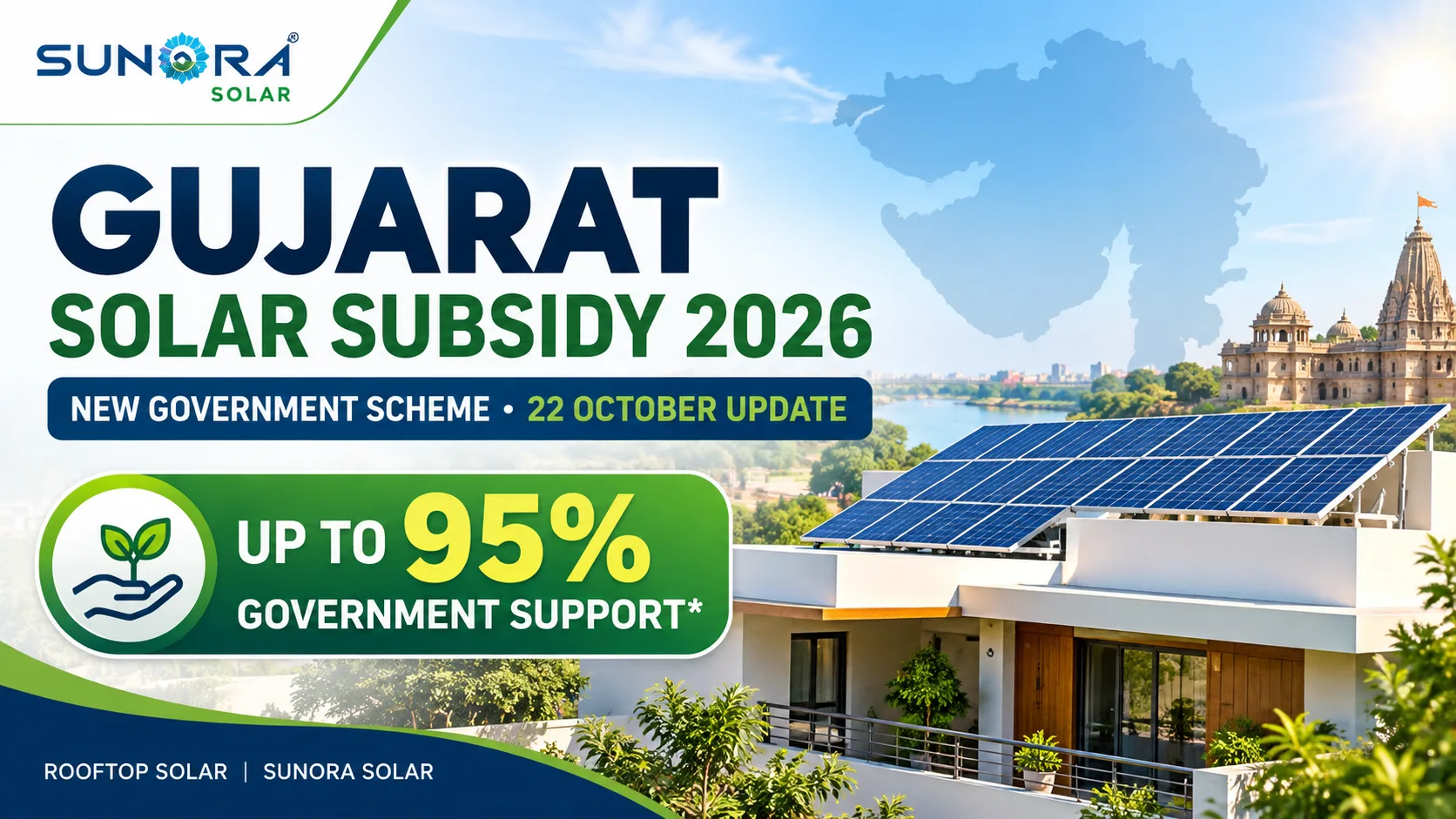
The Gujarat government has announced a major update to its rooftop solar subsidy programme on 22 October 2026, bringing significant financial relief to residential electricity consumers across the state. Under this new initiative, eligible households can receive additional financial assistance from the state government along with the existing subsidy available under the PM Surya Ghar: Muft Bijli Yojana.
This decision aims to make solar energy more affordable for middle-class families, low-income households and economically weaker sections. With the latest Gujarat Solar Subsidy 2026 update, general-category households will need to contribute only 10% of the applicable benchmark cost, while Scheduled Caste (SC) and Scheduled Tribe (ST) households will contribute just 5%, subject to scheme conditions.
The initiative is expected to benefit more than 3 lakh families across Gujarat, with an estimated government expenditure of approximately ₹1,000 crore. It is another important step towards encouraging rooftop solar adoption and reducing household electricity expenses.
For homeowners planning to install solar panels, understanding the new scheme, eligibility requirements and application process can help them make an informed decision.
What Is the New Gujarat Solar Subsidy Scheme 2026?
The new Gujarat rooftop solar subsidy is an additional financial assistance programme introduced by the state government under the existing PM Surya Ghar: Muft Bijli Yojana.
Previously, residential consumers could receive financial assistance from the central government to install rooftop solar systems. However, the initial investment could still be a challenge for many households.
To address this issue, the Gujarat government has introduced additional state-level financial support. Under the revised structure, the government will cover the eligible remaining installation cost after considering the central subsidy and the beneficiary's contribution.
The main objective of the Gujarat Solar Scheme 2026 is to make rooftop solar installations more accessible to households that want to generate their own electricity and reduce their dependence on conventional power sources.
According to the announcement, the new state assistance applies to eligible residential rooftop solar systems with an installed DC capacity of up to 2.18 kWp.
How Much Subsidy Can You Get Under the New Scheme?
One of the biggest benefits of the new Gujarat Solar Subsidy 2026 is the reduced financial contribution required from eligible households.
Under the revised subsidy framework:
- General Category: Consumers contribute 10% of the applicable benchmark cost.
- SC/ST Category: Eligible consumers contribute only 5% of the applicable benchmark cost.
- Government Assistance: The central and Gujarat state governments cover the remaining eligible amount through their respective subsidies.
This means eligible SC/ST households can receive government assistance covering up to 95% of the benchmark cost, while general-category households can receive assistance covering up to 90%.
It is important to understand that these percentages relate to the applicable benchmark cost, not necessarily every component of a solar installation quotation. Actual project prices may vary depending on system specifications, equipment and installation requirements.
Who Is Eligible for Gujarat Rooftop Solar Subsidy 2026?
Although the new subsidy provides substantial financial benefits, consumers must meet the applicable eligibility conditions.
The key eligibility requirements include:
- The applicant must be a residential electricity consumer in Gujarat.
- The rooftop solar installation must be eligible under the PM Surya Ghar: Muft Bijli Yojana.
- The installed solar system's DC capacity must not exceed 2.18 kWp for the additional state subsidy.
- The system must be commissioned on or after 22 October 2026.
- Eligible SC/ST applicants must provide the required category documentation to claim the applicable contribution benefit.
- The applicant must complete the required registration, installation and DISCOM verification procedures.
One important condition is that beneficiaries receiving the additional state subsidy cannot add further rooftop solar capacity for three years from the installation date.
Consumers who already have a rooftop solar system installed under an earlier programme may also qualify for additional assistance for further installation, provided their cumulative installed capacity remains within the prescribed 2.18 kWp limit and all other conditions are fulfilled.
These conditions should be verified before proceeding with an installation.
What Is the Difference Between the Central and Gujarat State Solar Subsidy?
Many homeowners are familiar with the PM Surya Ghar Yojana, but the latest Gujarat government announcement introduces additional financial support.
Here is how both contributions work:
1. Central Government Subsidy
The PM Surya Ghar: Muft Bijli Yojana provides Central Financial Assistance (CFA) to eligible residential consumers installing rooftop solar systems. The central subsidy is generally ₹30,000 per kW for the first 2 kW and an additional ₹18,000 for the third kW, subject to applicable scheme limits.
2. Additional Gujarat Government Subsidy
The Gujarat government provides additional financial assistance after accounting for the central subsidy and the beneficiary's prescribed contribution.
This additional support significantly reduces the initial investment required from eligible households.
Together, these two government support mechanisms make rooftop solar more affordable for residential electricity consumers in Gujarat.
How to Apply for the Gujarat Solar Subsidy 2026?
Homeowners interested in installing rooftop solar panels should follow the applicable PM Surya Ghar registration and installation process.
Here are the general steps:
Step 1: Register on the PM Surya Ghar Portal
Visit the official PM Surya Ghar website and register using your electricity consumer number, mobile number and other required details.
Official website: https://pmsuryaghar.gov.in/
Step 2: Select Your Solar System Capacity
Choose a suitable rooftop solar system based on your household's electricity consumption and the applicable subsidy eligibility conditions.
Step 3: Select an Eligible Solar Vendor
Choose an eligible registered vendor for your rooftop solar installation. Discuss the equipment specifications, project cost and applicable subsidy benefits before confirming the installation.
Step 4: Complete Solar Installation
After receiving the required approval, proceed with the installation. The system must meet the applicable technical and government requirements.
Step 5: Complete Inspection and Verification
Once installation is completed, the required inspection, net-metering and DISCOM verification procedures must be completed.
Step 6: Receive the Eligible Subsidy
After successful verification and completion of the required formalities, the applicable subsidy is transferred to the beneficiary's bank account through Direct Benefit Transfer (DBT), as per the scheme procedure.
For the additional Gujarat state subsidy, the state's distribution companies facilitate the payment process, while Gujarat Urja Vikas Nigam (GUVNL) coordinates the allocation of funds.
What Are the Benefits of Installing Rooftop Solar in Gujarat?
Apart from government financial assistance, rooftop solar systems offer several long-term advantages for residential consumers.
1. Reduced Electricity Bills
Solar panels generate electricity using sunlight, helping homeowners reduce their dependence on electricity supplied by the grid. Depending on energy consumption and system capacity, households can significantly reduce their monthly electricity expenses.
2. Lower Initial Investment
The combination of central and additional Gujarat government subsidies reduces the financial burden of installing rooftop solar. This makes solar energy more accessible to middle-class and economically weaker households.
3. Long-Term Electricity Savings
A properly designed and maintained rooftop solar system can generate electricity for many years. This helps homeowners manage their long-term electricity expenses.
4. Environmentally Friendly Energy
Solar energy is a renewable and clean source of electricity. By adopting rooftop solar, households can reduce their dependence on conventional electricity generation and contribute to a cleaner environment.
5. Greater Energy Independence
Generating electricity at home provides households with greater control over their energy consumption and helps reduce their dependence on conventional power sources.
Why Choose Sunora Solar for Your Rooftop Solar Installation?
Choosing the right solar installation company is an important step towards getting the best results from your investment. A properly designed solar system can help you achieve better energy generation, reliable performance and long-term savings.
Sunora Solar helps customers explore suitable solar solutions based on their electricity requirements, available rooftop space and budget.
Whether you are planning a new residential rooftop solar installation or want to understand the latest Gujarat Solar Subsidy 2026 benefits, getting professional guidance can make the process easier.
Our team can help you understand suitable system capacity, installation requirements, equipment options and the applicable government subsidy process.
Before finalising your solar installation, it is important to check your eligibility and understand all scheme conditions to avoid confusion during the application process.
Conclusion
The new Gujarat Solar Subsidy Scheme announced on 22 October 2026 is an important opportunity for residential electricity consumers looking to switch to solar energy. With the additional state government assistance, eligible general-category households need to contribute only 10% of the applicable benchmark cost, while eligible SC/ST households contribute just 5%.
The initiative is expected to make rooftop solar more affordable for thousands of families while supporting Gujarat's renewable energy goals.
If you are planning to install rooftop solar panels and want to understand how much subsidy you can receive, contact the Sunora Solar expert team today. Our team will help you understand the latest subsidy benefits, check your eligibility and find a suitable rooftop solar solution for your home.
Want to know more about this service? Please contact the Sunora Solar expert team for professional guidance and assistance with your solar installation.