
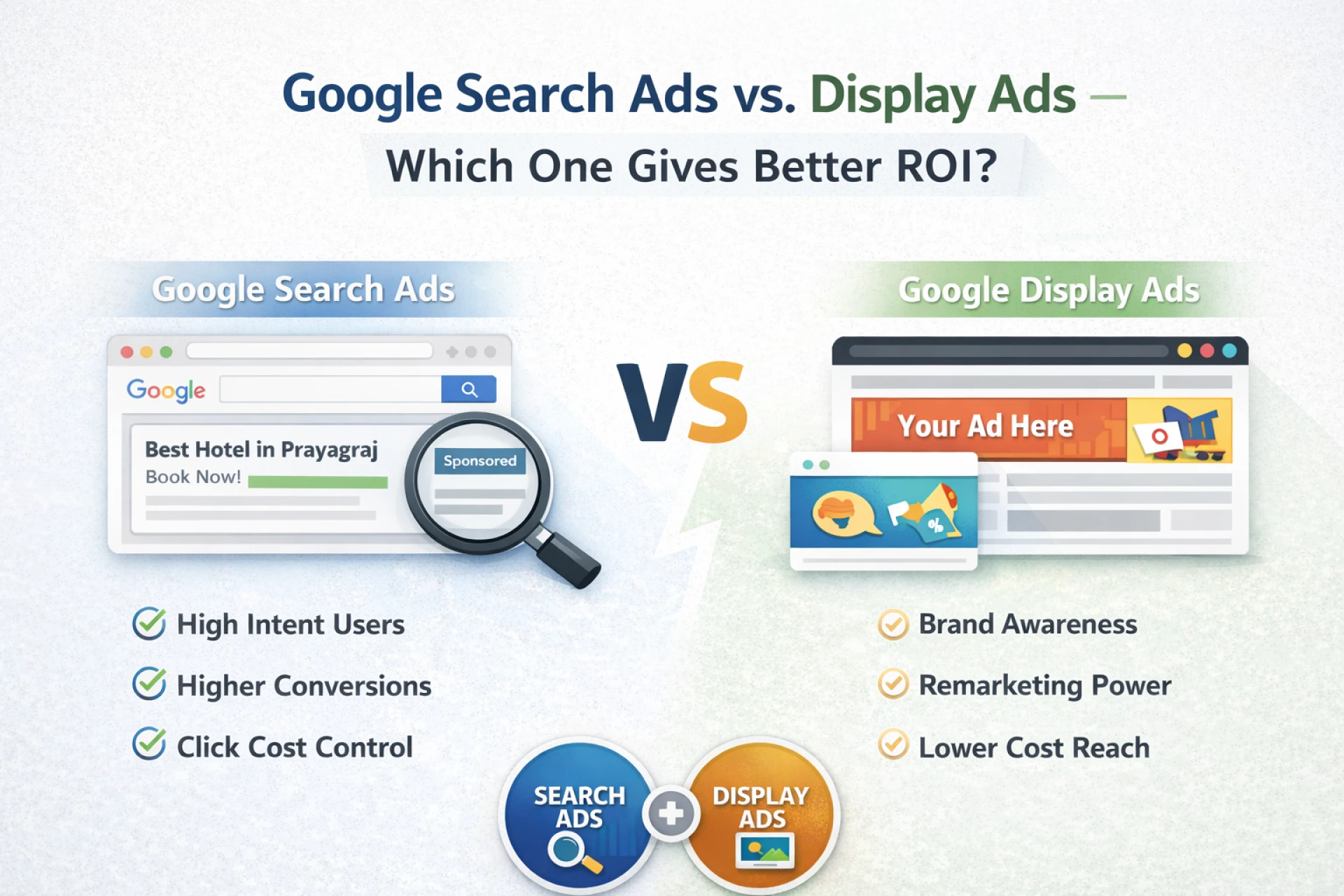
When businesses invest in online advertising, one of the most common questions they ask is whether Google Search Ads or Google Display Ads deliver better return on investment. Both ad formats are part of Google Ads, yet they work in very different ways and serve different marketing objectives.
Understanding the strengths, limitations, and ideal use cases of each is essential for businesses that want consistent leads, sales, and growth. As a performance-driven digital marketing agency Indore, we often help brands choose the right advertising strategy based on ROI, not assumptions.
In this detailed blog, we will break down Google Search Ads vs Display Ads, compare their ROI potential, and help you decide which option makes the most sense for your business.
What Are Google Search Ads?
Google Search Ads are text-based advertisements that appear at the top of Google search results when users actively search for specific keywords related to a product or service.
For example, when someone searches for “best hotel in Prayagraj” or “Google Ads agency near me,” the ads that appear at the top are Search Ads.
Search Ads are triggered by keywords, meaning they target users who already have intent. These users are actively looking for solutions, services, or products, which makes Search Ads extremely powerful for conversions.
Key characteristics of Google Search Ads include high intent traffic, strong lead quality, text-only format, and direct response-focused campaigns. They are best suited for businesses that want immediate inquiries, calls, or sales.
What Are Google Display Ads?
Google Display Ads are visual advertisements that appear across millions of websites, mobile apps, and YouTube channels that are part of the Google Display Network.
These ads can be in the form of banners, images, or responsive visual creatives. Display Ads are shown to users based on interests, browsing behavior, demographics, or previous interactions with a website.
Unlike Search Ads, Display Ads do not depend on keywords. Instead, they focus on audience targeting and brand exposure. This makes them ideal for increasing awareness and staying visible to potential customers.
Understanding ROI in Google Ads
ROI, or Return on Investment, measures how profitable your advertising campaigns are. In simple terms, ROI tells you whether you are earning more than you are spending on ads.
ROI does not always mean direct sales. For some businesses, ROI can be measured in cost per lead, phone calls, brand recall, or long-term customer value. This is especially important when comparing Search Ads and Display Ads, as they play different roles in the marketing funnel.
ROI Potential of Google Search Ads
Google Search Ads are widely considered the strongest performer when it comes to direct ROI.
The biggest advantage of Search Ads is user intent. When someone searches for a service or product, they are already interested. This intent leads to higher click-through rates, higher conversion rates, and better-quality leads.
Search Ads also deliver faster results. Campaigns can start generating leads on the same day they go live. This makes them ideal for businesses that want immediate visibility and measurable outcomes.
Another reason Search Ads deliver strong ROI is budget control. Advertisers can choose how much they want to spend daily and can pause or scale campaigns instantly based on performance.
However, Search Ads can be competitive. High-demand keywords often have higher cost per click, which means proper keyword research and optimization are critical.
ROI Potential of Google Display Ads
Google Display Ads typically have lower cost per click compared to Search Ads, but they also attract users with lower intent. This means direct conversions from cold Display traffic are usually lower.
Where Display Ads truly perform well is in brand awareness and remarketing. When users see your brand repeatedly across websites, it builds trust and familiarity. Over time, this increases the likelihood of conversions.
Remarketing Display Ads often generate very strong ROI because they target users who have already visited your website or interacted with your brand. These users are far more likely to convert than new visitors.
Display Ads are also useful for businesses that want mass reach at a low cost, especially in competitive industries where Search Ads are expensive.
Which One Delivers Better ROI?
In most cases, Google Search Ads deliver better direct ROI because they target users who are already searching for a solution. If your primary goal is leads or sales, Search Ads usually outperform Display Ads.
However, Display Ads should not be ignored. While they may not convert immediately, they play a critical role in supporting conversions, improving brand recall, and reducing overall cost per acquisition through remarketing.
From our experience as a google ad agency Indore, the most successful campaigns are not built on a single ad format. They use both Search and Display Ads strategically.
When Google Search Ads Are the Better Choice
Google Search Ads work best when your business offers a service or product that people actively search for. They are ideal if you want fast results, high-quality leads, and clear performance metrics.
Industries such as hotels, real estate, clinics, educational institutes, and professional services often see excellent ROI from Search Ads. Local businesses also benefit greatly from search-based advertising because users frequently look for services near them.
Many companies seeking immediate growth choose Search Ads as their primary channel when working with the best google ad agency in Indore.
When Google Display Ads Make More Sense
Google Display Ads are a better choice when your goal is to build awareness, launch a new brand, or stay visible to previous visitors.
Display Ads are especially powerful for remarketing campaigns, where ads are shown to users who have already interacted with your website. These campaigns often deliver strong ROI at a lower cost.
Display Ads are also useful for supporting Search Ads by keeping your brand top-of-mind until users are ready to convert.
The Best ROI Strategy: Using Search and Display Together
Instead of choosing between Search Ads and Display Ads, businesses should focus on using both as part of a complete marketing funnel.
Search Ads capture users with high intent, while Display Ads support them through remarketing and brand visibility. This combination improves overall conversion rates and reduces cost per lead over time.
Most performance-focused advertisers structure campaigns in this way to maximize ROI and long-term growth.
Budget Allocation for Maximum ROI
For most small and medium-sized businesses, allocating a higher budget to Search Ads makes sense initially. A smaller portion can be assigned to Display Ads for remarketing and awareness.
As data and conversions increase, budgets can be adjusted to focus more on what delivers the strongest results.
Common Mistakes That Reduce ROI
Many businesses fail to get good ROI from Google Ads due to poor strategy and execution. Common mistakes include running Display Ads without remarketing, choosing the wrong keywords for Search Ads, ignoring conversion tracking, and sending traffic to poorly designed landing pages.
Avoiding these mistakes alone can significantly improve ROI.
Role of Landing Pages in ROI
No matter how good your ads are, ROI depends heavily on your landing pages. A high-converting landing page should load quickly, be mobile-friendly, clearly explain your offer, and include strong calls to action.
Search Ads and Display Ads both perform better when paired with optimized landing pages.
Search Ads vs Display Ads for Local Businesses
Local businesses usually see stronger ROI from Search Ads because users search with high intent phrases such as “near me” or “best service provider.” This makes Search Ads ideal for generating calls and inquiries.
That is why many local brands partner with a reliable digital marketing agency Indore to start with Search Ads before expanding into Display campaigns.
Measuring ROI Correctly
To accurately measure ROI, businesses should track cost per lead, conversion value, assisted conversions, and lifetime customer value. Display Ads often assist conversions rather than generate them directly, so attribution tracking is essential.
Final Conclusion
Google Search Ads and Google Display Ads serve different purposes, but both are essential for a well-rounded advertising strategy.
Search Ads generally deliver higher direct ROI due to strong user intent, while Display Ads support brand awareness and remarketing, which improves long-term profitability.
Businesses that work with the best google ad agency in Indore understand that the real power of Google Ads lies in using Search and Display together, not choosing one over the other.
With the right strategy, optimization, and tracking, both ad formats can drive sustainable growth and consistent ROI.