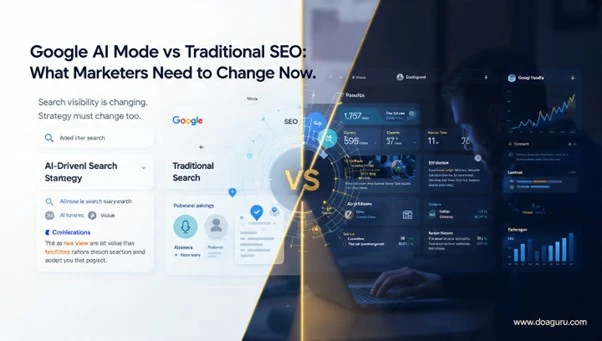
Google AI Mode vs Traditional SEO: What Marketers Need to Change Now
Introduction
Search has not changed fundamentally in over a decade. Google's AI Mode- the conversational, summary-first interface now rolling out across its search products- is not a feature update. It is a structural shift in how people receive information from Google. And for businesses that depend on organic search traffic, the implications are significant.
The traditional SEO playbook was built around a specific model: optimise your pages, rank in the top ten results, earn clicks, convert visitors. Google AI Mode disrupts that model at the first step. If the search engine generates a direct AI-powered answer to a user's query, a large proportion of users never scroll to the blue links below. They get their answer from the AI summary and move on.
This is called a zero-click experience, and it is becoming increasingly common. So the question every marketer and business owner should be asking is: what do we do now?
As the best SEO company in Jabalpur, DOAGuru Infosystems has been closely studying how AI Mode functions, which types of content it favours, and what practical changes businesses need to make to remain visible in this new search environment.
Understanding How Google AI Mode Works
Google AI Mode uses the company's Gemini models to generate responses to search queries by synthesising information from multiple sources across the web. Rather than presenting a ranked list of links, it presents a coherent answer, often with citations embedded in the text. Those citations are where the opportunity lies for businesses and content creators.
Being cited in an AI Mode response is the new equivalent of ranking on page one. The logic shifts from keyword density and backlink count to something more nuanced: does your content actually answer the question in a clear, accurate, and well-structured way? Is your site trustworthy enough for Google to cite?
The factors that influence citation in AI Mode responses align closely with what Google calls E-E-A-T: Experience, Expertise, Authoritativeness, and Trustworthiness. These are not new concepts in SEO, but AI Mode makes them more important than they have ever been.
What Traditional SEO Gets Right -- and Where It Falls Short
Traditional SEO fundamentals still matter. Technical health of your website, page load speed, mobile optimisation, structured data markup, clean URL structures -- none of this has become irrelevant. In fact, AI Mode relies on Google's ability to accurately crawl and understand your content, which makes technical SEO even more foundational.
Where traditional SEO falls short is in its overemphasis on keywords and volume metrics at the expense of genuine content quality. For years, the question was: how often should I use this keyword? The better question -- and the one AI Mode rewards -- is: does this piece of content genuinely serve someone who has this question?
Content that is thin, overly optimised for keywords, or written to a formula rather than to an audience will not perform well in an AI Mode world. Google's models are increasingly good at distinguishing between content that informs and content that merely mimics the structure of informative content.
Five Specific Changes Marketers Need to Make
1. Shift from Keyword Targeting to Question Answering
Map your content to specific, well-defined questions your audience is asking, not just keyword phrases. Long-tail, conversational queries are what AI Mode handles most often. Structure your content to directly answer a clear question, then expand with context, evidence, and practical detail.
2. Build Author Credibility and Source Authority
AI Mode favours content from sources that demonstrate genuine expertise. This means publishing content with real author bylines, linking author profiles to credentials, earning mentions on trusted external sites, and ensuring your About and Contact pages reflect a legitimate, established business. Google needs to trust your source before it will cite it.
3. Use Structured Data More Aggressively
FAQ schema, HowTo schema, Article schema, and Review schema all help Google's models understand and categorise your content. If your content answers questions in a structured format and you have marked it up correctly, it is significantly more likely to be pulled into an AI-generated response.
4. Optimise for Passage-Level Relevance
AI Mode does not need your entire page to be relevant -- it needs specific passages within your page to be highly relevant to specific queries. This changes how you should write. Clear headings, concise paragraph structure, and direct language within each section matter more than overall page word count.
5. Diversify Traffic Sources
Any business that is entirely dependent on Google organic traffic is carrying significant risk in 2026. Email marketing, social media, YouTube, podcasts, community building -- these are not alternatives to SEO. They are complementary channels that reduce your exposure to any single algorithmic shift.
The Local SEO Angle
There is one area where AI Mode has not yet displaced traditional results significantly, and that is local search. Queries with local intent -- "best digital marketing company in Jabalpur," "SEO agency near me," "graphic design services in Jabalpur" -- still return Google Maps results, Google Business Profile listings, and local pack entries prominently.
This means that for businesses serving a specific geographic market, local SEO remains one of the highest-return investment areas. Keeping your Google Business Profile accurate and active, collecting genuine reviews, ensuring NAP (name, address, phone) consistency across directories, and publishing locally relevant content are all practices that continue to drive results regardless of how AI Mode evolves.
What This Means for Your SEO Strategy
The businesses that will hold and grow their organic visibility through this transition are the ones that have always done SEO correctly: creating content with genuine depth, building real authority through backlinks and mentions, and maintaining technically sound websites. Those who have chased shortcuts will feel the impact more sharply.
If you are unsure where your current SEO strategy stands in relation to these changes, that uncertainty is worth resolving quickly. The longer you wait, the further competitors who are adapting will move ahead.