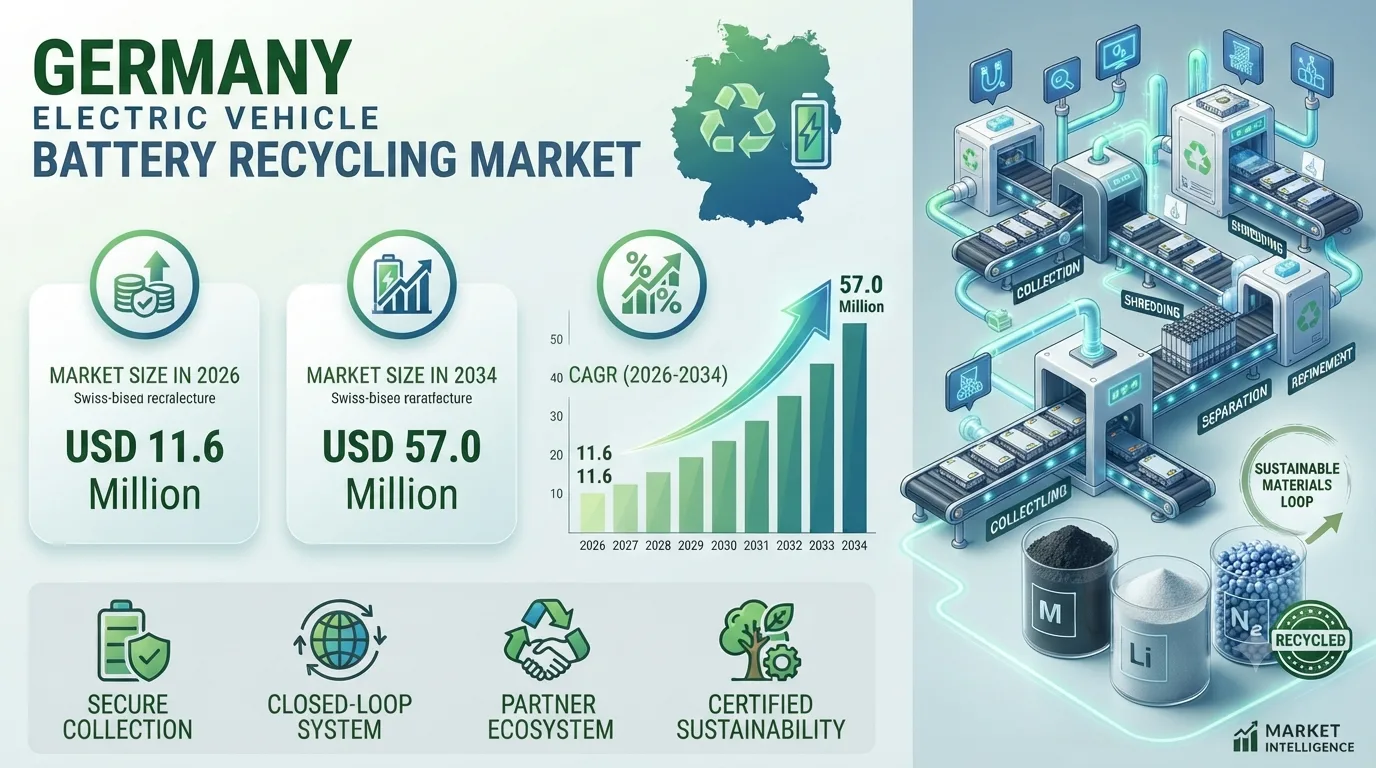
The Germany electric vehicle battery recycling market is witnessing strong growth driven by stringent EU regulatory frameworks, a rapidly expanding electric vehicle (EV) fleet, and fast-moving advances in closed-loop recycling technologies. The market grew from USD 9.1 Million in 2025 to USD 11.6 Million in 2026 and is projected to reach USD 57.0 Million by 2034, exhibiting a compound annual growth rate (CAGR) of 22.00% during 2026-2034. Germany’s battery-electric passenger car fleet crossed 2 million vehicles at the start of 2026, new battery-electric registrations reached a record 37% share of the new car market in October 2026, and the EU Batteries Regulation is raising lithium, cobalt, copper and nickel recovery targets from 2027 onward. Together, these factors are building a large and predictable stream of end-of-life batteries and production scrap for domestic recyclers. This market is strategically important to Germany’s economy as it protects the country’s automotive industry from raw-material supply risk, reduces dependence on imported critical minerals, and supports its circular-economy and climate goals.
The Germany electric vehicle battery recycling market is poised for sustained expansion, supported by binding EU recycling and recovery targets, a growing EV fleet, and fresh capacity from BASF, Mercedes-Benz, cylib and other players. With a projected CAGR of 22.00% through 2034, the market presents significant opportunities for established recyclers, automakers pursuing closed-loop supply chains, and new technology entrants focused on high-recovery hydrometallurgical and direct recycling solutions.
GERMANY ELECTRIC VEHICLE BATTERY RECYCLING MARKET SUMMARY
- Market Definition: The Germany electric vehicle battery recycling market covers the collection, discharge, dismantling, mechanical treatment and chemical refining of end-of-life EV batteries and battery production scrap, in order to recover valuable materials such as lithium, nickel, cobalt, manganese, copper and aluminium for reuse in new batteries.
- Market Ecosystem: The ecosystem includes automakers and battery manufacturers, collection and logistics providers, dismantling and pre-treatment (“spoke”) facilities producing black mass, hydrometallurgical and pyrometallurgical refiners (“hubs”), cathode active material producers, research institutes, and regulators.
- Major Segments: The market is segmented by type (lithium-ion, lead-acid, and others), process (hydrometallurgical, pyro-metallurgical, and others), vehicle type (passenger cars and commercial vehicles), application (electric cars, electric buses, energy storage systems, and others), and region (Western, Southern, Eastern and Northern Germany).
- Market Size: USD 9.1 Million in 2025, USD 11.6 Million in 2026, and a forecast of USD 57.0 Million by 2034 at a CAGR of 22.00% during 2026-2034.
- Regulatory Backdrop: The EU Batteries Regulation requires lithium-based battery recycling efficiency of 65% by the end of 2025 and 70% by the end of 2030, material recovery of 50% for lithium and 90% for cobalt, copper and nickel by the end of 2027 (rising to 80% and 95% by the end of 2031), and minimum recycled content of 16% cobalt, 6% lithium and 6% nickel in new EV batteries from August 2031.
- EV Fleet Momentum: Germany registered 545,142 new battery-electric passenger cars in 2025, more than 368,000 in the first half of 2026 (up 48% year on year), and its battery-electric fleet stood at about 2.03 million vehicles at the start of 2026, creating the feedstock base for future recycling volumes.
- Technology Shift: The industry is moving from basic black mass production toward integrated mechanical-hydrometallurgical processing, direct recycling, AI-assisted sorting and disassembly, and recycling routes for next-generation chemistries such as sodium-ion.
PORTER'S FIVE FORCES ANALYSIS – GERMANY ELECTRIC VEHICLE BATTERY RECYCLING MARKET
The competitive dynamics of the Germany electric vehicle battery recycling market can be analyzed using Porter’s Five Forces framework.
Porter's Five Forces Analysis – Germany Electric Vehicle Battery Recycling Market
- Competitive Rivalry: Moderate to High. Chemical majors (BASF), automakers (Mercedes-Benz), global recyclers (Li-Cycle under Glencore, Redux under Redwood Materials, Umicore) and well-funded start-ups (cylib, Duesenfeld, Primobius) are all building capacity for the same limited feedstock. Rivalry centers on securing OEM and gigafactory scrap contracts and on achieving the highest metal recovery rates. Business implication: players must differentiate through recovery yield, secured feedstock agreements, and integration across the value chain.
- Bargaining Power of Suppliers (Feedstock Providers): Moderate to High. Automakers, cell manufacturers and dismantlers control access to end-of-life batteries and production scrap, which today make up the bulk of recycling input. Until large volumes of EV batteries reach end of life after 2030, feedstock owners can negotiate favorable terms. Business implication: recyclers should lock in long-term take-back and offtake partnerships with OEMs and battery makers.
- Bargaining Power of Buyers (Cathode Makers, Battery Manufacturers and OEMs): Moderate. Buyers of recovered metals and battery-grade materials are few and technically demanding, and they benefit from recycled-content mandates that raise the value of certified recycled output. Business implication: producing battery-grade, traceable materials supported by battery passport data strengthens pricing power.
- Threat of Substitutes: Low to Moderate. Primary mining and imported refined materials, second-life reuse of EV batteries in stationary storage, and export of black mass to Asia are alternatives to domestic recycling, but binding recycled-content rules, hazardous-waste controls on black mass, and supply-security concerns limit their impact. Business implication: recyclers should position domestic recycling as the lower-risk, regulation-aligned source of critical raw materials.
- Threat of New Entrants: Moderate. Hydrometallurgical refining requires heavy capital, process know-how, and permits under Germany’s Federal Immission Control Act, which raise entry barriers. However, strong public and private funding and technology spin-outs continue to attract new entrants. Business implication: incumbents should protect their position through process IP, scale, and early access to feedstock.
Competitive Rivalry – Moderate to High (Healthy)
- Competition spans integrated chemical groups (BASF), automaker-owned plants (Mercedes-Benz), international recyclers (Li-Cycle/Glencore, Redwood Materials/Redux, Umicore) and German technology specialists (cylib, Duesenfeld, Primobius, Accurec), driving differentiation through recovery rates, process innovation, and closed-loop partnerships rather than price alone.
- BASF’s commercial black mass plant in Schwarzheide (up to 15,000 tons per year), Mercedes-Benz’s in-house recycling plant in Kuppenheim, and cylib’s Dormagen and Bavaria projects reflect active capacity build-out and strategic repositioning that is strengthening the overall market ecosystem.
Request for Sample Report: https://www.imarcgroup.com/germany-electric-vehicle-battery-recycling-market/requestsample
MARKET GROWTH DRIVERS:
Several key factors are propelling the expansion of the Germany electric vehicle battery recycling market. Stringent EU and German regulatory frameworks are the most powerful driver. The EU Batteries Regulation sets recycling efficiency targets of 65% for lithium-based batteries by the end of 2025, rising to 70% by the end of 2030, and requires lithium recovery of 50% by the end of 2027 and 80% by the end of 2031, alongside 90% to 95% recovery for cobalt, copper and nickel. Minimum recycled content in new EV batteries of 16% cobalt, 6% lithium and 6% nickel from August 2031, together with the digital battery passport, pushes automakers and cell makers to source certified recycled material. Additionally, the expanding EV fleet is creating a substantial future waste stream. Germany’s battery-electric car fleet passed 2 million at the start of 2026, and the new federal EV incentive, which opened for applications in May 2026, helped lift first-half registrations by 48% and pushed the battery-electric share of new registrations to a record 37% in October 2026.
MARKET GROWTH DRIVERS:
The Germany electric vehicle battery recycling market is also benefiting from accelerating technological advancement and a strong industrial base. Recyclers are developing direct recycling, which recovers more material with less energy, along with AI-assisted sorting, robotic disassembly and automation that improve precision and lower costs. Closed-loop supply chains are gaining momentum as automakers integrate recycling into their own operations, with Mercedes-Benz opening Europe’s first battery recycling plant with an integrated mechanical-hydrometallurgical process in Kuppenheim in October 2024. Furthermore, growing industrial capacity and supply-security priorities are attracting investment. BASF began commercial black mass production in Schwarzheide in 2025, cylib is building a 30,000-ton-per-year hydrometallurgical facility in Dormagen, and recycling is increasingly viewed as a way to reduce Europe’s dependence on imported lithium, nickel and cobalt. Forward-looking projects, such as the 25-partner SIB:DE consortium developing recycling for sodium-ion batteries, show that circularity is being built into new battery chemistries from the start.
GERMANY ELECTRIC VEHICLE BATTERY RECYCLING MARKET SEGMENTATION
Segmentation analysis provides a detailed view of the Germany electric vehicle battery recycling market by category:
- Type Insights: Lithium-ion, Lead-acid, Others.
- Process Insights: Hydrometallurgical, Pyro-metallurgical, Others.
- Vehicle Type Insights: Passenger Cars, Commercial Vehicles.
- Application Insights: Electric Cars, Electric Buses, Energy Storage Systems, Others.
- Regional Insights: Western Germany, Southern Germany, Eastern Germany, Northern Germany.
COMPETITIVE LANDSCAPE
The Germany electric vehicle battery recycling market features a competitive landscape that combines chemical and automotive majors, international recyclers, and fast-growing German technology specialists. Key companies operating in the market include:
- BASF SE
- Mercedes-Benz Group AG
- Li-Cycle Holdings Corp. (Glencore plc)
- cylib GmbH
- Redux Recycling GmbH (Redwood Materials, Inc.)
- Duesenfeld GmbH
- Primobius GmbH
- Accurec Recycling GmbH
- Umicore SA
Strategic developments are shaping the competitive arena, notably BASF’s start of commercial black mass production in Schwarzheide (June 2025), Mercedes-Benz’s in-house recycling plant in Kuppenheim (October 2024), Li-Cycle’s exclusive feedstock agreement with a luxury EV manufacturer for its German Spoke facility (January 2025), Glencore’s takeover of Li-Cycle (August 2025), and cylib’s acquisition of a Bavarian pre-processing plant with up to 10,000 tons of annual capacity (July 2026).
REGIONAL ANALYSIS:
Regional dynamics within the Germany electric vehicle battery recycling market are shaped by the location of automotive manufacturing, battery production, and recycling infrastructure across the country.
- Western Germany: Home to North Rhine-Westphalia’s chemical and industrial clusters, the region hosts cylib’s hydrometallurgical facility under construction in Dormagen and benefits from dense logistics links and Rhine-corridor access to feedstock.
- Southern Germany: Anchored by the automotive heartland of Baden-Württemberg and Bavaria, the region combines OEM-led closed-loop recycling, such as Mercedes-Benz’s Kuppenheim plant, with new pre-processing capacity from cylib in Wernberg-Köblitz, giving it direct access to large vehicle and battery supply chains.
- Eastern Germany: A growing battery value-chain hub, with BASF’s black mass plant, prototype metal refinery and cathode material production in Schwarzheide, Li-Cycle’s German Spoke facility, and proximity to large cell and vehicle manufacturing sites.
- Northern Germany: Supported by Lower Saxony’s research-driven recyclers such as Duesenfeld, the automotive base around Salzgitter and Wolfsburg, and the port logistics of Hamburg and Bremen for black mass and material flows.
RECENT INDUSTRY DEVELOPMENTS
July 2026: cylib acquired a battery pre-processing facility in Wernberg-Köblitz, Bavaria, with capacity of up to 10,000 metric tons per year of end-of-life EV batteries, with operations planned for the fourth quarter of 2026 subject to approval under the Federal Immission Control Act. The site will supply black mass to cylib’s hydrometallurgical plant in Dormagen.
May 2026: The online portal for Germany’s new EV purchase incentive opened, offering direct grants for new battery-electric and other electrified vehicles and supporting a sharp rise in registrations.
April 2026: cylib joined a 25-partner German consortium (SIB:DE) to develop Europe’s first industrial recycling process for sodium-ion batteries.
February 2026: Fraunhofer ISC revealed ‘ProBatman’, a collaborative project on direct battery recycling.
June 2025: BASF started commercial operation of its black mass plant in Schwarzheide, with an annual capacity of up to 15,000 tons of end-of-life lithium-ion batteries and production scrap, equal to roughly 40,000 EV batteries.
January 2025: Li-Cycle Holdings Corp. announced a new exclusive recycling agreement with a high-performance luxury EV manufacturer for its Germany Spoke facility, supplying feedstock sourced from Germany.
October 2024: Mercedes-Benz opened Europe’s first battery recycling plant with an integrated mechanical-hydrometallurgical process in Kuppenheim, southern Germany, becoming the first car manufacturer worldwide to close the battery recycling loop with its own in-house facility.
Key Aspects Required for the Germany Electric Vehicle Battery Recycling Market
- Market Performance: USD 9.1 Million in 2025 and USD 11.6 Million in 2026, with a projected trajectory to USD 57.0 Million by 2034.
- Market Outlook: A 22.00% CAGR during 2026-2034 indicates robust growth across lithium-ion and lead-acid recycling, hydrometallurgical and pyro-metallurgical processes, and passenger car, commercial vehicle and energy storage applications.
- Growth Drivers: EU Batteries Regulation targets for recycling efficiency, material recovery and recycled content; a battery-electric fleet above 2 million vehicles supported by a new federal EV incentive; technological advances in direct recycling, automation and AI sorting; and automaker and industrial investment in closed-loop supply chains.
- Competitive Landscape: A multi-tier structure with chemical and automotive majors (BASF, Mercedes-Benz), international recyclers (Li-Cycle/Glencore, Redwood Materials/Redux, Umicore), and German technology specialists (cylib, Duesenfeld, Primobius, Accurec), with competition centered on feedstock access and recovery performance.
- Value Chain Analysis: From EV battery collection and logistics through discharge and dismantling, mechanical processing into black mass, hydrometallurgical or pyro-metallurgical refining, production of cathode materials and precursors, and reuse in new battery manufacturing.
- Industry Trends: Shift from standalone black mass production toward integrated mechanical-hydrometallurgical plants; direct recycling gaining attention; AI and robotics in disassembly; tighter controls on black mass as hazardous waste keeping feedstock in the region; and early development of recycling routes for sodium-ion batteries.
- Strategic Recommendations: Secure long-term feedstock agreements with automakers and cell manufacturers; invest in high-recovery hydrometallurgical and direct recycling capacity; align output with recycled-content and battery passport requirements; pursue partnerships that link recyclers with cathode producers; and plan capacity in step with the growth in end-of-life volumes after 2030.
Note: If you need any specific information that is not covered currently within the scope of the report, we will provide the same as a part of customization.
Report Format, Delivery, and Customization Details
- Report Format Mode: PPT, PDF, and Excel
- Report Delivery Mode: Online Delivery, Physical Delivery
- Report Delivery Time: Report Delivered Over Email within 24 to 48 hours. If requested by the client, a physical copy will be delivered within three to ten days.
- Report Confirmation Mode: Yes via Email
- Report Customization Mode: Yes via Email / Call
- Report Table of Content: Yes
- Report List of Figures: Yes
- Report Methodology Mode: Yes
- Request For Sample Report: Yes