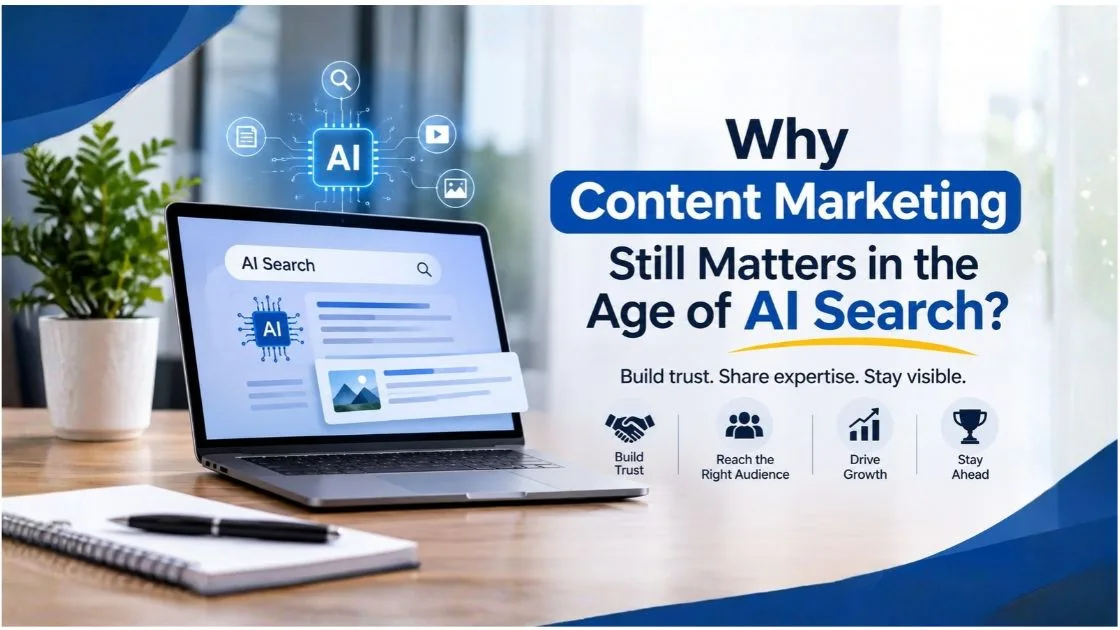
Search is changing faster than at any time in the last twenty years. Your customers are no longer just typing keywords into Google and scrolling through ten blue links. They're asking ChatGPT for recommendations, reading Google's AI Overviews, and comparing options on Perplexity and Gemini before they ever visit a website.
This creates a new question for every business: when someone asks an AI tool about your industry, does your brand get mentioned?
That's what generative engine optimization (GEO) is about. In this guide, you'll learn what GEO is, how it differs from traditional SEO, and eight practical steps to improve your brand's visibility in AI-powered search.
What Is Generative Engine Optimization?
Generative engine optimization is the practice of making your brand, content and expertise easy for AI systems to find, understand, trust and cite in their answers.
Traditional SEO aims to rank a web page in search results. GEO aims to get your brand included inside the answer itself. When an AI tool writes "Here are some trusted agencies for..." or "According to...", GEO is the work that helps your name appear there.
GEO vs SEO: What's the Difference?
GEO doesn't replace SEO. It builds on it. AI tools still rely heavily on content that search engines already find, crawl and trust. But the goal and the signals shift.
- Goal: SEO aims for a high ranking position. GEO aims to be mentioned or cited in AI answers.
- Content style: SEO focuses on keywords and pages. GEO focuses on clear answers, facts and expertise.
- Trust signals: SEO relies on backlinks and technical health. GEO also relies on brand mentions, reviews and consistency across the web.
- Success metric: SEO measures clicks and rankings. GEO measures brand mentions, citations and assisted conversions.
The simplest way to think about it: SEO gets you found, GEO gets you recommended.
Why GEO Matters for Businesses Right Now
AI answers often satisfy the user without a click. If your brand isn't part of that answer, you can lose visibility even while your rankings look stable. Early adopters also have an advantage, because most businesses haven't started optimizing for AI search yet. The brands that build authority now will be the ones AI tools learn to trust.
8 Practical Steps to Improve Your AI Search Visibility
1. Build a Strong SEO Foundation First
AI tools can't cite what they can't find. Make sure your website loads fast, works well on mobile, has clean URLs, and can be crawled without errors. If you're unsure where your site stands, start with a 10-step website audit checklist to uncover technical issues before you work on GEO.
2. Answer Questions Directly and Clearly
AI systems look for content that answers questions cleanly. Structure your pages around real customer questions and give a direct, two-to-three sentence answer near the top of each section, then add detail below. Use clear headings like "What is...", "How much does... cost" and "How to choose...".
3. Show Real Expertise and Experience
Generic content is easy for AI to ignore. Content with first-hand experience, original data, real examples and named authors is far more likely to be trusted. Add author bios, share what you've learned from actual projects, and publish case studies with real results.
4. Use Structured Data (Schema Markup)
Schema markup helps machines understand what your content means. Add Organization, LocalBusiness, Article, FAQ, Product and Review schema where relevant. It clarifies who you are, what you offer and why you're credible.
5. Keep Your Brand Information Consistent Everywhere
AI tools build their understanding of your brand from many sources. Your name, services, location and description should match across your website, Google Business Profile, LinkedIn, directories and social profiles. Inconsistent information creates confusion, and confusion reduces trust.
6. Earn Mentions on Trusted Websites
Being mentioned on respected industry sites, news platforms, podcasts and community forums signals authority. Focus on genuine value: expert commentary, guest articles, research and partnerships. Mentions of your brand, even without a link, can help AI systems connect your name with your expertise.
7. Collect and Showcase Reviews
Reviews on Google, Clutch, G2, Trustpilot or industry platforms act as social proof for people and machines alike. Ask happy clients for detailed reviews that mention the specific service you provided.
8. Track Your AI Visibility
Regularly ask ChatGPT, Gemini, Perplexity and Google's AI Mode the questions your customers ask. Note whether your brand appears, which competitors are mentioned, and which sources are cited. Track referral traffic from AI tools in Google Analytics 4 and watch for changes over time.
A Real-World Example
For an industry trade expo, combining technical SEO, structured content and authority building helped improve the event's visibility in both traditional and AI-powered search. You can read the full approach in this GEO case study.
Common GEO Mistakes to Avoid
- Writing only for keywords instead of real questions
- Publishing thin, AI-generated content with no original insight
- Ignoring technical SEO and slow page speed
- Having outdated or conflicting business information online
- Measuring only rankings and ignoring brand mentions
Frequently Asked Questions
What is generative engine optimization in simple words?
Generative engine optimization is the process of improving your content and online presence so AI tools like ChatGPT, Gemini and Google AI Overviews mention or cite your brand in their answers.
Is GEO replacing SEO?
No. GEO builds on SEO. A strong SEO foundation remains essential because AI systems rely on content that is crawlable, trusted and well-structured.
How long does GEO take to show results?
GEO is a long-term strategy. Many businesses notice early changes in a few months, but consistent authority building over 6 to 12 months usually delivers the strongest results.
Can small businesses benefit from GEO?
Yes. Small and local businesses can stand out by answering specific customer questions, keeping their business information consistent, and building strong reviews. These are areas where large competitors are often weaker.
Final Thoughts
AI search is changing how customers discover brands, but the fundamentals still matter: be useful, be clear, be consistent, and be trusted. Businesses that combine strong SEO with GEO now will be the names AI tools recommend tomorrow.
If you want expert help building visibility across Google and AI search, explore these SEO and GEO services designed to help brands grow in the new era of search.