Start with our A Complete Guide to Artificial Intelligence . You’ve felt it — the excitement, the pressure, the quiet fear that the skills you’ve built could change overnight. If you want to level up as a business analyst, move toward being a Data scientist, or earn a meaningful professional certification, understanding generative artificial intelligence is the single most practical move you can make right now.
I’ll give you a concise, experience-driven playbook: what generative artificial intelligence does, five practical ways to use it this week, the skills that will actually earn you promotions, and a 90-day plan that converts small wins into visible impact. This is written for people who want clear, usable steps — not vague theory.
What generative artificial intelligence means for your day-to-day
In plain terms, generative artificial intelligence describes models that create content from prompts: summaries, code snippets, visuals, and structured outputs. For analysts and data teams, that means drafts of reports, code scaffolds to speed experimentation, and faster ways to test hypotheses.
This change is not academic. Organizations are moving from pilots to real deployment and measuring ROI: enterprise reports document growing usage and measurable productivity effects. That’s why learning to apply generative artificial intelligence responsibly is a career multiplier, not just a technical curiosity.
Five practical ways to use generative artificial intelligence this week
You don’t need to be a Machine learning engineer to benefit. Here are immediate, low-risk use cases you can implement now:
1. Rapid hypothesis generation
Ask a model to list five plausible drivers for a KPI change, then turn those into SQL queries or quick experiments.
2. First-draft reporting
Feed a cleaned dataset and ask for an executive summary plus suggested visuals. Use that draft to cut meeting prep time by a large margin.
3. Code scaffolding and query help
Generate boilerplate Python or SQL for cohort analysis and treat the output like a junior teammate you review.
4.Stakeholder-ready translations
Convert technical model outputs into a one-page brief that focuses on decisions and risks so leaders can act fast.
5. Product and metric prototyping
Generate A/B test ideas, candidate metrics, or feature-engineering approaches to accelerate collaboration with PMs and engineers.
Enterprise teams are reporting measurable time savings and are increasingly formalizing Gen AI ROI. Use these quick wins to free time for higher-value strategy and model design.
The skills that actually matter (and how to signal them)
Your long-term value comes from combining judgement with AI fluency. Focus on skills that get you noticed:
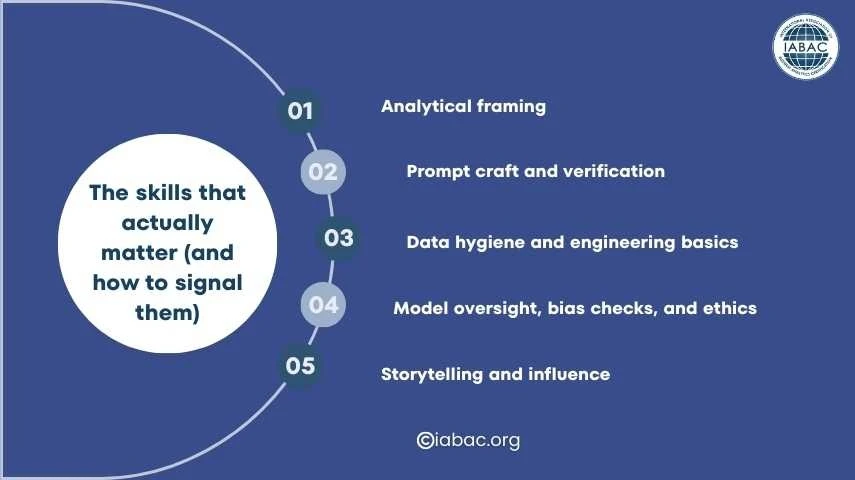
- Analytical framing. Ask sharper questions before you automate.
- Prompt craft and verification. Write prompts that elicit useful outputs and always validate results.
- Data hygiene and engineering basics. Clean inputs make generative artificial intelligence far more reliable.
- Model oversight, bias checks, and ethics. Learn how to spot hallucinations and unintended behaviour.
- Storytelling and influence. Translate outputs into recommendations executives trust.
A structured professional certification helps you demonstrate practical competence. Programs like Artificial Intelligence Foundation, Certified Machine Learning Associate, Certified Artificial Intelligence Expert, and Certified Deep Learning Expert combine hands-on labs and governance, which hiring teams increasingly value. Evidence shows that certifications remain a reliable signal for skills in hiring and promotion decisions.
A 90-day roadmap to move from curiosity to career wins
Here’s a compact, repeatable plan you can follow:
Days 1–14 — Explore:
Try hands-on prompts. Pick one repetitive task and write a simple prompt template to automate a first draft.
Days 15–45 — Prototype:
Build a minimal automation using generative artificial intelligence: a report template, a query generator, or an insights summary tool. Track time saved and errors avoided.
Days 46–75 — Upskill:
Take a short applied course that includes labs and real cases. Start a certification pathway that focuses on applied projects and governance.
Days 76–90 — Showcase:
Create a short case study that quantifies impact: hours saved, decisions enabled, or faster go-to-market. Present the case and ask for a pilot budget.
Repeat this loop. Every small, measurable win builds trust and creates opportunities for bigger projects.
Real signals from the job market and organizations
Demand for AI skills is rising quickly; job postings requiring AI-related skills have surged, and workplace learning teams are prioritizing AI fluency. That means your investments in learning generative artificial intelligence and data science pay off in visibility and opportunity.
Ethical and governance checklist for your projects
Before you scale anything, run a quick checklist for generative artificial intelligence projects:
- Validate outputs against source data and document failure modes.
- Check for biased or unsafe outputs and add guardrails.
- Keep a human in the loop for decisions that affect customers or revenue
- Record prompt versions and model versions for reproducibility.
Applying this checklist ensures your generative artificial intelligence projects are trustworthy and defensible.
Metrics to track (so you can quantify impact)
Measure simple, persuasive numbers:
- Hours saved per week from automation.
- Number of decisions made faster because of generated summaries.
- Error rate reduction after adding validation to generated code.
- Stakeholder satisfaction with the quality of generated briefs.
These metrics make it easy to show the business case and expand pilots quickly.
Practical answers to questions professionals actually ask
Will generative artificial intelligence replace my role?
No — routine parts of many jobs will change. The people who win are those who pair domain expertise with the ability to build, verify, and govern outputs.
Should a business analyst aim to become a Data scientist?
Progress progressively: strengthen SQL and data-cleaning, then learn Machine learning basics while practicing model evaluation and interpretability.
How should I frame certification on my resume?
Lead with projects: list the certification and a short bullet about a real project where you applied generative artificial intelligence and the measurable result.
How to present your first gen AI project to leaders
Use this concise structure: problem → approach (include how you used generative artificial intelligence) → results (quantified) → next steps. Emphasize controls and validation steps so stakeholders trust the work.
If you want a structured path to applied learning, review the Artificial Intelligence certification page for a focused curriculum. When you’re ready to compare and choose, visit IABAC Global Certifications to explore the full suite and pick the credential that maps best to your role.
What to say to your manager this week
Try a short pitch: “I can automate our weekly report draft using generative artificial intelligence, save the team X hours per week, and present results in two weeks. If it works, I’ll package it as a pilot with clear checks and an ROI metric.” That sentence often opens the door.
Learning generative artificial intelligence gives you leverage early in your career. When you document your wins with generative artificial intelligence, you create proof employers respect. Use generative artificial intelligence carefully and you will amplify your judgment.
Generative artificial intelligence is more than a tool — it’s a multiplier for judgment and domain expertise. Start with a tiny experiment this week: automate a recurrent report, measure time saved, and craft a one-page case study. Then combine that practical work with a certification that proves you understand both capability and responsibility. Do that, and you don’t just adapt to change — you lead it.