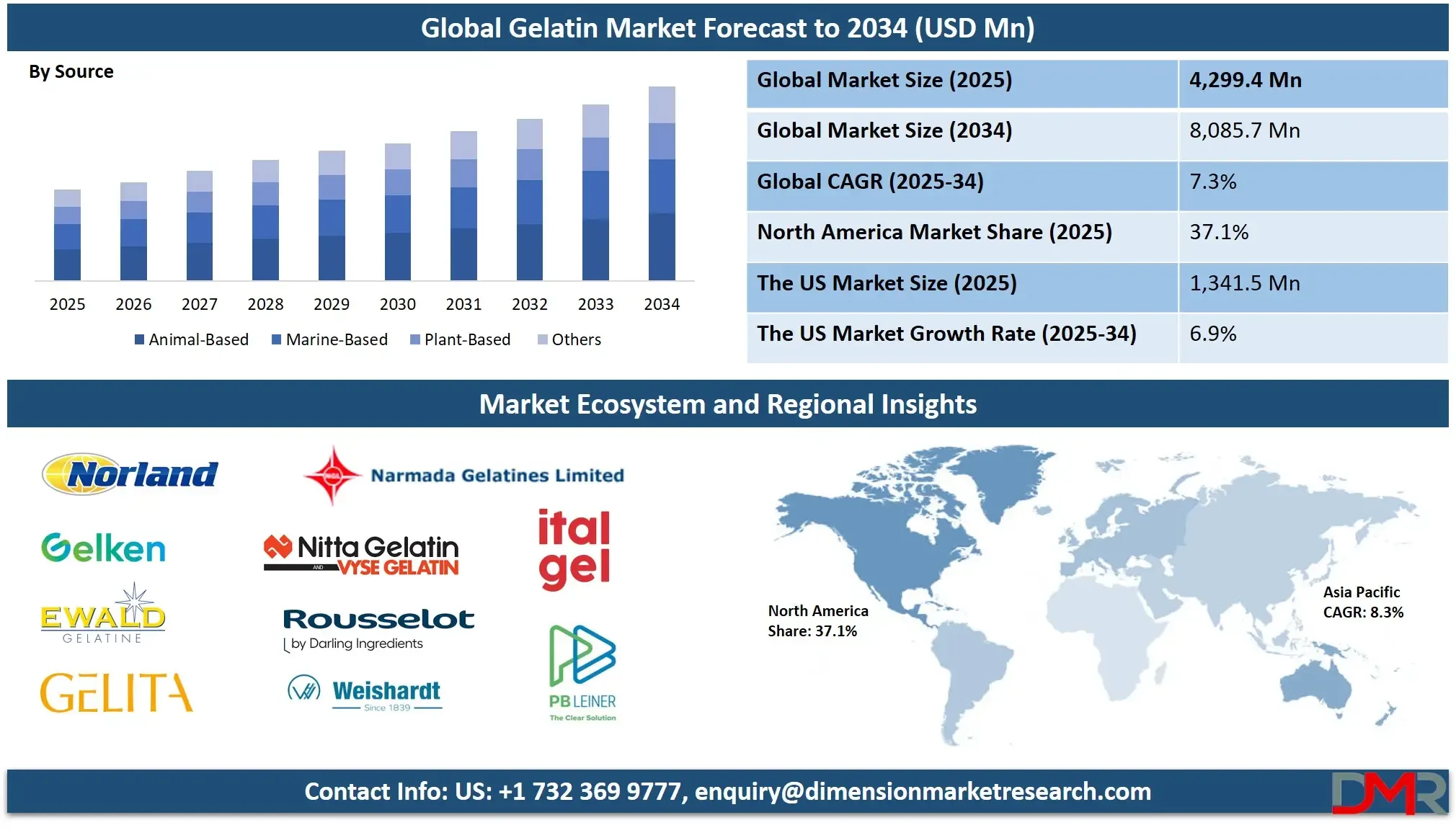
The Gelatin Market is gaining strong momentum as gelatin continues to find applications across food and beverages, healthcare and pharmaceuticals, cosmetics, personal care, nutraceuticals, and animal feed. According to Dimension Market Research, the market is estimated at USD 4,299.4 million in 2025 and is projected to reach USD 8,085.7 million by 2034, expanding at a 7.3% CAGR during 2025–2034.
Gelatin is a protein obtained through the partial hydrolysis of collagen. Its gelling, stabilizing, emulsifying, film-forming, and water-binding properties make it an important functional ingredient for manufacturers. Demand is increasing as food producers, pharmaceutical companies, and supplement brands seek ingredients that provide both functional performance and nutritional value.
The growing popularity of collagen-based supplements and functional foods is another major factor supporting market expansion. Gelatin-derived collagen peptides are increasingly incorporated into beauty-from-within products, sports nutrition, joint-health supplements, gummies, protein products, and functional beverages. At the same time, pharmaceutical manufacturers use gelatin for capsules, drug delivery applications, and wound-care products.
Market Dynamics Shaping Gelatin Demand
Growing Demand for Functional Foods and Nutraceuticals
The increasing focus on preventive healthcare is creating new opportunities for gelatin manufacturers. Consumers are becoming more interested in functional foods and supplements that support wellness, joint health, skin health, and nutritional requirements.
Gelatin is particularly valuable because it can perform multiple roles within a formulation. It can provide texture, stabilize products, support encapsulation, and contribute protein content. This versatility is helping manufacturers introduce gelatin into gummies, protein bars, collagen supplements, functional beverages, and other wellness-oriented products.
The aging population in several developed economies is also contributing to demand for collagen and gelatin-based products. Consumers seeking solutions for mobility, skin appearance, and healthy aging are encouraging supplement manufacturers to develop new gelatin-based formulations.
Expanding Pharmaceutical Applications
Healthcare and pharmaceutical applications represent another important growth avenue. Gelatin is widely used for hard and soft capsules because of its compatibility, stability, and ability to form suitable capsule shells.
The material is also being explored in wound-care products, drug delivery systems, and biomedical applications. As pharmaceutical manufacturing expands across emerging markets, demand for reliable excipients and encapsulation materials is expected to support the gelatin market.
Clean-Label and Natural Ingredient Trends
Consumers increasingly prefer recognizable and naturally derived ingredients. This trend is encouraging food and beverage manufacturers to examine gelatin as an alternative to certain synthetic ingredients.
Gelatin's multifunctional characteristics allow it to serve as a gelling agent, stabilizer, and thickener in various products. Its use in confectionery, desserts, dairy products, meat processing, and functional foods continues to provide manufacturers with formulation flexibility.
Download Sample PDF of the Report: https://dimensionmarketresearch.com/request-sample/gelatin-market/
Market Segmentation Analysis
By Source
The market is segmented into animal-based, marine-based, plant-based, and other sources. Animal-based gelatin continues to represent the dominant source because of its established production infrastructure, functional properties, and broad industrial acceptance.
Bovine, porcine, and poultry sources are widely used for commercial gelatin production. At the same time, marine-derived gelatin is gaining attention because it can address specific dietary and religious requirements and provide opportunities for brands seeking alternative sourcing strategies.
Plant-based alternatives are also attracting interest as vegetarian and vegan lifestyles expand. Although plant-based hydrocolloids such as agar and pectin can replace gelatin in selected applications, they do not always replicate gelatin's complete functional profile.
By Type
The gelatin market is categorized into Type A and Type B. Type A gelatin is expected to maintain a leading position due to its functional characteristics and suitability for high-volume food, nutraceutical, and pharmaceutical applications.
Manufacturers select gelatin types according to factors such as gel strength, viscosity, processing requirements, and final product characteristics.
By Application
Food and beverages represent a major application area. Gelatin is extensively used in confectionery, desserts, functional foods, beverages, and meat processing because of its ability to create desirable texture and stability.
Healthcare and pharmaceuticals represent another significant application category, particularly for dietary supplements, drug encapsulation, and wound dressings. Cosmetics and personal care manufacturers are also exploring gelatin and collagen-derived ingredients for beauty and wellness products.
Regional Market Outlook
North America is expected to maintain the largest revenue share, accounting for approximately 37.1% of the global gelatin market in 2025. The region benefits from established food processing, pharmaceutical, nutraceutical, and supplement industries. The U.S. gelatin market alone is projected to reach USD 1,341.5 million in 2025, with a forecast CAGR of 6.9%.
Europe represents another important market, with its gelatin industry supported by food manufacturing, pharmaceuticals, nutraceuticals, and cosmetics. The European gelatin market is estimated at USD 756.7 million in 2025 and is projected to reach USD 1,333.7 million by 2034, expanding at a 6.5% CAGR.
Asia Pacific is positioned as an important growth region as rising disposable income, expanding food processing industries, increasing healthcare expenditure, and growing interest in functional nutrition support gelatin consumption. China, India, Japan, and South Korea are among the markets contributing to regional demand.
Competitive Landscape
The gelatin market includes major global producers and specialized regional manufacturers competing through product quality, production capacity, certifications, application development, and supply-chain capabilities.
Prominent companies include Gelita AG, Rousselot, PB Leiner, Nitta Gelatin, Weishardt Group, Ewald-Gelatine, Italgel, Sterling Biotech, TROPHIC, Qinghai Gelatin, Narmada Gelatines, Xiamen Gelken Gelatin, Lapi Gelatine, India Gelatine & Chemicals, and Great Lakes Gelatin Company.
Companies are increasingly focusing on specialized gelatin grades, clean-label formulations, collagen products, halal and kosher certification, and improved processing technologies. Capacity expansion and strategic partnerships are also being used to address rising demand from food, pharmaceutical, and nutraceutical customers.
Challenges and Opportunities
Despite strong growth prospects, the gelatin market faces challenges related to raw material availability, price volatility, supply-chain consistency, and dietary restrictions.
Traditional gelatin is primarily derived from animal sources, which can limit its adoption among vegan consumers and certain religious or cultural groups. This has encouraged companies to develop marine-based products and explore alternative functional ingredients.
At the same time, these challenges are creating opportunities for innovation. Manufacturers that can offer traceable sourcing, halal and kosher certification, improved sustainability, and specialized gelatin solutions may gain a competitive advantage.
Future Outlook
The future of the gelatin market is expected to be shaped by the convergence of food innovation, preventive healthcare, nutraceutical growth, and consumer demand for functional ingredients. The market's projected expansion from USD 4,299.4 million in 2025 to USD 8,085.7 million by 2034 demonstrates the significant commercial opportunity available across established and emerging applications.
Future growth is likely to come from collagen supplements, functional foods, pharmaceutical encapsulation, beauty and wellness products, and innovative gelatin formulations. Companies that combine functional performance with transparent sourcing and consumer-focused product development will be well positioned to benefit from the market's long-term expansion.
Frequently Asked Questions
What is the size of the Gelatin Market?
The global Gelatin Market is estimated at USD 4,299.4 million in 2025 and is projected to reach USD 8,085.7 million by 2034.
What is the CAGR of the Gelatin Market?
The market is projected to grow at a 7.3% CAGR between 2025 and 2034.
Which region leads the Gelatin Market?
North America is expected to hold the largest revenue share, accounting for approximately 37.1% in 2025.
What are the major applications of gelatin?
Major applications include food and beverages, healthcare and pharmaceuticals, cosmetics and personal care, animal feed, and other industrial uses.
Who are the key companies in the Gelatin Market?
Major companies include Gelita AG, Rousselot, PB Leiner, Nitta Gelatin, Weishardt Group, Ewald-Gelatine, Italgel, and Sterling Biotech, among others.