
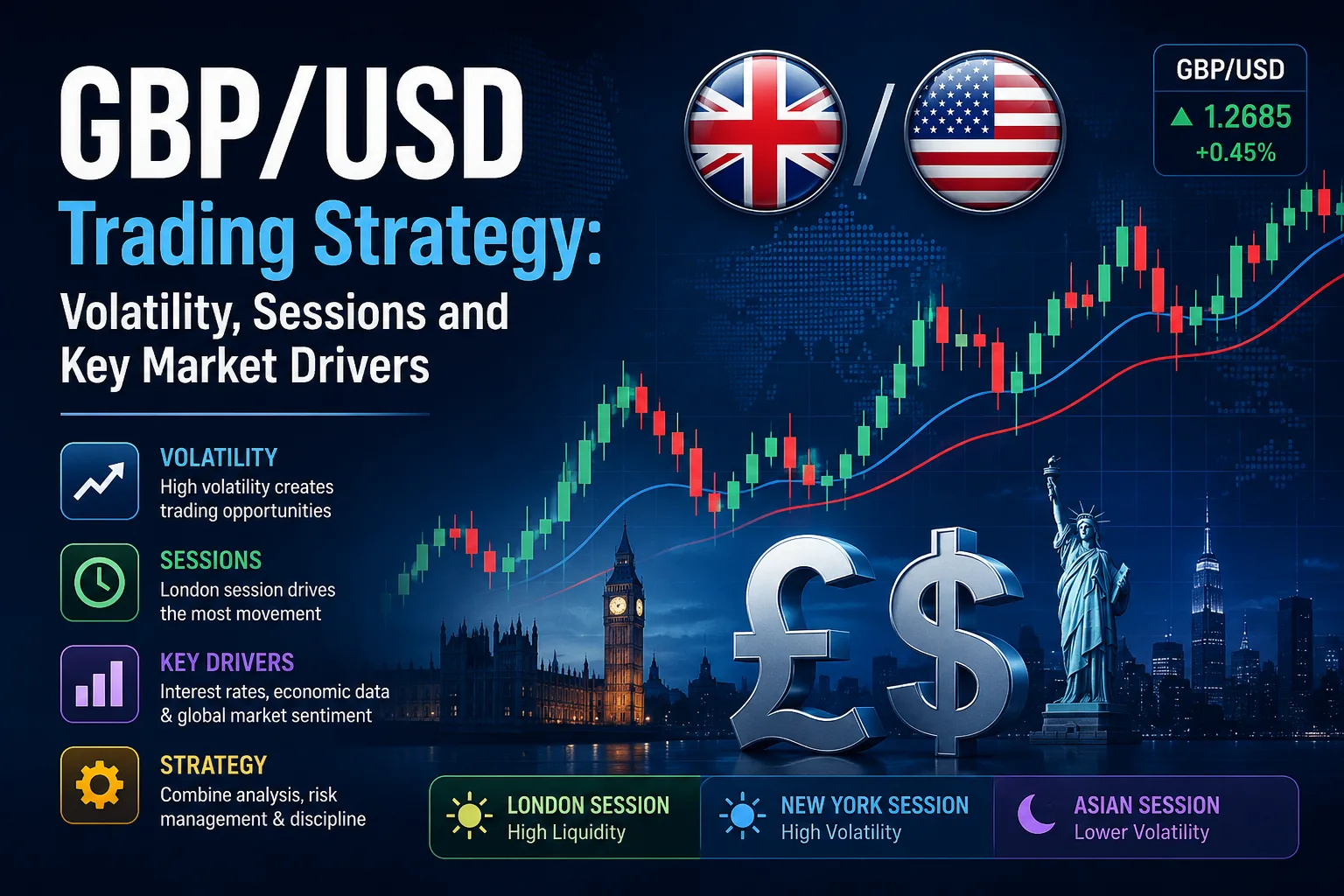
Ever seen GBP/USD trading drastically within the same hour and not know what caused it? The first step in creating a GBP/USD trading strategy is to learn what's actually moving this pair, not reacting based on what has moved. In this guide, we’ll explore the effect this currency combination has during trading sessions, the key events for this pair, and how it could affect your own analysis.
What is GBP/USD and Why is it Important in Forex Trading?
GBP/USD reflects the exchange rate between the British pound sterling and the US dollar. Essentially, it shows how many dollars it takes to buy one pound. In general, it indicates the amount of dollars needed in order to purchase one pound. Together, they interpret the news on both sides of the Atlantic, responding to central bank updates, political moods and all in between.
Don't confuse liquidity with volatility, and do try to separate one from the other in your mind. It's true that normal conditions would see tighter spreads and smoother execution under the circumstances, and this is attributable to deep liquidity. But it can also react swiftly to significant announcements if new data necessitates a rapid reprice, and if the normal liquidity conditions can momentarily succumb.
Nicknamed "cable," GBP/USD is one of the most traded currency pairs in the forex market, along with the EUR/USD and USD/JPY currency pairs. It's also often considered more sensitive to UK-specific headlines than a pair like EUR/USD.
What are the GBP/USD Trading Sessions?
Forex trading sessions proceed all day around the clock, and each trading session of GBP/USD tends to operate differently.
The Asian trading session tends to be quieter as the trading volume in sterling is lighter. Prices start to rise when the London session begins. In addition, the New York session brings in the flow of the U.S. dollar and other data that can extend or retrace the previous trend.
SessionApproximate Hours (GMT)Common CharacteristicAsian00:00–09:00 Low volume, low rangesLondon08:00–17:00Increased activity, sterling-drivenNew York13:00–22:00USA driving times and data.London-New York overlap13:00–17:00
Highest liquidity, larger moves possible
The London-New York overlap period, indicated as such, is generally the time of day when there is the highest liquidity and volatility in the market. Of course, it's a general rule, since any session can still surprise you.
What are the Key Market Drivers of GBP/USD?
GBP/USD tends to respond to monetary policy, such as interest rates and economic indicators, such as:
- Interpret the policy of the Bank of England for interest rates and forward guidance.
- Federal Reserve decisions: impacting overall US dollar demand.
- Inflation data in the UK and USA, as this can easily impact interest-rate expectations.
- Data on employment, UK wage data and US non-farm payrolls.
- GDP and growth data, as it signals relative economic strength.
- Regarding interest rate expectations, which tend to be priced in advance of decisions.
- Political and geopolitical news, especially UK news.
- Breadth (US dollar) strength or weakness relates to global sentiment.
- Symptoms of market risk sentiment: GBP/USD can react to "risk-on/risk-off" sentiment.
Honestly, these drivers don't typically operate in isolation. Price action can be the collective result of many more factors.
How to Build an Effective GBP/USD Trading Strategy?
Experienced traders do not stick to only one type of analysis. They use a blend of fundamental and technical analysis. Fundamental analysis is closely dependent on the economic calendar, with central bank decisions and inflation figures being thoroughly considered for sterling and the dollar. However, price action itself is underwent by technical analysis. It includes support and resistance, market structure and trend direction, and sometimes moving averages, usually on multiple time frames.
Within that framework, many traders build their GBP/USD trading strategy around one of a few common approaches:
- Trend trading: It identifies the broader direction of GBP/USD, often using moving averages or higher-timeframe price structure, then looks for entries that align with that direction rather than against it. Many trend traders wait for a pullback within an established trend before considering a position, though a trend can reverse without warning.
- Breakout trading: It focuses on the moments when GBP/USD moves beyond a defined support or resistance level, usually on increased volume. This can happen around a high-impact news event, a session open, or the London-New York overlap, though not every breakout leads to a sustained move, and some reverse quickly.
- Range trading: This trading strategy applies when GBP/USD moves between a fairly consistent support and resistance level rather than trending, which can be more common during quieter periods such as the Asian session. Range traders may look to buy near support and sell near resistance, while watching for signs the range could break.
- News-based (event-driven) trading: It centres on positioning around scheduled releases such as Bank of England or Federal Reserve decisions, inflation data, or employment reports, since these can trigger some of GBP/USD's sharpest moves. This carries its own risks, including wider spreads and fast price swings around the announcement, which is why some traders wait for the initial volatility to settle before assessing the move.
As an example, a trader might notice the GBP/USD pair approaching a high time-period resistance level just prior to an anticipated inflation reveal by the United Kingdom. Then wait for the data before using price action vs their risk parameters vs their overall trend. All of this could be a trader's way of creating a more defined picture of GBP/USD, but no cocktail of tools will predict success.
What are the Common GBP/USD Trading Mistakes?
Even expert traders can suffer from bad habits! The dos and don'ts of some of the mistakes include:
- Making trades around high-impact events immediately, without being aware of the volatility and spread risks.
- Being oblivious to the general trend in the market when focusing on short-term fluctuations.
- High volatility can magnify losses as well as profits, and overleveraging can make that happen.
- Trading when there is only one technical signal without looking for confirmation.
- Overlooking spread and execution conditions, which can escalate rapidly during volatile times.
- Assuming that a trend reversal has taken place when it has not.
Recognising these patterns won't eliminate risk, but it can support more considered decisions.
Important Risk Management Practices when Trading GBP/USD
Because GBP/USD can move quickly around news events, risk management deserves as much attention as analysis. When trading GBP/USD, it is vital to keep these practices in mind:
- Risk-taking should be based on account size and risk appetite, rather than assumptions about how much risk a trade can handle.
- Setting a stop-loss, meaning determining where to exit a trade if the market moves in the wrong direction.
- Understanding how to use leverage and how it can increase both potential profits and losses.
- Keeping an eye on a trading calendar to track economic and financial events that could create volatility.
- Maintaining a clear risk-to-return profile by balancing potential outcomes against the potential risk.
- Following structured risk-management approaches, such as the 3 5 7 rule in trading, can help traders maintain consistency when assessing exposure and managing positions.
- Staying out of periods of extreme exposure when unusually volatile market conditions are expected.
Currency volatility can create both opportunities and risks. But thoughtful risk management helps you approach either with a clearer plan, rather than relying on guesswork.
Conclusion
To draw a conclusion, a thought-out GBP/USD trading strategy isn't about predicting each move. Rather, it’s about being aware of what’s frequently affecting this pair. GBP/USD can be influenced by volatility, the dynamics of the trading sessions, monetary policy, economic figures and technical conditions. Combined with a good risk management regimen, structured analysis can provide a clearer picture of the pound-dollar relationship.