
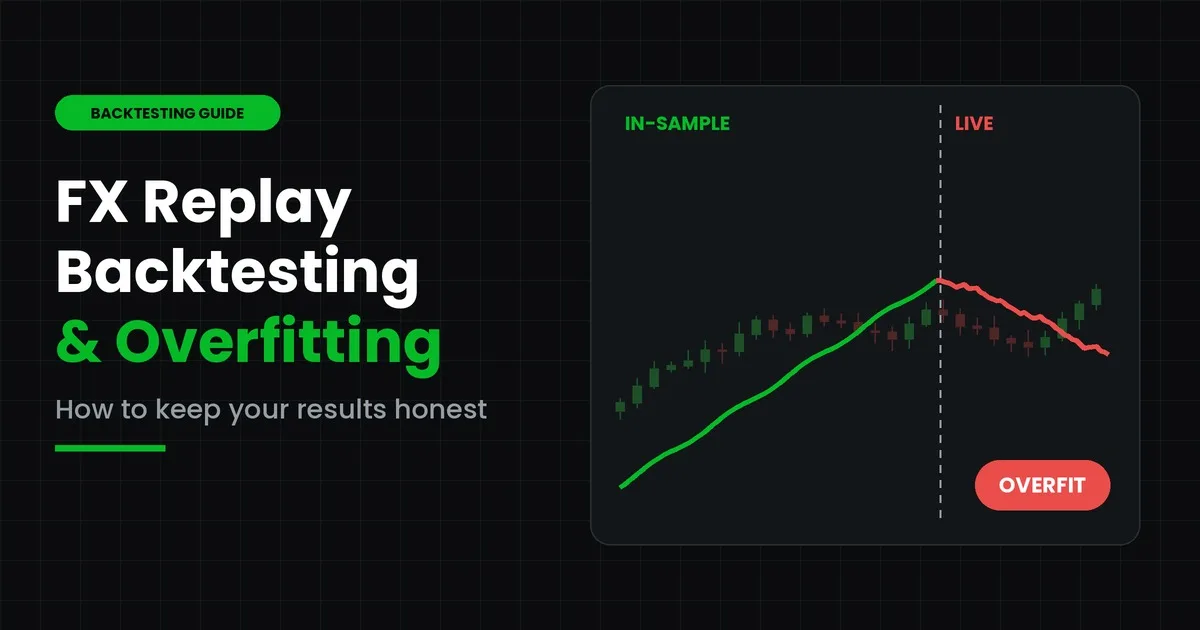
Every trader remembers their first “perfect” backtest. The equity curve climbs smoothly, the win rate looks incredible, and the drawdowns seem tiny. Then the strategy goes live, and within a few weeks, the results fall apart.
In most cases, the problem is not bad luck. Instead, it is overfitting. A strategy has been shaped so closely around past data that it no longer reflects how markets actually behave.
The FX Replay backtesting platform is a popular tool for manual, bar-by-bar practice and strategy testing. However, like any testing tool, it only shows you what you put into it. If your process is flawed, your results will be flawed too. In this guide, we will explain what overfitting is, why it happens during FX Replay backtesting, and how you can keep your numbers honest.
What Is Overfitting in Trading?
Overfitting happens when a strategy fits historical data too well. In simple terms, the rules start describing noise rather than real market behavior.
For example, imagine you test a moving average crossover on EUR/USD. At first, the results are average. So you add an RSI filter. Then you add a time-of-day filter. After that, you skip Mondays because two big losses happened on Mondays. Eventually, the backtest looks excellent.
But here is the issue. Each new rule was added because of what you already saw in the data. As a result, the strategy is no longer predicting anything. It is simply memorizing the past.
Markets rarely repeat in exactly the same way. Therefore, a memorized strategy usually fails once it meets new price action.
Why Overfitting Is Easy on a Replay Platform
The FX Replay backtesting platform lets you move through historical charts candle by candle. You place trades as if the market were live, and the platform tracks your results. This approach feels much closer to real trading than spreadsheet testing. Even so, it creates its own set of risks.
Hindsight Bias Creeps In
Even when future candles are hidden, your memory is not. If you have watched GBP/USD during a major news event, you may subconsciously remember how it moved. Consequently, your “objective” entries may not be objective at all.
Discretion Becomes a Loophole
Manual backtesting strategies often include some judgment. That is fine in principle. However, when rules are vague, it becomes tempting to take only the trades that “look good.” Over time, this selective behavior inflates your results.
Endless Rewinding
A replay tool makes it easy to restart a session. If a test goes badly, you can simply reset and try a slightly different version. After twenty attempts, one version will almost certainly look great. Yet that success may come from chance alone.
Small Sample Sizes
Manual testing takes time. As a result, many traders stop after 30 or 40 trades. Unfortunately, that sample is far too small to separate skill from randomness.
Warning Signs Your Backtest Is Overfitted
Before you trust any result, look for these red flags. If you spot more than one, slow down and review your process.
The equity curve looks too perfect. Real strategies have rough patches. A smooth line with almost no drawdown is often a sign that the rules were tuned to the data.
You have many rules but few trades. Every filter you add removes trades. When a strategy has eight conditions and only 25 trades, it is likely describing a handful of past events.
Small changes break everything. Try shifting a stop loss by a few pips or changing a moving average from 20 to 22. If performance collapses, the strategy is fragile.
It only works on one pair or one period. A sound idea usually shows at least some edge across similar markets and different years. If it only works on one pair in one quarter, be cautious.
You cannot explain why it works. Good strategies usually have a logical reason behind them, such as trend continuation or mean reversion after an overextension. If the only reason is “the backtest says so,” that is a concern.
How to Keep Your FX Replay Backtesting Results Honest
The good news is that overfitting can be managed. It cannot be removed completely, but a disciplined process reduces it a great deal. Below are the methods experienced traders rely on.
1. Write Your Rules Before You Start
First, define the strategy in writing before opening a single chart. Include entry conditions, exit conditions, stop loss placement, position sizing, and the market sessions you will trade.
Be specific. “Enter on a strong candle” is not a rule. Instead, write something like “Enter when the candle closes above the 20 EMA and its body is larger than the previous three candles.”
Clear rules make your FX Replay backtesting repeatable. In addition, they remove much of the room for selective trade picking.
2. Split Your Data Into In-Sample and Out-of-Sample
This is the most important habit on the list. Divide your historical data into two parts.
The first part is your in-sample data. You use it to develop and adjust the strategy. The second part is your out-of-sample data. You do not touch it until the strategy is fully finished.
For instance, you might develop rules on 2021 and 2022 data. Then, once the rules are locked, you test them on 2023 and 2024. If performance drops sharply, the original results were probably overfitted.
On the FX Replay backtesting platform, this simply means choosing your date ranges carefully. Keep a note of which periods you have already viewed, so you do not accidentally contaminate your out-of-sample set.
3. Limit the Number of Parameters
Every adjustable setting adds a new way to fit the past. Therefore, keep your strategy as simple as possible.
A useful guideline is to ask whether each rule earns its place. If removing a filter only reduces performance slightly, consider dropping it. Simpler strategies tend to hold up better in live markets.
4. Collect a Meaningful Sample Size
Aim for at least 100 trades per setup before drawing conclusions. More is better, especially for strategies with low win rates.
Admittedly, this takes patience during manual testing. However, a small sample can make a losing system look profitable and a profitable one look broken. Fortunately, the replay format allows you to speed up quiet periods and focus on the moments that matter.
5. Include Realistic Trading Costs
Many backtests ignore spreads, commissions, and slippage. On higher timeframes, this may not matter much. On scalping strategies, though, costs can erase the entire edge.
So, add a realistic spread to every trade. Also account for wider spreads during news releases and the Asian session. If the strategy survives these costs, it is far more trustworthy.
6. Test Across Different Market Conditions
Markets move through trends, ranges, high volatility, and quiet periods. A strategy tested only during a strong trend will naturally look excellent in trending conditions.
To avoid this trap, include a mix of conditions in your testing. Furthermore, test related pairs. A trend strategy that works on EUR/USD should show at least some edge on GBP/USD or AUD/USD.
7. Run a Sensitivity Check
Once your strategy is complete, adjust each key setting slightly. Move the stop loss up and down. Change indicator lengths by small amounts.
Robust backtesting strategies show similar results across a range of values. In contrast, fragile ones only work with one exact combination. If you see a “cliff” in performance, your settings are likely overfitted.
8. Keep a Detailed Trade Journal
Record every trade, including screenshots, the reason for entry, and the outcome. Also note any trades you skipped and why.
A journal keeps you accountable. Later, when you review it, patterns of hindsight bias or rule-bending become easy to spot.
9. Forward-Test Before Going Live
Finally, no backtest replaces real-time testing. After finishing your work on the FX Replay backtesting platform, trade the strategy on a demo account or with very small size for several weeks.
Forward testing shows how the strategy performs with unknown data and real emotions. If the results roughly match your out-of-sample tests, you have a reasonable degree of confidence.
A Practical Workflow for Honest Backtesting
To bring everything together, here is a simple workflow you can follow.
Start by writing down the strategy idea and the logic behind it. Next, choose your in-sample period and your out-of-sample period, and record both. Then, test the strategy on the in-sample data using the FX Replay backtesting platform, logging every trade with costs included.
After that, make limited adjustments. Keep a record of each change and why you made it. Once you are satisfied, lock the rules completely.
Now run the strategy on the out-of-sample data without changing anything. Compare the two sets of results. If they are broadly similar, move on to sensitivity checks and testing on other pairs. Finally, forward-test on a demo account before risking real capital.
This process is slower than chasing a perfect equity curve. Nevertheless, it produces results you can actually rely on.
Common Mistakes Even Experienced Traders Make
Even seasoned traders fall into a few familiar traps.
One common mistake is retesting the out-of-sample data after making changes. Once you adjust a strategy based on out-of-sample results, that data becomes in-sample. At that point, you need fresh data for a fair test.
Another mistake is focusing only on win rate. A 75% win rate means little if the average loss is three times the average win. Instead, look at expectancy, maximum drawdown, and the longest losing streak.
Lastly, many traders test only their favorite pair. While specialization has value, testing a single market increases the risk that your edge is just a quirk of that pair’s history.
Final Thoughts on Using an FX Replay Backtesting Platform Wisely
The FX Replay backtesting platform is a valuable tool for practicing execution and studying how a strategy behaves bar by bar. Still, the tool itself cannot protect you from overfitting. Only your process can.
In short, write clear rules, separate your data, keep strategies simple, and include realistic costs. Then confirm everything with out-of-sample and forward testing. When you treat backtesting as a scientific process rather than a search for perfect numbers, your results become far more honest.
Remember, the goal of FX Replay backtesting is not to prove a strategy works. The goal is to find out whether it does.
Applying the Same Standard to Any Trading Tool
The same skepticism that protects your backtests should apply to every indicator, signal tool, or trading service you consider. For example, traders researching GainzAlgo often search “is gainzalgo legit” before trying it, and that is a healthy instinct. Rather than relying on screenshots or marketing claims, test any tool’s signals with the methods above: use out-of-sample data, include trading costs, collect a large sample, and forward-test on a demo account. That way, your decisions rest on evidence you gathered yourself rather than on promises.