Moving from lab experiments to full-scale production involves a lot of challenges. For example, traditional extruders are larger, heavier and expensive, also requiring higher volumes of materials. The development of new polymers, thin films and related products thus take a lot more time, involving costs and slowing down production.
Thermo Scientific’s twin screw extruder, known as the Process 11, helps overcome these challenges by reducing material waste, speeding up testing and ensuring proper control on process conditions. Its compact design and benchtop feature makes it ideal for labs, while also preparing production units. As a result, researchers can bring innovative polymer products to the market faster and at almost half the costs incurred in traditional extruding.
4 Key Extrusion Trends And How Process 11 Satisfies Them
Extrusion technology is now evolving at a rapid rate to meet the rising demands of efficiency and sustainability. Recent advancements, like the small plastic extrusion machine by Thermo Scientific, is a part of this evolution by making extrusion faster, problem-free and also environment friendly. Not only does it help reduce waste and speed up production cycles but also ensure product quality and adapt machines to high-scale production.
Let’s see how it meets the evolving trends in extrusion:
1. Sustainability and Recycling
With more researchers using recycled and bio-based materials, the presence of mixed additives, pigments, and fillers are quite common. The bench-top twin screw extruder for R&D supports consistent mixing with minimum volatilisation, producing blends that reduce high amounts of waste. Hence, it helps companies that focus on sustainable practices and environment conservation.
2. Miniaturisation and Small-Batch Testing
Only 20-200 g of material is needed for the twin screw extruder to run, helping lab-scale extruders reduce raw material consumption by around 80-90%. This is a high number compared to pilot systems that require many kilograms per run. As a result, Thermo Scientific’s benchtop extruder ensures faster, more affordable trials.
3. Advanced Process Control
Nearly 75% of polymer plants track melt temperature, melt pressure, and torque to ensure product consistency and reduce waste. This lab equipment has in-built data capturing features, helping researchers fine-tune the entire process without glitches.
4. Flexible and Modular Design
The Process 11 is highly flexible, as all its main components, like the dies, screws and feeding systems, can be altered easily. This gives the extruder the flexibility to be used in a range of applications. For example, it can be used as an extrusion machine for plant‑based meat lab research or as lab equipment to make film or fiber samples from melt. The flexibility also helps it meet the evolving multi-purpose, reconfigurable trends in the extrusion technology.
Meeting Modern Manufacturing Demands
Working with polymers, additives and other sensitive materials now require accurate mixing and control parameters, like temperature, shear and residence time. The Process 11 twin screw extruder offers excellent mixing and the right control to ensure high quality of end products.
Further, its modular adjustments and integrated sensors makes it one of the choice extrusion machines for lab research as well as high-scale production. Be it compounding, blending or reactive extrusion, the Process 11 is an unsung hero, trying to manage materials efficiently and sustainably. With small amounts of the right materials, it can produce sheets, filaments and pellets seamlessly. It can also be used as an extruder for developing food or cosmetic formulations.
Key Capabilities and Accessories
- Small plastic compact design for lab research and production at scale
- Only 20–200 g needed per run, ensuring efficient material use
- Works with dies, filament spooler, sheet take-off, pelletiser, and melt pump
- Configurable for compliant food or cosmetic formulation development
- Can be used with MiniJet Pro to create film, sheet, or fiber samples
- Available in standard and hygienic versions for food-related applications
Factors
Material Requirement
- Pilot-Scale Extruder: Needs several kilograms per run
- Lab-Scale (Process 11): Requires only 20–200 grams per run
Setup Changeover
- Pilot-Scale Extruder: Takes hours to set up
- Lab-Scale (Process 11): Completed within a few minutes
Material Waste
- Pilot-Scale Extruder: Increased waste due to higher amounts required per run
- Lab-Scale (Process 11): 80–90% less waste compared to pilot-scale extruders
Rheology Integration
- Pilot-Scale Extruder: Limited measurement & tracking
- Lab-Scale (Process 11): Provides proper measurement & tracking
Lab-Scale vs Pilot-Scale: Who’s The Winner And WhyScaling Breakthroughs Across Multiple Sectors
The Process 11 twin screw extruder is not just a small plastic extrusion machine. It’s a bridge between lab research and extensive polymer production. On one hand, it helps scientists research new materials for fibers, films and plastic while on the other, it develops lightweight, durable components for healthcare and other industry products.
The hygienic side of the extruder makes it extremely useful in food and cosmetic production units. For example, plant-based meats require texture and consistency and so does developing a new nutritional product. This twin screw extruder adapts to the functional requirements of multiple sectors, making it indispensable for product innovation.
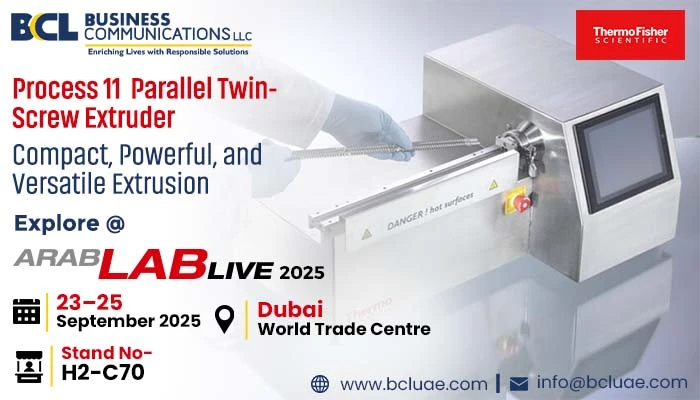
Get Proper Validation At ArabLab 2025
BCL has been bringing its innovations to the ArabLab events for quite some time now. It curates advanced solutions from its trusted suppliers and exhibits them at the global event, with hand-on testing opportunities for the attendees.
This year too, there won’t be an exception to the rule. According to the reports, BCL is bringing this innovative twin screw extruder machine to ArabLab 2025, helping researchers as well as producers try their hands on it.
The demonstration will feature live small-batch runs, integrated rheology measurement, and performance monitoring, showing how a bench-top twin screw extruder for R&D can replicate industrial results with minimal resources.
If you want to be a part of the exhibit, visit the ArabLab Exhibition 2025, Stall No: H2–C70, Dubai World Trade Centre from 23 to 25 September, without fail.