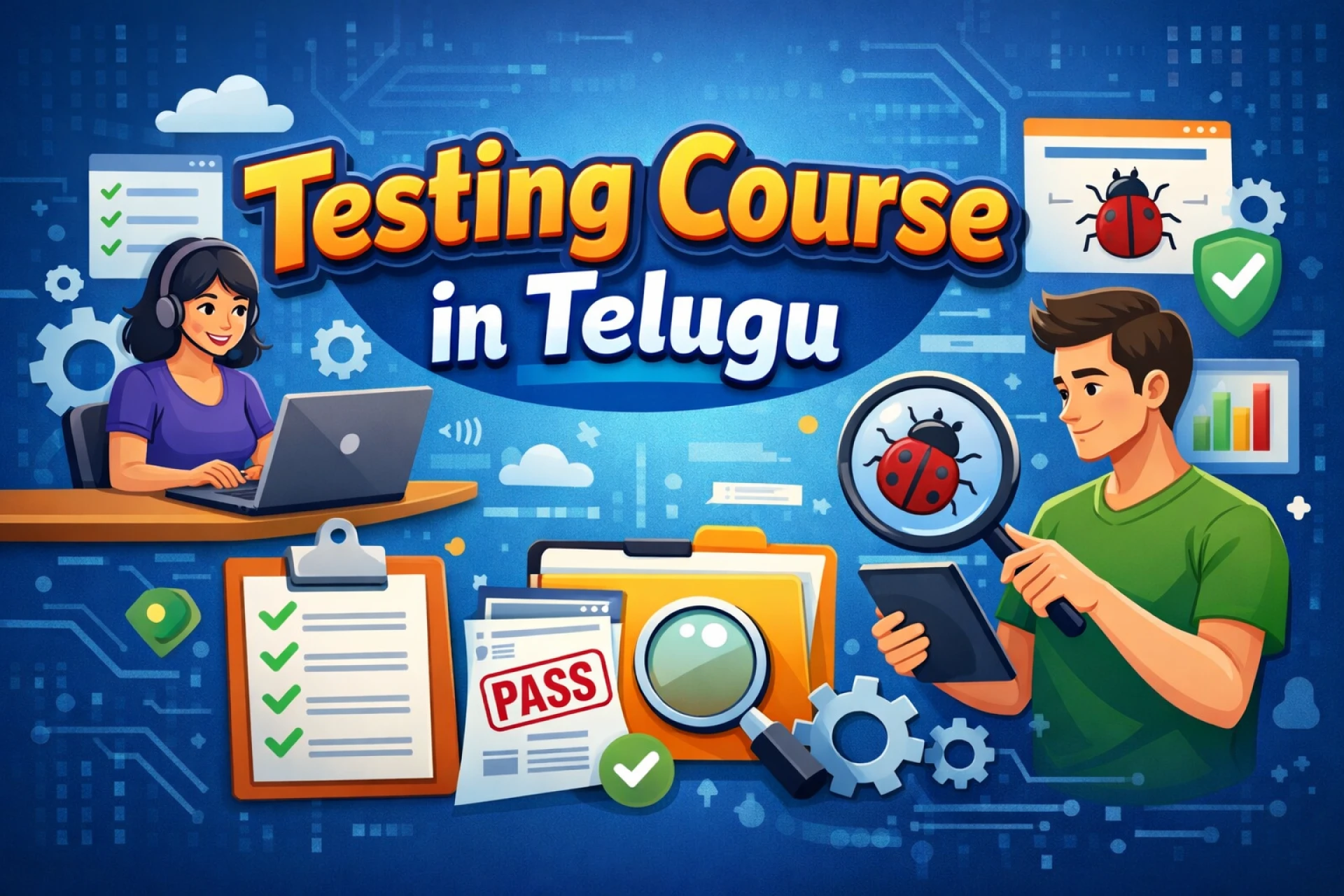
The demand for skilled professionals in the IT industry continues to grow as technology becomes an essential part of modern businesses. Companies rely on software applications, websites, and mobile platforms to provide services, manage operations, and interact with customers. However, before these software products are launched, they must be tested carefully to ensure they function correctly and meet quality standards. This process is known as software testing.
Software testing is a crucial step in the software development process because it ensures that applications are reliable, secure, and free from major defects. One of the most advanced approaches in this field is Full Stack Testing, which focuses on testing the entire application from the front-end interface to the backend database.
Many students from Telugu-speaking regions prefer learning technical subjects in their native language to better understand complex concepts. As a result, the Full Stack Testing Course in Telugu has become a popular choice for beginners who want to start a career in the software testing field.
In this blog, we will explore what Full Stack Testing is, the skills covered in the course, and the career opportunities available after completing the training.
What is Full Stack Testing?
Full Stack Testing refers to the process of testing a software application across all its layers to ensure that the system functions properly as a whole. It involves verifying both the front-end user interface and the back-end functionality, along with the communication between different components.
A modern software application usually consists of several layers, including:
- Front-end interface (User Interface)
- Backend server logic
- APIs used for communication between services
- Databases that store application data
- Integration with third-party systems
A Full Stack Tester ensures that each of these components works correctly and that the entire application performs smoothly.
For example, when testing an online travel booking website, the tester needs to verify several aspects, such as:
- Whether the website interface loads correctly
- Whether users can search for flights or hotels
- Whether the booking process works properly
- Whether payment transactions are successful
- Whether booking details are stored correctly in the database
Testing all these components ensures that the application provides a reliable and seamless experience for users.
Why Learn Full Stack Testing in Telugu?
Learning technical subjects entirely in English can sometimes be challenging for beginners. Studying in a familiar language like Telugu helps students understand concepts more clearly and build confidence while learning.
A Full Stack Testing Course in Telugu offers several benefits.
Clear Understanding of Concepts
Students can easily understand complex testing concepts when they are explained in Telugu.
Comfortable Learning Environment
Learners feel confident interacting with trainers and asking questions during training sessions.
Faster Learning
When students understand the concepts quickly, they can focus more on practicing tools and technologies.
Better Interview Preparation
Strong conceptual knowledge helps students perform better in technical interviews.
Key Modules Covered in the Course
A Full Stack Testing course usually includes multiple modules that help students develop both theoretical knowledge and practical skills.
Manual Testing
Manual testing is the basic step in learning software testing. It involves testing the application manually without using automation tools.
Topics typically include:
- Software Development Life Cycle (SDLC)
- Software Testing Life Cycle (STLC)
- Test case design
- Test scenario creation
- Defect tracking and reporting
- Bug life cycle
Manual testing helps students understand the fundamental concepts of software quality assurance.
Automation Testing
Automation testing involves using tools to execute test cases automatically.
Popular automation testing tools include:
- Selenium
- TestNG
- Maven
Automation testing increases efficiency and reduces the time required for repetitive tests.
Programming Fundamentals
Automation testing requires basic programming knowledge.
Most Full Stack Testing courses introduce programming languages such as:
- Java
- Python
Programming skills help testers create automation scripts and understand application behavior.
API Testing
APIs allow different software systems to communicate with each other.
API testing verifies whether these services work correctly and return accurate responses.
Common API testing tools include:
- Postman
- Rest Assured
API testing is an essential skill for modern software testers.
Database Testing
Database testing focuses on verifying the accuracy and reliability of stored data.
Students learn concepts such as:
- Writing SQL queries
- Data validation techniques
- Database integrity checks
Database knowledge helps testers identify backend issues.
Performance Testing
Performance testing evaluates how software behaves when a large number of users access it simultaneously.
For example, testers analyze whether the application can handle heavy traffic without slowing down.
A commonly used performance testing tool is:
- JMeter
Performance testing ensures system stability and scalability.
Course Duration
The duration of a Full Stack Testing course generally ranges from three to six months, depending on the institute and training program.
A typical course structure may include:
First Phase
Manual Testing and SQL fundamentals
Second Phase
Programming basics and Selenium automation
Third Phase
API testing and advanced automation techniques
Many institutes also provide real-time projects, resume preparation, and interview guidance.
Who Should Take This Course?
The Full Stack Testing course is suitable for many types of learners.
It is ideal for:
- Engineering graduates
- Science graduates
- Commerce graduates
- Computer application students
- Freshers looking for IT jobs
- Professionals planning to switch careers
Even individuals with minimal coding knowledge can successfully learn software testing.
Career Opportunities After Completing the Course
After completing the Full Stack Testing course, students can apply for several roles in the IT industry.
Common job roles include:
- Software Tester
- Quality Assurance Engineer
- Automation Tester
- Test Analyst
- QA Engineer
With experience, professionals can advance to higher roles such as:
- Senior QA Engineer
- Test Lead
- Quality Assurance Manager
These roles offer excellent career growth opportunities.
Salary Expectations
Software testing professionals receive competitive salaries depending on their skills and experience.
Typical salary ranges in India include:
Freshers
₹3 LPA – ₹5 LPA
2–4 Years Experience
₹6 LPA – ₹10 LPA
5+ Years Experience
₹12 LPA – ₹20 LPA or more
Professionals with strong automation testing expertise often receive higher salary packages.
Tools Covered in the Course
A Full Stack Testing course usually includes hands-on training with several industry-standard tools.
Common tools include:
Manual Testing Tools
Jira
Bugzilla
Automation Testing Tools
Selenium
TestNG
API Testing Tools
Postman
Performance Testing Tools
JMeter
Version Control Systems
Git
These tools are widely used in real software development environments.
Importance of Real-Time Projects
Practical experience is essential for becoming a skilled tester. Many training institutes provide real-time projects that simulate real industry scenarios.
Examples include:
- Testing e-commerce platforms
- Testing banking applications
- Testing healthcare systems
- Testing mobile applications
Working on such projects helps students gain practical knowledge and improve their job readiness.
Advantages of Choosing Software Testing as a Career
Software testing offers several advantages for individuals entering the IT industry.
High Industry Demand
Almost every software company requires testing professionals.
Easier Entry into IT Careers
Testing roles often provide easier entry compared to development roles.
Continuous Learning Opportunities
The testing field constantly evolves with new tools and technologies.
Global Career Opportunities
Testing professionals can work with multinational companies and international projects.
Conclusion
A Full Stack Testing Course in Telugu is an excellent choice for students who want to build a career in the software testing field. Learning technical concepts in Telugu helps beginners understand complex topics more easily and develop strong skills.
By mastering manual testing, automation testing, API testing, database testing, and performance testing, students can become skilled professionals ready for real-world software testing roles.