Organizations rely on advanced cloud technologies to run and streamline their business operations in today's fast-changing digital world. As more and more businesses switch to cloud-based ERP systems, learning how to use Oracle Fusion has become a useful skill for both IT and finance professionals. Oracle Fusion Technical Training is very important for helping students learn about the technical architecture, integrations, and customization options that are available for modern business systems.
What is Oracle Fusion Technical Training?
Oracle Fusion is a powerful cloud-based enterprise resource planning platform that brings together many business functions, such as finance, human resources, procurement, and supply chain management. Functional knowledge is about how a business works, but technical training goes deeper into the system's backend structure, tools, and technologies.
Students who take Oracle Fusion Technical Online Training learn how to do real-time implementations, set up systems, move data, make reports, and integrate systems. It gives professionals who want to work in cloud ERP technologies a strong base to build on.
Why Oracle Fusion Technical Skills Matter
As businesses move away from traditional on-premise systems and toward cloud-based platforms, the need for tech experts who can manage and customize these systems is growing. Oracle Fusion has a very flexible and scalable environment, but you need to know a lot about technology to use all of its features.
With structured Oracle Fusion Technical Training, students learn how to deal with complicated business needs, automate tasks, and make sure that different modules can talk to each other without any problems. This cuts down on manual work, makes things run more smoothly, and speeds up the whole system.
Training Covers Core Components
A good Oracle Fusion Technical Training program covers a number of important topics that you need to know in order to master the platform. These parts help students learn both the theory and the practice.
The Oracle Fusion Architecture
The first step in technical training is to learn about the architecture. It talks about how the different modules work together, how data moves through the system, and how cloud infrastructure helps businesses run.
BI Publisher Reports
BI Publisher is one of the most important tools that Oracle Fusion uses to make reports. Training includes making, changing, and keeping track of reports that meet the needs of the business.
OTBI stands for Oracle Transactional Business Intelligence.
OTBI helps with analytics and reporting in real time. It lets people make dashboards and look at business data right from the system.
Moving Data (FBDI and HDL)
Moving data is an important part of setting up an ERP system. Oracle Fusion has tools like HCM Data Loader (HDL) and File-Based Data Import (FBDI).
Quick Formulas and Personalization: The system uses fast formulas to set up rules and do math for businesses.
Web Services and Integrations: Oracle Fusion lets you connect to other systems using web services, REST APIs, and Oracle Integration Cloud (OIC).
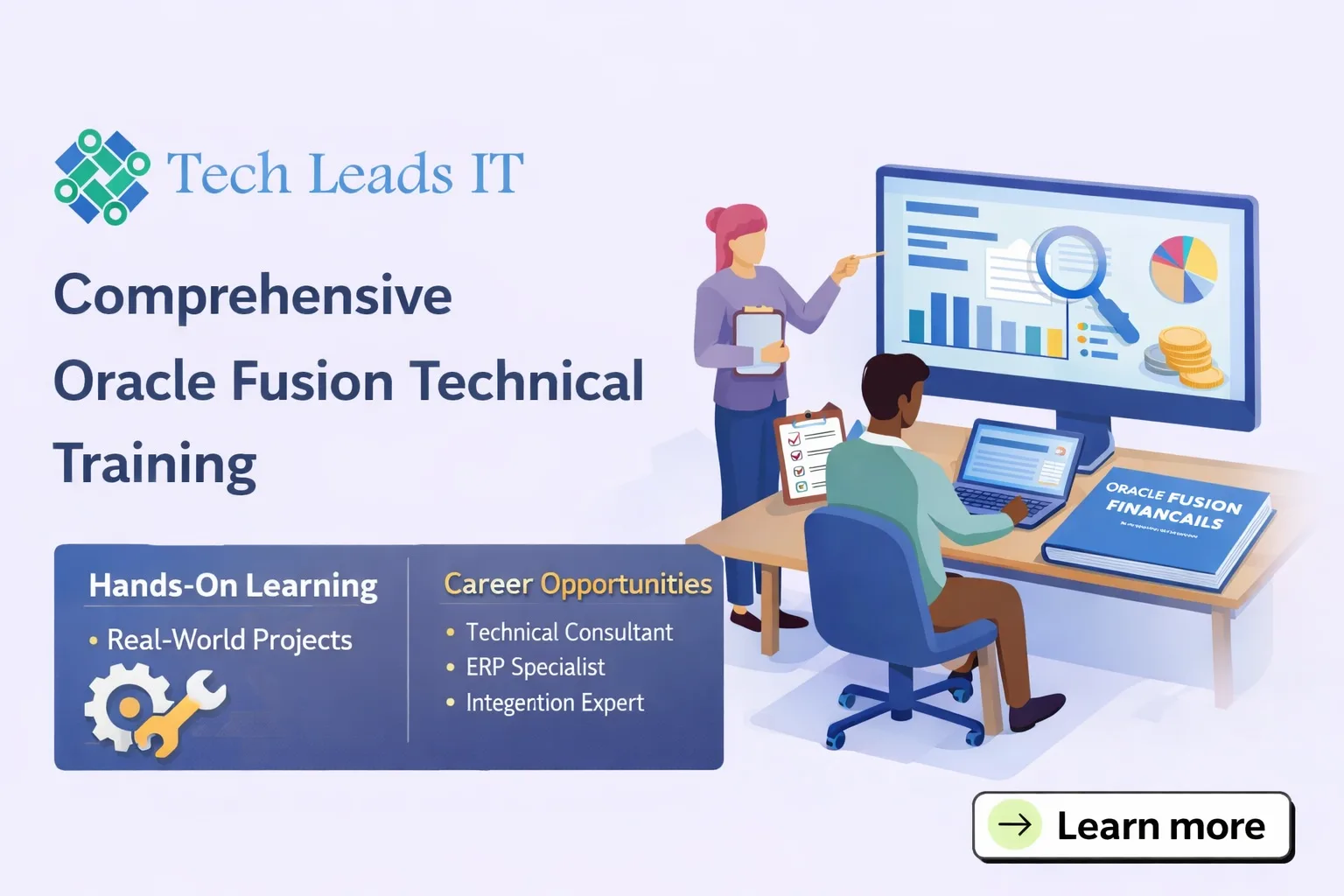
Learning by doing and seeing things in real time: One of the best things about Oracle Fusion Technical Training is that it focuses on learning by doing. Students work on real-life situations and case studies to get better at solving problems and getting ready for real-life problems.
Learning Oracle Fusion Technical Skills Has Its Benefits: A Lot of Jobs Available; Flexibility in your career; Better chances of getting a higher salary; Skills that Will Last;
- Job Options After Training:
- Consultant for Oracle Fusion Technical;
- Specialist in ERP Implementation;
- Developer of BI Publisher Reports;
- Consultant for Integration;
- Engineer for Cloud Application Support;
Final thoughts:
Oracle Fusion has changed how businesses work by giving them a single, cloud-based way to manage all of their processes. Oracle Fusion Technical Training is a full learning path that includes architecture, reporting, data migration, integrations, and customization. With the right training and real-world experience, people can have a successful career in cloud ERP.