
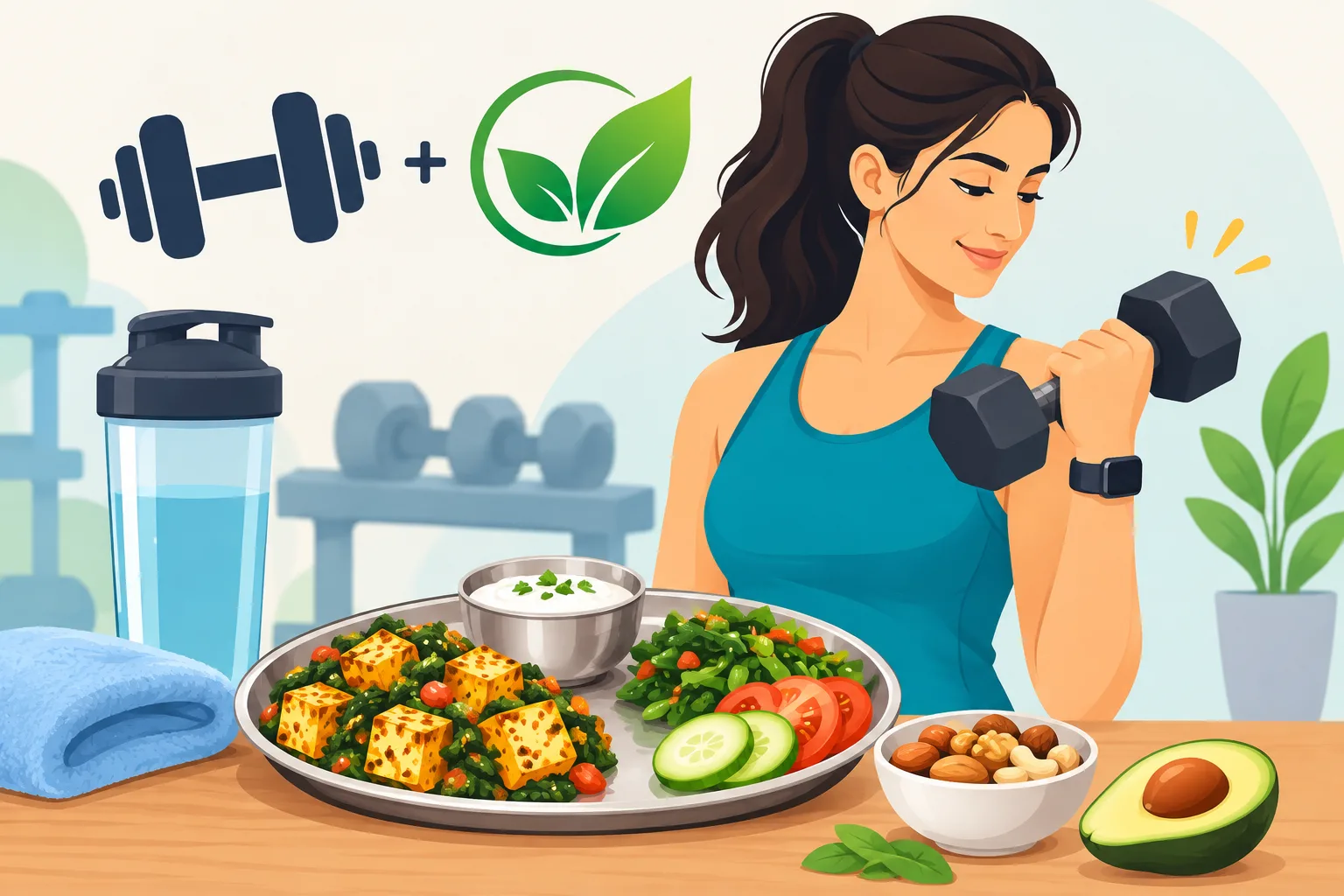
You have started lifting weights, found a workout routine you enjoy, and decided to try keto. Then comes the practical question: what do you actually eat?
At home, lunch might mean dal, rice, and sabzi. Your gym friend recommends chicken and brown rice. Meanwhile, your social media feed seems convinced that keto begins with butter coffee and ends with cheese.
There is a more practical middle ground.
You can combine strength training with a ketogenic diet, and your meals can still taste unmistakably Indian. But making the combination work takes more than replacing roti with paneer. You need enough protein, adequate food, and realistic expectations about performance. Research suggests keto can support similar gains in maximal strength to higher-carbohydrate diets, but it is not a proven shortcut to better workouts or bigger muscles.
Can You Build Strength on Keto?
Yes—getting stronger on keto is possible. The International Society of Sports Nutrition reports that ketogenic diets generally produce similar changes in maximal strength to higher-carbohydrate diets during resistance-training programmes. That does not mean the two approaches are interchangeable for every person or every training goal.[
There is an important distinction between increasing strength and maximising muscle growth. Keto has not demonstrated a clear advantage for building muscle, and overall exercise performance can be neutral or worse compared with a higher-carbohydrate diet. If your priority is demanding, high-volume training or competitive performance, strict carbohydrate restriction may not be the most helpful choice.
Think of keto as an eating option—not a fitness upgrade you must adopt to get results.
Understand What You Are Asking Your Body to Do
A ketogenic diet restricts carbohydrates enough to increase the production of ketones, which the body can use as fuel. Strength training, meanwhile, asks your muscles to perform repeated, demanding work and then recover. The challenge is to support that work while eating within a restrictive carbohydrate allowance.
This is where enthusiasm can sometimes get ahead of planning. Cutting rice, roti, fruit, and several other foods without replacing their energy or nutrients can leave your diet poorly matched to your training.
Rather than judging the plan only by whether you are “in ketosis,” pay attention to the whole picture: your strength, recovery, energy, and ability to eat consistently. Ketosis alone does not establish that a diet is supporting athletic performance.
Put Protein at the Centre of Your Plate
One common misunderstanding about keto is that protein needs to be kept extremely low. For someone lifting weights, that can distract from an important priority: eating enough protein to support muscle maintenance and growth.
The International Society of Sports Nutrition recommends approximately 1.4–2.0 grams of protein per kilogram of body weight daily for most exercising adults. Individual requirements depend on training, goals, and health status.
For a healthy person weighing 70 kg, that translates to roughly 98–140 grams a day. It is a useful planning range—not a personalised prescription.
In an Indian kitchen, possible protein anchors include:
- Eggs prepared as bhurji, omelettes, or egg curry.
- Fish or chicken, grilled, roasted, or cooked in a suitable curry.
- Tofu in bhurji, stir-fries, or palak-based dishes.
- Paneer in meals where the portion fits your overall energy needs.
- Unsweetened strained curd or Greek-style yoghurt, with the carbohydrate content checked.
These are meal-building ideas rather than foods to eat without limits. Recipes, serving sizes, and packaged-product labels determine how they fit your plan.
Keep the Indian Flavours—Rethink the Meal Structure
Your food does not need to become bland just because carbohydrates are lower.
A useful way to plan is to begin with a protein source, add vegetables, and then decide how much added fat the meal needs. This keeps the focus on a complete meal rather than finding a keto substitute for every familiar food.
Here are a few combinations to experiment with:
| Meal | Vegetarian idea | Non-vegetarian idea |
|---|---|---|
| Breakfast | Tofu bhurji with capsicum and spinach | Masala omelette with sautéed vegetables |
| Lunch | Palak tofu with cauliflower rice | Grilled fish with beans or cabbage sabzi |
| Dinner | Paneer tikka with a vegetable side | Chicken curry with cauliflower or courgette |
| Optional snack | Unsweetened strained curd, if it fits your plan | Boiled eggs |
These examples are not a complete ketogenic meal prescription. Quantities, cooking ingredients, protein totals, and daily carbohydrate intake still need to be worked out.
And you do not need to make a separate elaborate meal every evening. One practical option is to share the household’s vegetable dish and prepare a suitable protein portion alongside it.
What About Dal, Rajma, and Chana?
This is often the hardest part for Indian vegetarians.
Pulses contain protein, but they also contribute carbohydrates. That means generous portions of dal, rajma, or chana may be difficult to accommodate within a strict ketogenic allowance.
The answer is not to label these foods “bad.” Instead, decide whether strict keto suits your preferred way of eating. A vegetarian plan built around pulses may be easier to sustain with a less restrictive carbohydrate target.
If staying keto means you are constantly struggling to assemble satisfying meals, reconsider the restriction—not your commitment to fitness. There is no established strength-training advantage that makes ketosis essential.
What Should You Eat Before and After Training?
You do not need to turn workout nutrition into another full-time job.
For protein, your total daily intake matters more than hitting a tiny post-workout window. Spreading protein-containing meals across the day is a practical approach, rather than relying on one large serving at dinner.
Depending on timing and your tolerance, you could try:
- A small portion of unsweetened strained curd before training.
- Eggs or tofu as part of a pre-workout meal.
- Paneer bhurji, fish, or chicken in your next main meal after training.
- A suitable protein supplement when food alone makes your target difficult to meet.
Check supplement labels rather than assuming every “fitness” product fits keto. Also, choose meal timing that feels comfortable—you do not need to force a heavy meal just before a workout.
Do Not Confuse Weight Loss With Better Training
A falling scale can feel encouraging, but it does not tell the whole story.
Early ketogenic weight loss includes changes in body water associated with reduced carbohydrate stores. Those shifts can also affect measurements of fat-free mass, making short-term body-composition results harder to interpret.[pmc.ncbi.nlm.nih]
Alongside weight, keep a simple record of:
- The weights and repetitions you complete.
- How your sessions feel.
- Your energy between workouts.
- How consistently you can follow the eating plan.
- Whether your meals are satisfying and varied.
If your weight is dropping but your workouts and recovery are steadily deteriorating, the plan deserves a review. Fat loss and fitness progress are related goals, but they are not identical.
Avoid These Common Planning Traps
Making every meal mostly added fat
Butter coffee may fit a carbohydrate target, but it is not a replacement for a protein-containing meal. For strength training, dietary fat should not crowd out the protein needed to support adaptation.
Changing everything at once
Starting keto, sharply cutting food intake, and dramatically increasing your training makes it difficult to identify what is—or is not—working. A more measured approach makes your own response easier to assess.
Assuming poor performance is something to ignore
Keto is not inherently superior for exercise. If it consistently makes training less productive, consider whether a less restrictive approach would serve your goals better.
Treating supplements as the foundation
Protein powder can be convenient, but it is not mandatory. The priority is meeting your overall protein needs; supplements are simply one possible way to help do that.
A Safety Check Before You Begin
Get medical guidance before combining a ketogenic diet with diabetes treatment. Insulin and sulfonylureas can increase the risk of low blood sugar when carbohydrate intake changes. SGLT2 inhibitors require particular caution because combining them with a ketogenic diet can increase the risk of ketoacidosis. Do not adjust medication yourself
Avoid treating extra salt or electrolyte supplements as a universal fix for feeling unwell. Persistent dizziness, weakness, or other concerning symptoms deserve medical assessment rather than being dismissed as part of the diet.
Make the Plan Fit Your Life
You do not need imported ingredients, endless cheese, or a kitchen full of supplements to make Indian-style keto meals.
You do need to be honest about the trade-offs. Keto can coexist with strength training, but it does not outperform a higher-carbohydrate approach simply because it produces ketones. Adequate protein remains important, and your training response matters more than the label on your diet.
Build meals around foods you enjoy. Keep track of how you perform. Leave room to change course.
The goal is not to become better at following food rules. It is to find a way of eating that supports the stronger, more capable person you are working to become.
This article provides general information and does not replace personalised advice from a qualified healthcare professional or sports dietitian.
FAQs
Q: Can I build muscle while following a keto diet?
A: Yes, it is possible to build muscle on keto when your training, protein intake, and overall food intake support that goal. However, keto has not shown a clear advantage over higher-carbohydrate diets for muscle growth. Getting stronger and maximising muscle size are also different goals, so choose your diet accordingly.
Q: How much protein do I need if I lift weights on keto?
A: For most healthy exercising adults, a useful guideline is 1.4–2.0 grams of protein per kilogram of body weight daily. For someone weighing 70 kg, that is approximately 98–140 grams. Your individual needs may differ depending on your training, calorie intake, and health, so treat this as a starting point rather than a prescription.
Q: Is keto better than a balanced diet for strength training?
A: Not necessarily. Research suggests that ketogenic diets can produce similar improvements in maximal strength to higher-carbohydrate diets, but they are not consistently better for exercise performance. The more useful choice is the one that supports productive training and is manageable for you.
Q: Can vegetarians combine Indian keto meals with strength training?
A: Yes, but it takes planning to meet protein needs while keeping carbohydrates low. Meal ideas include tofu bhurji, paneer tikka, and unsweetened strained curd, with portions and carbohydrate content checked. If strict keto makes it difficult to meet your protein needs or enjoy varied meals, a less restrictive approach is worth considering; ketosis is not required for strength gains.
Q: Do I need a protein shake after every workout?
A: No. A protein shake is a convenient option, not a requirement. You can meet your needs through food, supplements, or a combination of both. Total daily protein intake is more important than rushing to drink a shake immediately after your last set.link.
Q: Will keto make my workouts feel harder?
A: It can. Responses vary, and a ketogenic diet may not support exercise performance as well as a higher-carbohydrate approach for some people. If your training quality keeps declining, do not assume you simply need more discipline—review whether the diet suits your workload and goals.
Q: Does faster weight loss mean I am losing more body fat?
A: Not always. Early weight loss on keto includes changes in body water as carbohydrate stores decline. A quick drop on the scale therefore does not represent only fat loss. Track your strength, recovery, and longer-term progress alongside body weight.
Q: Do I have to stay in ketosis to get stronger?
A: No. Strength gains come from effective resistance training supported by adequate nutrition and recovery—not from ketosis itself. You can make progress on a ketogenic, moderately low-carbohydrate, or higher-carbohydrate eating pattern. Keto is an option, not a prerequisite.
Q: Is keto safe if I take diabetes medication?
A: Speak with your prescribing clinician before starting. Reducing carbohydrates can change medication needs, and combining keto with an SGLT2 inhibitor raises particular concerns about ketoacidosis, a potentially serious condition. Never change medication doses on your own.