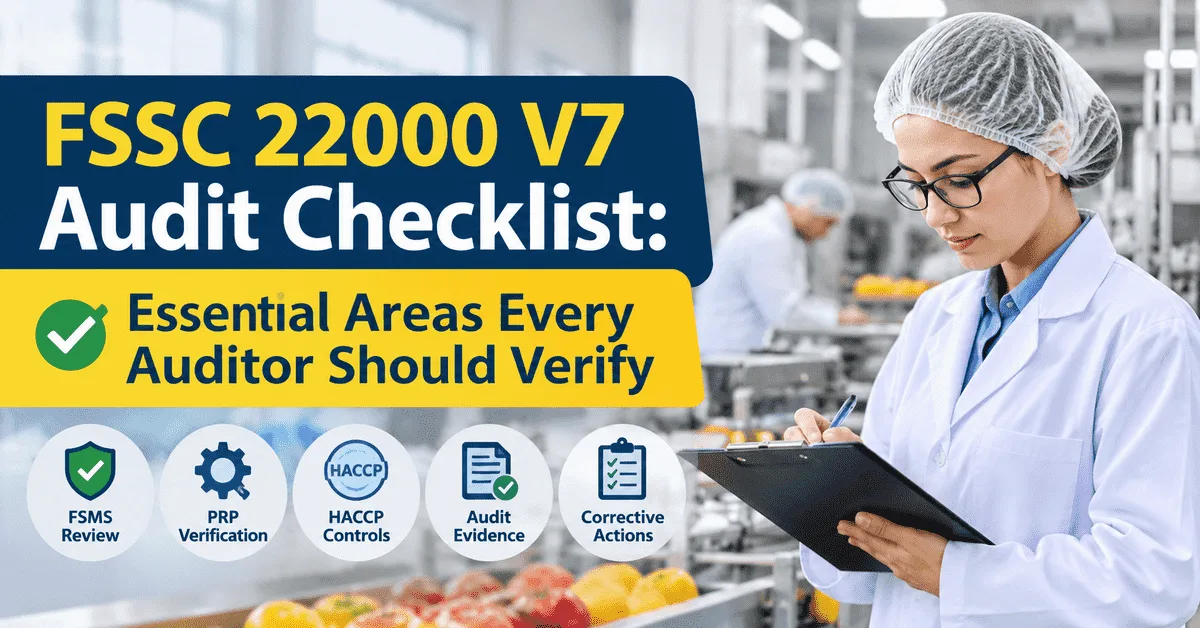
Food safety audits help organizations maintain effective controls, identify potential hazards, and meet certification requirements. Under FSSC 22000 Version 7, internal audits evaluate whether the Food Safety Management System (FSMS) is properly implemented, maintained, and continually improved.
An effective FSSC 22000 V7 audit checklist helps auditors review processes, examine documented information, collect objective evidence, and identify gaps requiring corrective action. Understanding essential verification areas makes audits more systematic and effective.
1. Review ISO 22000:2018 Requirements
The first step in an FSSC 22000 V7 internal audit is checking the implementation of applicable ISO 22000:2018 requirements. Auditors should review whether the organization has established, implemented, maintained, and continually improved its food safety management system.
Important areas include:
- Food safety policy and objectives.
- Organizational roles and responsibilities.
- Food safety hazard analysis.
- Operational planning and control.
- Monitoring and measurement activities.
- Management review and continual improvement.
Auditors should examine relevant FSMS documentation and records to confirm that these requirements are effectively implemented.
2. Verify Prerequisite Programs (PRPs)
Prerequisite Programs provide the basic environmental and operational conditions needed to maintain food safety. A proper PRP audit helps determine whether hygiene and operational controls are suitable for the organization's activities.
Key verification areas include:
- Cleaning and sanitation procedures.
- Pest control activities.
- Personnel hygiene and training.
- Equipment maintenance.
- Waste management.
- Prevention of cross-contamination.
- Storage and handling conditions.
Auditors should compare documented procedures with actual workplace practices to identify gaps in implementation.
3. Evaluate HACCP Plans and Food Safety Controls
HACCP verification is another important part of the food safety audit checklist. Auditors should determine whether hazards have been identified, assessed, and controlled through appropriate measures.
The audit should examine hazard analysis, control measures, critical control points (CCPs), critical limits, monitoring records, and corrective actions. Particular attention should be given to whether employees follow established procedures and maintain accurate records.
4. Check FSSC 22000 V7 Additional Requirements
Auditors must also consider the applicable FSSC 22000 V7 Additional Requirements alongside ISO 22000:2018 and relevant prerequisite program standards.
Depending on the organization's activities and food chain category, verification may include food safety and quality culture, food fraud prevention, food defence, allergen management, environmental monitoring, and other applicable controls.
The checklist should reflect the organization's scope and applicable requirements rather than applying every requirement indiscriminately.
5. Identify Nonconformities and Verify Corrective Actions
Effective nonconformity identification requires auditors to compare actual practices against defined requirements and evaluate supporting audit evidence.
When a gap is identified, auditors should record the finding clearly, explain the requirement that was not fulfilled, and document relevant objective evidence.
Corrective action verification should then establish whether the organization has addressed the root cause and implemented effective measures to prevent recurrence.
6. Improve Audit Preparation and Auditor Competence
Successful FSSC 22000 V7 audit preparation requires more than reviewing documents. Auditors need to understand the applicable requirements, prepare relevant questions, examine records, interview employees, and observe operational activities.
Developing these skills through structured learning can improve audit consistency and confidence. FSSC 22000 V7 auditor training provides structured online learning covering ISO 22000:2018, ISO 22002-100:2025, applicable sector-specific prerequisite programs, and FSSC 22000 V7 requirements. The course also includes audit checklists with more than 700 questions, supporting learners in understanding audit requirements and practical verification activities.
Conclusion
A well-prepared FSSC 22000 V7 audit checklist helps organizations evaluate food safety controls, review FSMS documentation, identify nonconformities, and verify corrective actions. By focusing on ISO 22000:2018 requirements, PRPs, HACCP verification, and applicable FSSC 22000 V7 Requirements, auditors can conduct more systematic and meaningful audits.
Continuous learning and practical audit knowledge also help food safety professionals strengthen their competence and contribute to the continual improvement of food safety management systems.