When it is time to replace your washing machine, one of the first decisions you will face is whether to choose a front-load or top-load washer. Both styles have come a long way, offering better cleaning performance, larger capacities, and more useful features than older generations.
But if your priorities are saving water and making the most of your laundry space, the difference between the two designs becomes more important.
The right washer depends on how often you do laundry, how much space you have, the size of your typical loads, and which features are useful to your household. At Riddle Appliance, we recommend looking at the complete picture rather than choosing a washer based only on appearance.
Let's compare Front-Load vs. Top-Load Washers and look at what you should know before choosing your next washer.
Front-Load vs. Top-Load Washers: What's the Difference?
The biggest difference is how you load and wash your clothes.
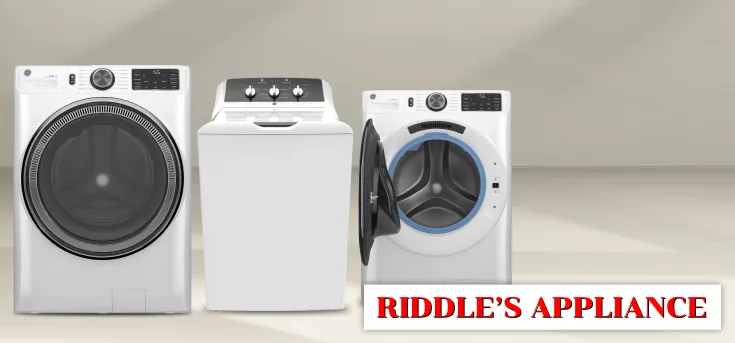
Top-Load Washers have a lid on the top of the appliance. Depending on the model, they may use an agitator or another wash system to move clothing through the water and detergent. Their familiar design makes them convenient for homeowners who prefer loading laundry from above.
Front-Load Washers have a door on the front of the appliance. The drum rotates horizontally, tumbling clothes through a controlled amount of water and detergent.
Front-load models can also be stacked with a compatible dryer, making them particularly useful in smaller laundry rooms.
Neither style is automatically right for every home. Your available space, laundry habits, household size, and water-saving goals should all factor into the decision.
How Front-Load Washers Work
A front-load washer cleans clothes by tumbling them through water and detergent inside a horizontal drum. Instead of filling the entire drum with water, the machine uses a controlled amount while the drum rotation helps move the clothing through the wash.
This design can provide significant water savings. According to ENERGY STAR, certified front-load washers use about 50% less water than standard top-load agitator washers.
Another advantage is the usable drum space. Without a traditional center agitator taking up space, front-load models offer plenty of room for larger items such as bedding and towels.
For example, the GE GFW550SSNWW offers a 4.8 cu. ft. capacity and features an UltraFresh Vent System with OdorBlock, Dynamic Balancing Technology, and built-in WiFi.
How Top-Load Washers Work
Top-load washers remain popular because they offer a familiar, straightforward laundry experience. You simply open the lid, place the clothes inside, select your cycle, and start the wash.
Some top-load washers use a traditional agitator, while others use an impeller-style wash system. Modern models can also offer features designed to improve cleaning performance, rinsing, and water management.
The GE GTW385ASWS provides a 4.3 cu. ft. capacity with Deep Rinse, manual water-level controls, and an agitator design. The GE GTW485ASWB increases the capacity to 4.5 cu. ft. and adds Wash Boost along with Deep Rinse and manual water-level controls.
These models are worth considering if you prefer the convenience and familiar operation of a top-loading washer.
Front-Load vs. Top-Load Washers: Which Uses Less Water?
If reducing water consumption is one of your biggest priorities, Front-Load vs. Top-Load Washers is an important comparison.
Front-load washers generally use less water because their tumbling wash action does not require the drum to fill to the same level as many traditional top-load agitator washers.
ENERGY STAR reports that certified front-load washers use about 45% less energy and 50% less water than standard top-load agitator washers. Modern top-load impeller washers can also be efficient, so it is important to compare the specifications of individual models rather than assuming every top-load washer uses the same amount of water.
Your actual water savings will also depend on how often you run the washer, the size of your loads, and which cycles you use.
Which Washer Saves More Space?
When it comes to space, the answer depends on your laundry room layout.
A front-load washer can be especially useful when you have limited floor space because it can often be paired with a compatible dryer in a stacked configuration.
Top-load washers generally work best side by side because the lid needs room to open from above.
Washer Dimensions and Laundry Room Layout
Before purchasing a new washer, measure the width, depth, and height of your available space.
Also measure the doorway and path leading to the laundry area. A washer that technically fits the laundry room may still be difficult to deliver if the entryway or hallway is too narrow.
Remember to leave room for water connections, drain hoses, electrical connections, and normal service access.
Stacking Options
If floor space is limited, a front-load washer and compatible dryer can be stacked to create a more compact laundry setup.
This can be particularly helpful in laundry closets, apartments, smaller homes, and utility rooms where every inch of floor space matters.
Top-load models generally are not intended for standard stacking because the lid needs clearance above the washer.
Door and Lid Clearance
Front-load washers require enough space in front of the appliance for the door to open fully.
Top-load washers require enough space above the appliance for the lid to open.
Think about shelves, cabinets, countertops, walls, and other nearby objects before choosing your washer style.
Front-Load Washers: Pros and Cons
Front-Load Washers offer several advantages for homeowners who want water efficiency and flexible installation options.
Pros:
- Generally use less water
- Efficient tumbling wash action
- Large usable drum capacity
- Suitable for many stacked laundry configurations
- Available with advanced wash and convenience features
Things to consider:
- The door requires clearance in front of the machine
- Loading and unloading may require more bending
- Some homeowners simply prefer the convenience of a top-loading design
GE Front Load Washer GFW550SSNWW
The GE GFW550SSNWW provides a 4.8 cu. ft. capacity and includes an UltraFresh Vent System with OdorBlock, Dynamic Balancing Technology, and built-in WiFi. It is a useful option for homeowners who want a front-load washer with modern convenience features.
Maytag Front Load Washer MHW5630HW
The Maytag MHW5630HW offers a 4.5 cu. ft. capacity along with a 12-hour Fresh Spin option and Steam Clean option. This model is worth considering when comparing Front-Load Washers for everyday household laundry.
GE Front Load Washer GFW655SSVWW
The GE GFW655SSVWW offers a larger 5.0 cu. ft. capacity and includes an UltraFresh Vent System with OdorBlock, SmartDispense Technology, Dynamic Balancing Technology, and Dryer Control.
The larger capacity can be useful for households that regularly wash bulky items or larger loads.
Top-Load Washers: Pros and Cons
Top-Load Washers are a practical choice for homeowners who prefer simple loading and a familiar washer design.
Pros:
- Easy to load from above
- No front door swing to consider
- Convenient for adding and removing laundry
- Available with different wash systems
- Offered in a variety of capacities
Things to consider:
- The lid needs overhead clearance
- Traditional agitator models may use more water than efficient front-load models
- Standard stacking is generally not an option
GE Top Load Washer GTW385ASWS
The GE GTW385ASWS offers a 4.3 cu. ft. capacity with Deep Rinse, manual water-level controls, and an agitator wash system.
It is a straightforward choice for homeowners who want a familiar top-load design with practical controls for everyday laundry.
GE Top Load Washer GTW485ASWB
The GE GTW485ASWB provides a 4.5 cu. ft. capacity and includes Wash Boost, Deep Rinse, manual water-level controls, and an agitator.
The additional capacity can be useful for families that regularly wash larger loads while still preferring a traditional top-loading design.
Maytag Top Load Washer MVW4005SW
The Maytag MVW4005SW features a 3.8 cu. ft. capacity, Deep Fill option, Quick Wash Cycle, and Dual Action Agitator with a fabric softener dispenser.
It is a practical option for homeowners who want the familiar operation of a top-load washer with useful cycle choices.
Cleaning Performance and Fabric Care
Cleaning performance depends on much more than whether a washer loads from the front or top.
The wash system, cycle selected, detergent, water temperature, load size, and type of clothing can all affect the results.
Front-load washers use a tumbling action that can provide thorough cleaning while using less water. Modern top-load washers have also improved significantly and can offer specialized cycles and wash options for different types of loads.
If you regularly deal with heavily soiled clothing, look for features such as deep-fill options, stain treatment cycles, steam, specialized wash programs, and temperature controls.
For example, the GE GFW655SSVWW combines its 5.0 cu. ft. capacity with SmartDispense Technology and other convenience features designed for everyday laundry management.
Which Washer Is Easier to Load and Unload?
This comes down largely to personal preference.
Top-load machines can be convenient for homeowners who prefer loading and unloading laundry from above. There is no front door to open, and you can easily see into the basket.
Front-load machines require you to place clothing through the front door. A pedestal can raise the washer to a more comfortable height, while a stacked installation can save valuable floor space.
If you frequently wash bulky items such as comforters and blankets, the open drum design of a front-load washer can also be useful.
Front-Load vs. Top-Load Washers: Energy and Water Efficiency
Water and energy efficiency should be considered together.
Using less water can also reduce the energy required to heat that water. ENERGY STAR uses measurements such as Integrated Water Factor and Integrated Modified Energy Factor to help compare washer efficiency.
The actual savings will depend on the washer, your household's laundry habits, load sizes, and selected cycles.
If water conservation is a major priority, look closely at efficient front-load models. If you prefer a top-load design, compare newer efficient models and their specifications rather than assuming all top-load washers have the same water usage.
Which Washer Is Better for Large Families?
For a large household, capacity should be one of the first things you compare.
A family doing several loads each week may benefit from a larger washer because it can accommodate more clothing, towels, bedding, and other bulky items in each cycle.
The GE GFW655SSVWW provides 5.0 cu. ft. of capacity, while the GE GFW550SSNWW offers 4.8 cu. ft. The Maytag MHW5630HW provides 4.5 cu. ft.
Among the top-load options, the GE GTW485ASWB offers 4.5 cu. ft.; the GE GTW385ASWS provides 4.3 cu. ft., and the Maytag MVW4005SW has a 3.8 cu. ft. capacity.
Rather than automatically choosing the largest washer, consider the size of your typical laundry loads. A washer that fits your actual routine can be more practical than simply choosing the highest capacity available.
Front-Load vs. Top-Load Washers: Which One Should You Choose?
The choice between Front-Load Washers and Top-Load Washers ultimately depends on how your household does laundry.
A front-load model may be a strong fit if water efficiency, larger usable drum space, and stacking flexibility are important to you.
A top-load model may be more convenient if you prefer easy overhead loading, want a familiar design, or have plenty of floor space for a side-by-side washer and dryer.
Before making your decision, measure your laundry room, check installation requirements, compare capacities, and consider the features you will actually use.
Final Thoughts
When comparing Front-Load vs. Top-Load Washers, there is more to consider than simply choosing the style you have used before.
Front-load washers generally have an advantage in water efficiency, and their design can make them a practical choice for laundry rooms where stacking is useful. Top-load washers remain a popular option for homeowners who prefer easy loading and a familiar washing experience.
The most important thing is finding a washer that fits your space, household size, laundry habits, and priorities.
Ready to Find the Right Washer for Your Home?
At Riddle Appliance, we can help you compare front-load and top-load washers based on capacity, features, installation requirements, and available laundry space. Compare the available models and find the washer that makes sense for your home and everyday routine.
Originally Posted At : Front-Load vs. Top-Load Washers: Which Saves More Water and Space?