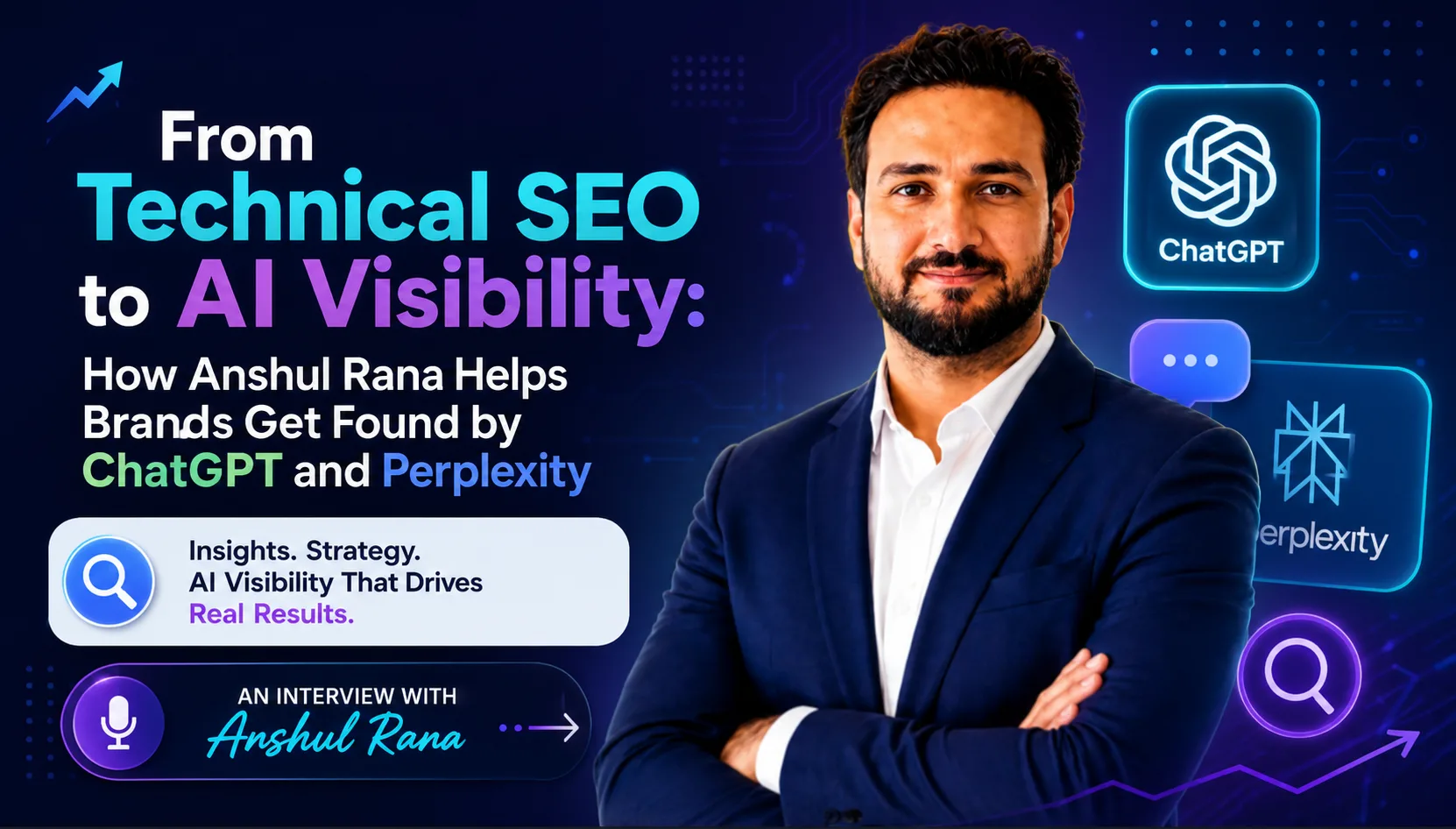
Most SEO specialists build their careers around a single discipline. Anshul Rana has spent his career at the intersection of multiple disciplines: technical SEO, structured data, and now AI visibility optimization. Founder of The Digital Geek and a Top Rated Plus Upwork professional with a 100% Job Success Score, Rana works with clients ranging from Indian SaaS companies to Australian IT firms and US-based healthcare providers. In this conversation, he explains how his technical background shapes his approach to GEO and AI search, and what the path from traditional SEO to AI visibility actually looks like for a business.
The Interview
Q: Your background is in technical SEO. How does that inform the way you approach AI visibility work?
A: Technical SEO taught me that search engines are machines, and machines need clean signals to make accurate decisions. That fundamental insight transfers directly to AI visibility. LLMs and generative AI systems are not reading your content the way a human does. They are parsing structure, verifying entities, and extracting passages based on how well your content is organized and how consistently your brand is represented across the web. Technical SEO skills like schema markup implementation, crawl optimization, site architecture, and structured data management are now directly relevant to AI search performance. The practitioners who understand the technical layer have a significant advantage in this space.
Q: You work with clients across healthcare, legal, IT, and SaaS. Can you walk us through what an AI visibility gap looks like for a real client?
A: A good example is a healthcare client in the US we worked with. Their website had strong organic rankings for clinical procedure terms. But when you asked ChatGPT or Perplexity questions like ‘what is the best treatment for trigeminal neuralgia’ or ‘which spine specialists in New Jersey treat herniated discs,’ they were not appearing in the responses at all. Competitors with weaker organic rankings but better structured content and stronger third-party mentions were being cited instead. The gap was not in their SEO rankings. The gap was in their AI entity footprint: missing schema markup, no author credentials on clinical pages, no consistent mention across medical directories and publications. Closing that gap required a combination of on-page restructuring, schema implementation, and off-page entity building.
Q: What does entity building actually mean in practice?
A: Entity building is the process of making your brand clearly identifiable and consistently represented across every surface that AI systems reference. That starts with your own website: Organization schema, Person schema for key team members, consistent NAP data, clear topical focus. Then it extends outward: Wikidata entries if relevant, LinkedIn profile alignment, citations in industry directories, press mentions, and community presence on platforms like Reddit and Quora where AI systems often pull third-party validation. Research shows that brands present across four or more platforms are nearly three times more likely to appear in ChatGPT recommendations. The AI is cross-referencing signals from multiple sources. Your job is to make those signals consistent and authoritative. For a deeper look at how LLMs actually process brand mentions versus backlinks, read LLMs Don’t Read Link Graphs They Read Sentences.
Q: How does schema markup specifically contribute to AI citations?
A: Schema markup is the closest thing we have to a direct communication channel with AI systems. It tells the AI explicitly what your content is, who created it, what organization it belongs to, and what questions it answers. Research published in 2026 found that content with proper schema markup has a 2.5 times higher chance of appearing in AI-generated answers. Sites with complete core schema see up to 40 percent more AI Overview appearances. For technical SEO specialists, this is familiar territory. FAQPage schema, Article schema with author markup, Organization schema with sameAs links to authoritative profiles, and Service schema for service-based businesses are the core implementations. If you want a practical walkthrough of schema implementation for businesses, this complete guide to Schema Markup for Local Business covers exactly what to implement and how. The key is accuracy. Post-March 2026 Google updates began using schema as a trust verification signal, not just a display trigger. Inaccurate schema now works against you.
Q: What does a typical engagement look like when a client comes to you specifically for AI visibility?
A: It starts with a citation audit across the major AI platforms relevant to their category. We ask the questions their clients ask and map who is appearing, what content they are citing, and what entities they are associating with those brands. Then we build a gap analysis: what schema is missing, what third-party mentions are absent, what content is too thin or poorly structured to be extracted. The remediation work spans on-page restructuring, schema implementation, content brief creation for new pages, and an off-page strategy targeting relevant directories, publications, and community platforms. We also set up tracking using tools like Otterly.ai or manual prompt monitoring so the client can see citation frequency improve over time. Most clients have never measured this before. That visibility alone changes how they think about content investment.
Q: Is AI visibility work something a business can handle in-house, or does it require a specialist?
A: A business with a capable in-house marketing team can handle the basics: improving content structure, adding FAQ sections, and implementing core schema using a plugin or their developer. But the more technical elements, particularly schema nesting, entity graph alignment, and understanding what third-party sources actually influence AI citations in a specific category, benefit from specialist knowledge. The space is also moving fast. What worked six months ago may not work the same way today. For businesses where AI search visibility is a real commercial concern, working with someone who is actively doing this across multiple clients and categories is worth the investment.