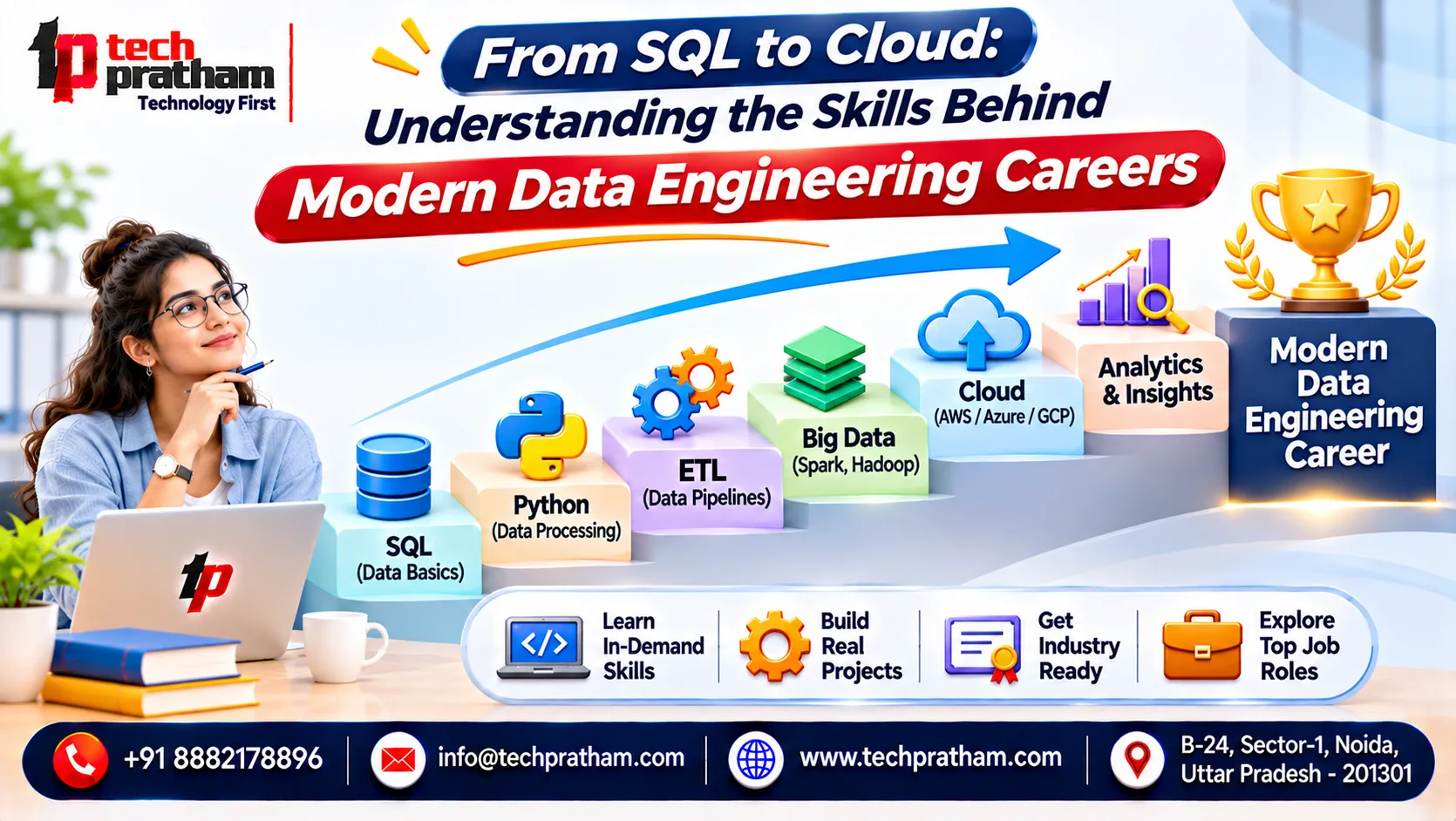
When people first explore data engineering, they often encounter a long list of technologies. SQL, Python, Apache Spark, cloud platforms, data warehouses, APIs, orchestration tools, and streaming systems may all appear in the same job description. This can create the impression that becoming a data engineer means learning as many tools as possible.
That is not necessarily the right way to think about the field. The more useful question is how these technologies work together to solve a data problem. Data engineering is fundamentally about creating dependable systems that collect, process, store, and deliver data. Once that bigger picture is clear, the individual technologies become easier to understand and learn.
Building the Foundation With SQL and Databases
A learner's first major challenge is usually understanding how data is stored.
SQL provides the language needed to retrieve, filter, combine, transform, and analyze relational data. Database concepts provide the structure behind those queries.
This foundation matters because later technologies do not eliminate the need for database knowledge.
Even when organizations use cloud platforms and distributed systems, engineers still need to understand data structures, relationships, indexing, transactions, and query performance. For someone considering a Data Engineering Online Course in India, SQL should therefore be viewed as a core skill rather than a preliminary topic to rush through.
Moving From Code to Data Workflows
Python adds another dimension. While SQL is particularly useful for working with structured data and databases, Python can support automation, file processing, API integration, transformation logic, testing, and pipeline development. The important learning transition happens when a student stops thinking about isolated scripts and starts thinking about workflows.
For example, imagine receiving sales information every morning from several systems. A data engineer might need to collect the files, validate their structure, remove duplicates, transform the records, store them in a suitable destination, and make the resulting dataset available for analytics.
That is a workflow, not simply a programming exercise.
Understanding ETL, ELT, and Data Pipelines
ETL and ELT concepts help learners understand how data moves through an organization. Data can originate from applications, databases, APIs, spreadsheets, event systems, or external services. The engineering challenge is to move that information into useful destinations while maintaining quality and reliability.
A pipeline can include extraction, transformation, loading, scheduling, monitoring, logging, and error handling. This is one reason Data Engineering Training should ideally include practical pipeline exercises rather than concentrating only on theoretical definitions.
Why Data Warehouses Matter
Once data is collected, organizations need appropriate systems for storing and analyzing it. Data warehouses are designed to support analytical workloads. Learners may study concepts such as dimensional modeling, fact and dimension tables, schemas, partitioning, and analytical queries.
Understanding these concepts helps explain why data engineers make architectural decisions instead of simply transferring files between systems. For example, a reporting team may need fast access to historical sales information. The engineer must consider how the data should be modeled and transformed so that downstream users can work efficiently.
The Shift Toward Cloud Data Engineering
Cloud platforms have changed how many organizations build data systems.
Instead of maintaining every server and storage component themselves, companies can use managed services for storage, databases, compute, orchestration, analytics, and machine learning workloads.
This makes cloud knowledge valuable, but learners should avoid treating it as a list of service names. The stronger approach is to understand the architecture first and then learn how a particular cloud platform implements those components. A structured Data Engineering Course in India can help learners make this connection by introducing cloud technologies after foundational data concepts.
Distributed Processing and Spark
When datasets become large, processing may need to be distributed across multiple machines. Apache Spark is widely associated with this area. Learners can explore distributed data processing, DataFrames, transformations, actions, partitioning, and optimization. However, the technology becomes much easier to understand once learners already know SQL, Python, data transformation, and pipeline fundamentals. This illustrates an important principle: data engineering skills are cumulative.
Projects Connect Everything
The strongest learning experience usually happens when multiple technologies are brought together. A project might begin with an API or database source, move through Python-based processing, apply SQL transformations, load information into a warehouse, and run through a scheduled pipeline. Such projects help learners understand the relationship between components. They also reveal practical challenges that tutorials sometimes hide: missing values, inconsistent formats, duplicate records, failed jobs, changing schemas, and incomplete source data.
The Role of Certification
Certification can be useful as a structured learning target. Data Engineering Certification Training in India may help learners prepare for relevant certification objectives while reinforcing technical concepts. But certification should support practical learning rather than replace it. Data engineering is an implementation-oriented field, so the ability to build, explain, test, and troubleshoot systems remains important.
Final Thoughts
The path from SQL to cloud is not really a collection of disconnected technologies. It is a progression from understanding data to processing it, organizing it, moving it reliably, and operating systems at scale. Learners who understand this progression can approach Data Engineering Training in India with a clearer idea of what they are building toward and why each skill matters.