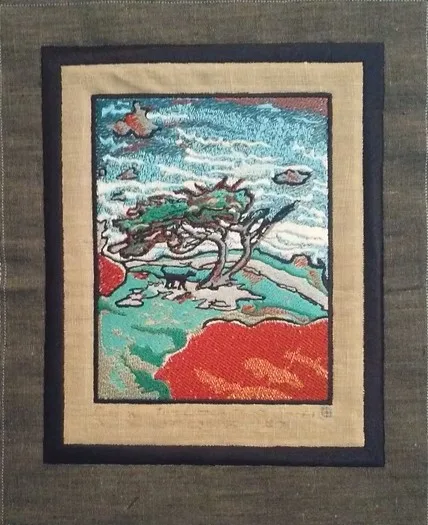
A photograph records a place as it appears; embroidery asks you to feel it. The real craft begins when you decide which details deserve thread, texture, colour, and artistic freedom.
When should a photograph become stitched art?
You do not need to embroider every detail in a photograph. In fact, doing so can weaken the artwork. Fine embroidery begins when you choose what to keep, simplify, soften, or transform.
A strong textile interpretation keeps the heart of the scene while allowing the needle to speak differently from a camera. That difference gives machine embroidered fine art its own visual language.
Think about a coastal dune lake along Northwest Florida’s scenic Highway 30A. The photograph may show reeds, water, sand, sky, trees, reflections, and changing light. Your stitched artwork can say more with less.
Start with the feeling, not every detail
Before choosing an image for embroidery, ask yourself one simple question: What do you want to remember? The answer often reveals the true subject better than the photograph itself.
Perhaps it is the quiet water at sunrise. Maybe it is the soft line of dunes, the shape of a distant tree, or the calm space between land and sky.
That emotional focus helps you decide which elements deserve attention. A textile artist can then reduce background clutter, strengthen important forms, and create breathing room around the central subject.
Let the focal point guide the needle
Every successful landscape needs a visual place where your eyes naturally rest. In embroidery, this focal point becomes even more important because thread creates physical texture and visual weight.
You might emphasize a cluster of grasses, a glowing horizon, or a reflection across still water. Less important details can become simpler stitches, quieter colour areas, or open fabric.
This approach keeps the artwork clear and helps you connect with the scene quickly. It also makes the piece easier to enjoy when displayed in a home, office, or gallery setting.
Simplification can make the scene stronger
A photograph captures thousands of tiny visual facts. Embroidery does not need to copy them. Removing unnecessary details can make the landscape feel more spacious, peaceful, and expressive.
Look closely at your source image. Which lines define the landscape? Which shapes create depth? Which details could disappear without changing the feeling?
Those answers form the foundation of the textile design. Simplification is not a loss of accuracy. It is a thoughtful editing process that gives the artist room to create.
Texture turns a picture into an experience
Photography gives you visual texture. Embroidery gives you physical texture. That difference is one of the most exciting reasons to transform an image into stitched artwork.
Long stitches can suggest reeds or grasses. Dense thread can create visual weight in trees. Open areas can suggest sky, water, or distance. Each stitch adds touch and movement.
With machine embroidered fine art, thread can function much like ink in printmaking. Layered colour compositions are drawn and built through stitching, creating a repeatable artistic process with a distinctive textile character.
Colour does not have to obey the photograph
A camera records colour under specific light and conditions. Textile art gives you permission to interpret that colour. You can make water cooler, skies softer, or grasses richer.
The goal is not to invent a completely different landscape. Instead, you can adjust colour to strengthen mood, balance, depth, and visual harmony.
This is especially powerful for coastal artwork, where pale sand, blue-green water, muted grasses, and warm sunlight can create a calm palette suited to modern coastal interiors.
Know when transformation becomes the better choice
Some photographs work beautifully as direct references. Others become stronger when you crop them, simplify their forms, alter their colours, or change the balance between positive and negative space.
If the original image feels busy, ask what you would remove. If it feels flat, consider where texture or stronger shapes could create depth.
If you are choosing artwork for your home, this process also matters. You may find that an interpreted landscape works better with your room than a literal photographic reproduction.
Embroidery can function as printmaking
Fine art embroidery can be understood as more than decorative needlework. When an artist develops a repeatable design and produces numbered impressions, embroidery can operate as a printmaking medium.
Like serigraphy, block printing, or etching, the process can translate an original composition into a series. Here, thread replaces ink and adds a tactile surface that traditional prints cannot provide.
Sequential numbering also gives each edition a clear place within the artist’s body of work. Custom framing can then turn the textile print into a finished presentation for collectors and interior spaces.
Choose the right image for your textile artwork
The strongest source image usually has a clear subject, memorable shapes, balanced space, and enough contrast to survive artistic simplification. You do not need a perfect photograph.
You need an image with something worth translating. A quiet shoreline, a bend in the water, or a small group of coastal plants can carry more artistic potential than a crowded scenic view.
The same thinking applies beyond landscapes. If you want to commission a custom embroidered portrait, the artist must first identify the expression, gesture, or feature that gives the person their character.
What should you look for when buying?
When shopping for textile artwork, look beyond the image alone. Ask how the design was created, how colour was developed, whether the work belongs to a numbered edition, and how it will be presented.
If you are searching for a machine embroidery painting for sale, study the stitch detail, composition, materials, scale, and overall finish. These details help you understand what you are actually bringing into your space.
For collectors, an unframed textile art print can also offer flexibility. You can select framing that suits your interior while preserving the character of the stitched artwork.
Let the photograph become something new
The best embroidered interpretation does not compete with the photograph. It gives the original scene another voice. You still recognize the place, yet you experience it through thread, colour, texture, and human choice.
That is where photography and fiber art meet. A photograph preserves a moment; embroidery edits, slows, and reshapes that moment into an object you can live with.
For landscapes inspired by Northwest Florida’s coastal dune lakes and Highway 30A, this transformation can preserve more than scenery. It can hold the quiet rhythm of water, sand, grasses, light, and place.
When you choose machine embroidered fine art, look for the story behind the stitches as much as the scene itself. The right textile artwork should feel considered, tactile, and emotionally connected to the landscape it interprets.