
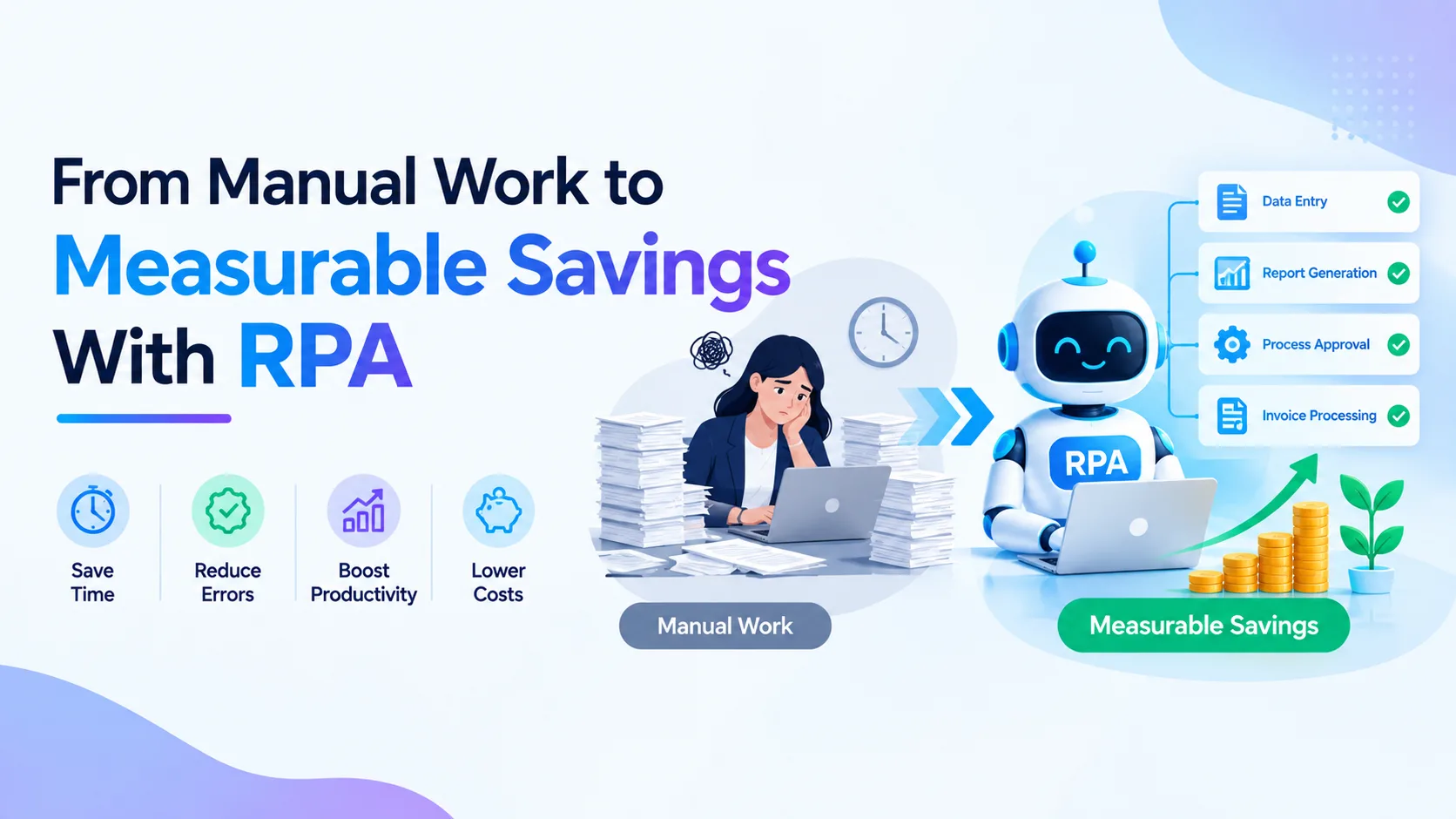
The Journey From Manual Work to Measurable Savings Using RPA
Companies are always seeking to cut their running costs, boost productivity, and maximise the output of their current employees. But many teams still waste hours on repetitive tasks like data entry, invoice processing, report generation, handling emails, and updating systems. One way to transition these activities from manual to automated is through the use of Robotic Process Automation (RPA).
Instead of replacing complete business processes, RPA involves software bots to automate repetitive, rule-based tasks. This enables workers to concentrate on work that involves judgment, creativity, communication, and problem solving — and the companies to see measurable improvements in their efficiency and cost control.
Why Is Manual Work So Costly?
The manual approach can seem affordable because it's using people and things that are already available. But when the same activities are repeated thousands of times, their real cost can become large.
Staff members may be copying information between applications for a significant part of their day, checking records, updating spreadsheets, or answering basic requests. These activities are time consuming, and also provide opportunities for human error.
When a human is used, they are often subject to hidden costs that are typical of manual labour, such as:
- Time spent on repetitive administrative activities
- Data-entry and processing errors
- Rework due to wrong information
- Slowdown in regular procedures
- As the number of transactions rises, so do the operating expenses
Modern AI development services increasingly complement RPA by adding intelligence to these automated workflows — helping systems handle not just rule-based tasks but also context-dependent decisions that would otherwise still require human input.
How Repetitive Tasks Are Transformed Into Automated Workflows With RPA
RPA bots can communicate with applications as a human user. They can open systems, retrieve information, input data, check data, create documents, and transfer data between platforms following fixed rules.
For instance, an accounts payable process could involve an employee receiving an invoice, scanning for important information, cross-checking information, typing the data into an accounts payable system, and updating a spreadsheet. If this workflow is well-defined, an RPA bot can do these things automatically.
This provides a process that can be repeated multiple times, involves less manual interaction, and reduces the time that manual tasks are repeated by employees. Organizations that also invest in artificial intelligence development services alongside RPA gain an even greater advantage — enabling bots to handle both structured and unstructured data with greater accuracy.
Where Businesses Can Apply RPA
RPA is especially valuable in cases of repetitive, rule-based, high-volume, and somewhat predictable processes. It can be used across several departments without any organization having to abandon the current software.
Common applications include:
Finance: Invoice processing, payment reconciliation, expense reporting, and financial data consolidation.
Human Resources: Onboarding of employees, payroll data updates, attendance tracking, and document management.
Customer Service: Updating of customer data, classification of tickets, and regular information retrieval.
Operations: Order processing, inventory updates, reports, and data synchronisation.
IT: User account provisioning, system monitoring, regular data transfer, and service requests.
Assessing the Value of RPA Benefits
The more you can measure the impact of automation, the more valuable it is. Businesses should have a baseline to compare performance after they implement the automation process. Professional RPA services typically include implementation support and performance tracking to help organizations establish these benchmarks from the start.
Useful metrics include:
- The number of hours saved each month
- Cost per transaction
- Processing time
- The percentage of errors and rework
- The number of transactions that were completed
- The time that employees can allocate to more productive tasks
For example, if there are 1,000 transactions per month that must be completed manually and each transaction takes 6 minutes, the organisation is spending approximately 100 working hours per month on the activity. Automation of many of the processes through RPA can result in significant capacity that can be diverted to other areas.
RPA Is More Than a Cost-Cutting Tool
While cost reduction is a key driver of RPA adoption, it is just a piece of the RPA value. There is also an opportunity to enhance consistency, scalability, and process visibility through automation.
Bots can execute standardized workflows without fatigue or variations in performance. They can also work outside of business hours, helping organizations move work through quicker when it's right for them.
Employees can have more time to do analysis, customer work, decision-making, and strategic tasks after eliminating repetitive tasks.
Creating an RPA Strategy — From the Business Perspective
The key to successful RPA adoption is not just the technology; it's the process. Companies need to look at processes where automation can provide an obvious benefit to the operation.
The following are examples of factors that may be included in a practical evaluation:
- How frequently is the process performed?
- How much time does it take employees?
- How predictable are the rules?
- What is the frequency of the errors?
- What would be the impact of quicker processing on the business?
- Are there results that can be measured following automation?
It can be easier to show results in processes with high volume and clear objectives before attempting to do so in other processes throughout the organization. Teams that combine RPA with AI app development services can extend automation even further — building intelligent applications that handle exceptions and edge cases beyond standard rule-based bots.
Transitions From Manual Work to Measurable Results
RPA offers a roadmap for businesses to move from repetitive manual tasks to more efficient operations. Predictable processes that can be automated can save organizations from unnecessary effort, inconsistent processing, and measurable operational savings.
The best way to do it is not to automate everything. Rather, businesses should look for the right processes, set up measurable metrics, track results, and continuously optimize the automated processes.
RPA is not a simple assembly of software bots, but rather an automation tool that is aligned with clear business goals. It transforms repetitive tasks into tangible productivity, efficient resource utilization, and operational sustainability.