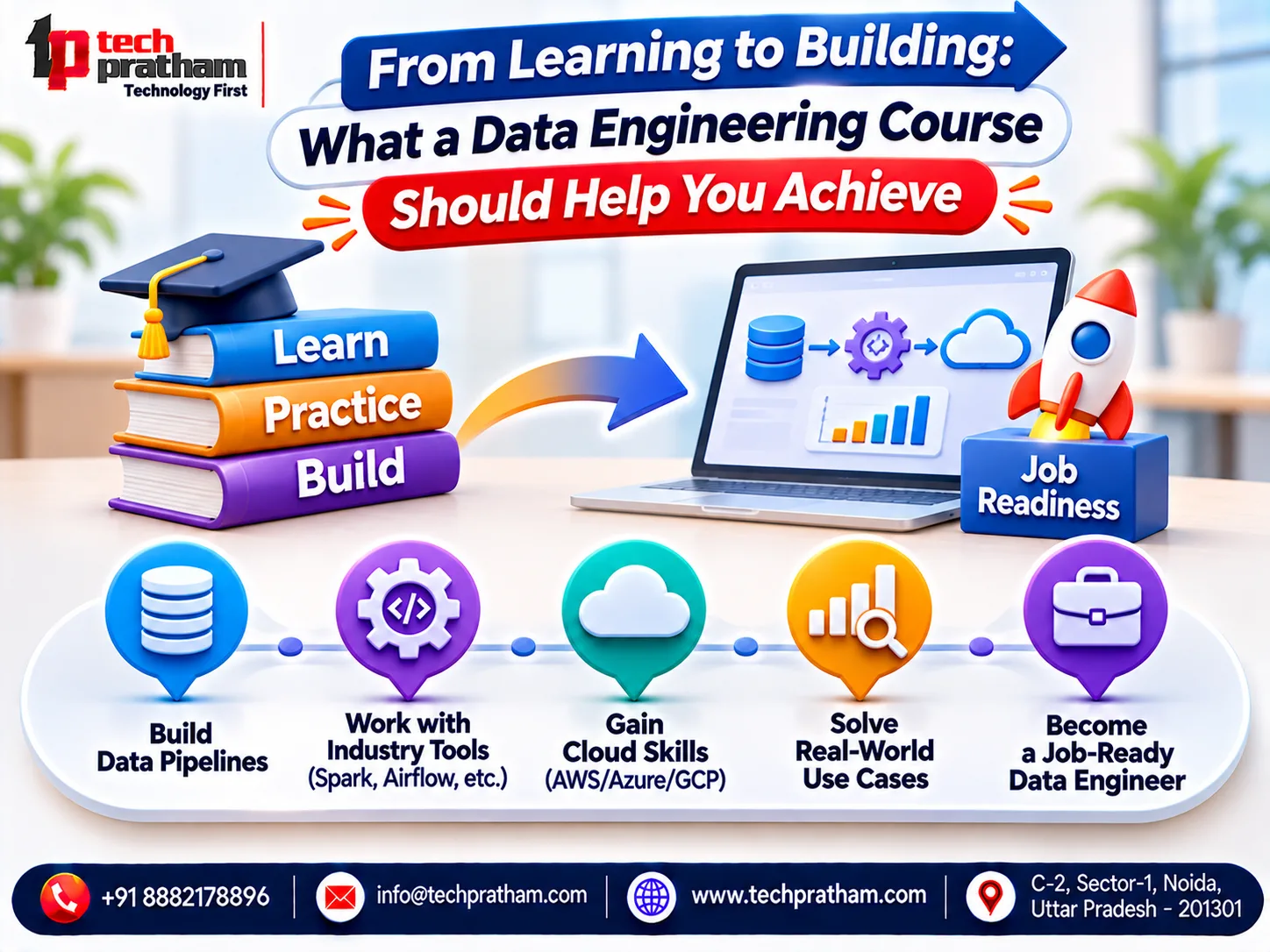
Learning data engineering is different from simply learning a programming language or completing a collection of technical tutorials. The real objective is to understand how data systems work together and eventually become comfortable building workflows that move and transform information.
For many learners, the transition from theory to practical work is where the biggest challenge appears. SQL may make sense in isolation, Python may seem manageable, and cloud services may be understandable individually. But combining these skills into a reliable data pipeline requires a different level of understanding. This is why learners should evaluate courses by asking a practical question: What will I be able to build when the training is complete?
The Best Data Engineering Course in India Should Move You Toward Practical Work
A strong program should gradually take learners from understanding concepts to creating working data workflows. The journey may begin with databases and SQL, followed by Python, data processing, ETL or ELT, data warehousing, cloud concepts, and pipeline development.
The important part is not simply learning these subjects. It is understanding how they interact. A Best Data Engineering Course in India should help learners see the complete path from a raw data source to a processed and usable dataset.
Understand the Full Data Journey
Consider a simple business scenario. A company may receive information from a website, mobile application, CRM system, transaction database, and external API. These sources may store data in different formats.
Someone needs to collect the information, transform it, remove inconsistencies, validate it, and move it into an environment where analysts or applications can use it.
This is where data engineering concepts become practical. Understanding this complete journey helps learners see why individual technologies exist instead of treating each tool as an isolated subject.
SQL Should Become More Than a Query Language
SQL is often one of the first skills learners encounter, and for good reason. However, the objective should go beyond writing basic queries. Learners should become comfortable understanding data relationships, filtering and aggregating information, joining datasets, and working with structured data.
As their knowledge grows, they can begin thinking about how SQL fits into transformations, reporting workflows, data warehouses, and pipelines. That connection makes SQL more useful in real-world data work.
Python Should Be Used to Solve Data Problems
Python can support many activities in a data engineering workflow. Instead of learning it only through generic programming examples, learners can use it for file processing, data transformation, API interaction, automation, validation, and pipeline-related tasks. This practical approach helps learners understand programming as a tool for solving data problems.
Projects Should Demonstrate Integration
The strongest evidence of learning often comes from projects. A useful project should require multiple skills to work together. For example, learners might receive raw information from an external source, clean and transform it using Python or SQL, store the processed information, and automate the workflow.
This demonstrates much more than knowing individual commands. When evaluating Data Engineering Training in India, learners should ask whether projects involve genuine integration or simply consist of disconnected exercises.
Cloud Skills Should Support the Bigger Picture
Cloud platforms are important in modern data environments, but learning should focus on concepts as well as products. Learners should understand why organizations use cloud storage, scalable computing, managed databases, data warehouses, and automated workflows.
They should also gain awareness of areas such as security, permissions, reliability, and scalability. This broader understanding makes it easier to adapt when an organization uses a different platform.
Learn to Diagnose Problems
Building a workflow is only part of data engineering. What happens when something breaks? A useful learning environment should expose learners to common issues such as missing values, duplicate records, unexpected schemas, failed transformations, incorrect joins, and pipeline errors.
Troubleshooting these situations helps develop the analytical mindset required for technical work. Instead of asking only, “What command should I use?” learners begin asking, “Why did this happen?” That shift is important.
Certification Is a Supporting Outcome
Certification can provide formal evidence of completing structured education, but it should not replace practical ability. When looking at Data Engineering Certification Training in India, consider whether the program combines certification with projects, assignments, and technical practice. The strongest outcome is not simply having a certificate. It is being able to explain the concepts and projects behind it.
Measure Your Progress by What You Can Build
At the end of a course, learners should be able to look back and identify tangible progress. Can you work confidently with SQL? Can you process data using Python? Can you explain ETL and ELT? Can you design a basic pipeline? Can you discuss data quality and storage? Can you explain a project from beginning to end?
These are more meaningful questions than simply asking how many modules you completed. Ultimately, effective Data Engineering Training should move a learner from consuming technical information toward applying it. The ability to understand, build, test, and improve data workflows is what turns course learning into practical capability.