Artificial intelligence is rapidly changing how SaaS products are built, delivered, and experienced. From AI copilots and intelligent search to predictive analytics and automated workflows, SaaS companies are finding new ways to use AI to improve customer experiences and create competitive advantages.
But turning an AI idea into a reliable production feature is rarely as simple as connecting an application to an AI model.
SaaS product teams must make decisions about use cases, data, model selection, architecture, security, user experience, evaluation, infrastructure, and ongoing optimization. This is where AI consulting for SaaS can make a significant difference.
An experienced AI consulting partner can help a SaaS company move from an initial idea to a validated proof of concept and eventually to a scalable AI-powered product.
What Is AI Consulting for SaaS Product Teams?
AI consulting for SaaS involves helping software companies identify, design, build, deploy, and optimize AI-powered capabilities within their products or internal operations.
Unlike general AI consulting, SaaS-focused AI consulting considers the specific requirements of software products, including:
- Existing SaaS architecture
- Multi-tenant environments
- Customer-facing workflows
- Product roadmaps
- APIs and third-party integrations
- Data security and privacy
- Scalability and reliability
- AI infrastructure and inference costs
- User experience
- Continuous product iteration
An enterprise AI consulting company can work with product managers, developers, designers, data engineers, and business stakeholders to determine where AI can deliver measurable value.
The objective isn't simply to add an AI feature. It is to build an AI capability that solves a genuine customer problem and supports the SaaS company's broader business goals.
Why Do SaaS Teams Need AI Consulting?
Many SaaS companies know they need to explore AI but aren't sure where to begin.
A product team might have several possible ideas: an AI assistant, automated customer support, document processing, predictive analytics, or personalized recommendations. Building all of them simultaneously can consume significant time and resources.
AI consulting services for SaaS companies can help teams prioritize opportunities based on business impact, technical feasibility, data availability, and implementation complexity.
Identify High-Value AI Opportunities
AI consultants can evaluate existing workflows and customer pain points to identify opportunities where automation or intelligence can create measurable improvements.
Choose the Right Technology
Not every problem requires a large language model. Depending on the use case, a traditional machine learning model, retrieval-augmented generation (RAG), recommendation engine, AI agent, or third-party AI API may be more appropriate.
Reduce Development Risk
A consulting partner can validate assumptions through discovery and proof-of-concept development before the company makes a larger production investment.
Accelerate Time to Market
An experienced AI team can bring specialized expertise that may not already exist within an internal SaaS engineering organization.
Build for Production
An AI prototype that works in a demonstration is very different from a production-ready SaaS feature. Production systems need monitoring, evaluation, security, scalability, cost controls, and reliable failure handling.
From AI Idea to SaaS Product: The AI Consulting Process
A structured process can help SaaS teams move from experimentation to a production-ready AI solution.
1. Define the Business Problem
The first step isn't selecting an AI model. It is defining the problem.
A SaaS team should ask:
- What customer or business problem are we solving?
- Who experiences the problem?
- How is it currently handled?
- What does the existing process cost?
- How frequently does the problem occur?
- What would success look like?
For example, instead of saying, "We want to add generative AI," a product team might define the objective as:
"We want customers to find relevant information in our platform 50% faster."
That objective creates a foundation for evaluating possible solutions.
2. Identify and Prioritize AI Use Cases
Once the problem is clear, the next step is determining whether AI can solve it effectively.
Common SaaS AI solutions include:
- AI copilots
- Conversational assistants
- Intelligent search
- Recommendation engines
- Predictive analytics
- Automated document processing
- Customer support automation
- Content generation
- Workflow automation
- AI agents
Each use case should be evaluated against factors such as potential business value, implementation complexity, data requirements, risk, and expected ROI.
A simple prioritization framework can classify opportunities as:
High value + low complexity: Prioritize first
High value + high complexity: Plan strategically
Low value + low complexity: Consider opportunistically
Low value + high complexity: Usually deprioritize
3. Assess Data Readiness
AI performance depends heavily on the quality and accessibility of data.
Before development begins, an AI consulting team should assess:
- What data is available?
- Where is the data stored?
- Is it structured or unstructured?
- Is it accurate and up to date?
- How much historical data exists?
- Can the data legally be used for the intended purpose?
- What privacy or compliance requirements apply?
For generative AI applications, this may include evaluating product documentation, customer records, knowledge bases, support tickets, databases, and other information sources.
If the data isn't ready, improving the data pipeline may be more important than building the AI feature itself.
4. Select the Right AI Technology
There is no universal AI architecture for SaaS products.
Depending on the requirements, an AI product development consulting team may recommend:
- Large language models for natural-language applications
- RAG for answering questions using proprietary information
- Machine learning for predictive use cases
- Vector databases for semantic retrieval
- AI agents for multi-step workflows
- Computer vision for image-based applications
- Recommendation systems for personalization
- Third-party AI APIs for rapid implementation
- Custom or fine-tuned models for specialized requirements
The right approach balances accuracy, latency, scalability, security, development effort, and cost.
5. Build a Proof of Concept
A proof of concept (POC) allows a SaaS team to test whether an AI idea works before committing to full-scale development.
A POC might answer questions such as:
- Can the AI produce sufficiently accurate results?
- Is the available data adequate?
- Can the solution integrate with existing systems?
- What is the expected response time?
- What will inference costs look like?
- What edge cases could create problems?
The purpose of a POC isn't to create the final product. It is to reduce uncertainty.
6. Develop the AI Feature
After validating the concept, the team can move toward production development.
This may involve:
- Backend and API development
- Model integration
- Prompt engineering
- RAG pipelines
- Data pipelines
- Vector search
- Frontend development
- Authentication and authorization
- Logging and monitoring
- Integration with existing SaaS workflows
At this stage, AI consultants typically work closely with the existing engineering and product teams.
7. Test and Evaluate the AI System
Traditional software testing alone isn't enough for AI-powered applications.
AI systems can produce different outputs for similar inputs, and quality isn't always represented by a simple pass/fail test.
AI evaluation may include:
- Accuracy
- Relevance
- Hallucination rates
- Response quality
- Safety
- Latency
- Reliability
- Security
- User satisfaction
- Cost per interaction
For customer-facing AI features, teams should also establish clear fallback mechanisms when the AI cannot confidently complete a task.
8. Deploy and Launch
Once the AI feature meets the required quality standards, it can be introduced into production.
Many SaaS teams benefit from a gradual rollout rather than releasing the feature to every customer simultaneously.
A launch strategy could include:
- Internal testing
- Employee beta
- Limited customer beta
- Controlled production rollout
- Wider availability
- Continuous optimization
This approach gives product teams an opportunity to identify unexpected issues before the feature reaches the entire customer base.
9. Continuously Improve the AI Feature
Launching an AI feature is not the end of the process.
AI-powered SaaS products need ongoing monitoring and improvement.
Teams can track:
- Feature adoption
- User engagement
- AI accuracy
- Customer feedback
- Failure rates
- Response latency
- Infrastructure costs
- Model performance
Over time, the team can optimize prompts, retrieval systems, models, workflows, and user interfaces based on real-world usage.
Key AI Technologies SaaS Product Teams Can Leverage
The technology used depends on the product's requirements.
Generative AI
Generative AI can create text, summaries, reports, recommendations, code, and other content based on user input.
Large Language Models
LLMs can power conversational interfaces, AI assistants, content generation, summarization, and natural-language search.
Retrieval-Augmented Generation
RAG combines language models with external knowledge sources, allowing AI applications to retrieve relevant information before generating an answer.
This can be particularly useful for SaaS products that need to work with proprietary customer or organizational data.
AI Agents
AI agents can perform multiple steps toward a goal, potentially interacting with tools, APIs, databases, and business workflows.
Predictive Machine Learning
Traditional ML remains valuable for use cases such as forecasting, fraud detection, churn prediction, lead scoring, and demand forecasting.
Recommendation Systems
Recommendation engines can personalize products, content, workflows, or next-best actions based on user behavior and historical data.
How AI Consultants Work With SaaS Product Teams
An external AI consulting team doesn't necessarily need to replace an existing development organization.
In many cases, the most effective approach is collaboration.
A typical AI product team may include:
- Product Manager: Defines business requirements and priorities
- AI/ML Engineer: Develops models and AI pipelines
- Software Engineer: Builds applications and APIs
- Data Engineer: Manages data pipelines and data quality
- DevOps Engineer: Handles infrastructure and deployment
- QA Engineer: Tests functionality and AI performance
- Security Engineer: Addresses security and compliance
- UX Designer: Designs the user experience
AI consulting services can supplement an internal team with specialized skills while allowing the company's existing product organization to retain ownership.
Build vs. Buy vs. Partner for SaaS AI
SaaS companies generally have three options when introducing AI.
Build Internally
Building internally offers maximum control and can make sense when the company already has strong AI expertise.
However, hiring and maintaining a specialized AI team can take time and increase costs.
Buy an Off-the-Shelf Solution
Existing AI tools can provide a faster path for common use cases.
The trade-off is that customization may be limited, and the solution may not fit specialized workflows.
Partner With an AI Consulting Firm
An AI consulting firm can provide specialized expertise while developing a solution around the company's specific product and business requirements.
This can be useful when the use case is complex or requires integration with existing SaaS infrastructure.
For many companies, a hybrid approach works well: use existing AI services where possible while developing custom components where differentiation matters.
How Much Does AI Consulting for SaaS Cost?
The cost of AI consulting varies substantially from one project to another.
Key cost factors include:
- AI use-case complexity
- Project scope
- Data availability and quality
- Model requirements
- Number of integrations
- Development team size
- Security and compliance requirements
- Infrastructure requirements
- Testing and evaluation
- Ongoing maintenance
A basic AI integration can be relatively straightforward, while a production-grade AI platform involving proprietary data, complex workflows, multiple integrations, and strict security requirements can require significantly more investment.
Rather than evaluating an AI consulting proposal only by its development cost, SaaS companies should consider the expected business value and long-term operating costs.
How to Choose an AI Consulting Partner for Your SaaS Product
Selecting the right AI consulting firm for SaaS requires more than checking whether the company can build an AI model.
Look for a partner with experience in:
SaaS Product Development
The partner should understand APIs, cloud infrastructure, application architecture, multi-tenant systems, and product development.
AI Implementation
Look for practical experience taking AI systems from prototypes into production.
Data and AI Infrastructure
The partner should understand data pipelines, model integration, vector databases, RAG architectures, evaluation, and monitoring.
Security and Compliance
AI applications may process sensitive business or customer information. Security should therefore be considered from the beginning.
Product and UX Design
An AI feature should fit naturally into the product rather than feel like an isolated chatbot added to the interface.
Post-Launch Support
AI systems require ongoing monitoring and optimization, so clarify how the partner handles maintenance after launch.
Common Mistakes SaaS Teams Make When Implementing AI
Even technically capable SaaS companies can run into problems when adopting AI.
Starting With the Technology
Choosing a model before defining the business problem can result in an impressive demo with little practical value.
Ignoring Data Quality
Poor-quality data can undermine even sophisticated AI systems.
Treating a POC as a Production Product
A prototype may work under controlled conditions but fail when exposed to real users and large-scale workloads.
Underestimating AI Evaluation
Teams need objective methods to measure AI quality before and after launch.
Ignoring Security and Privacy
AI applications can introduce new data and access risks if security isn't incorporated into the architecture.
Forgetting About Operating Costs
Model usage, infrastructure, storage, monitoring, and data processing can create ongoing costs.
Launching Without Monitoring
Without monitoring, teams may not know when accuracy declines, costs increase, or users encounter recurring failures.
How to Measure the ROI of AI in SaaS
AI implementation should be tied to measurable business outcomes.
Potential metrics include:
- Reduction in manual work
- Lower customer support costs
- Increased customer engagement
- Improved conversion rates
- Higher retention
- Increased feature adoption
- Faster task completion
- Increased revenue
- Reduced operational costs
- Improved employee productivity
For example, if an AI-powered support assistant reduces the number of repetitive support requests by 30%, the company can calculate the resulting operational savings and compare them with development and operating costs.
For revenue-generating features, teams can also measure adoption, conversion, expansion revenue, and customer retention.
AI Consulting Roadmap: From Idea to Launch
A successful SaaS AI initiative can follow a structured roadmap:
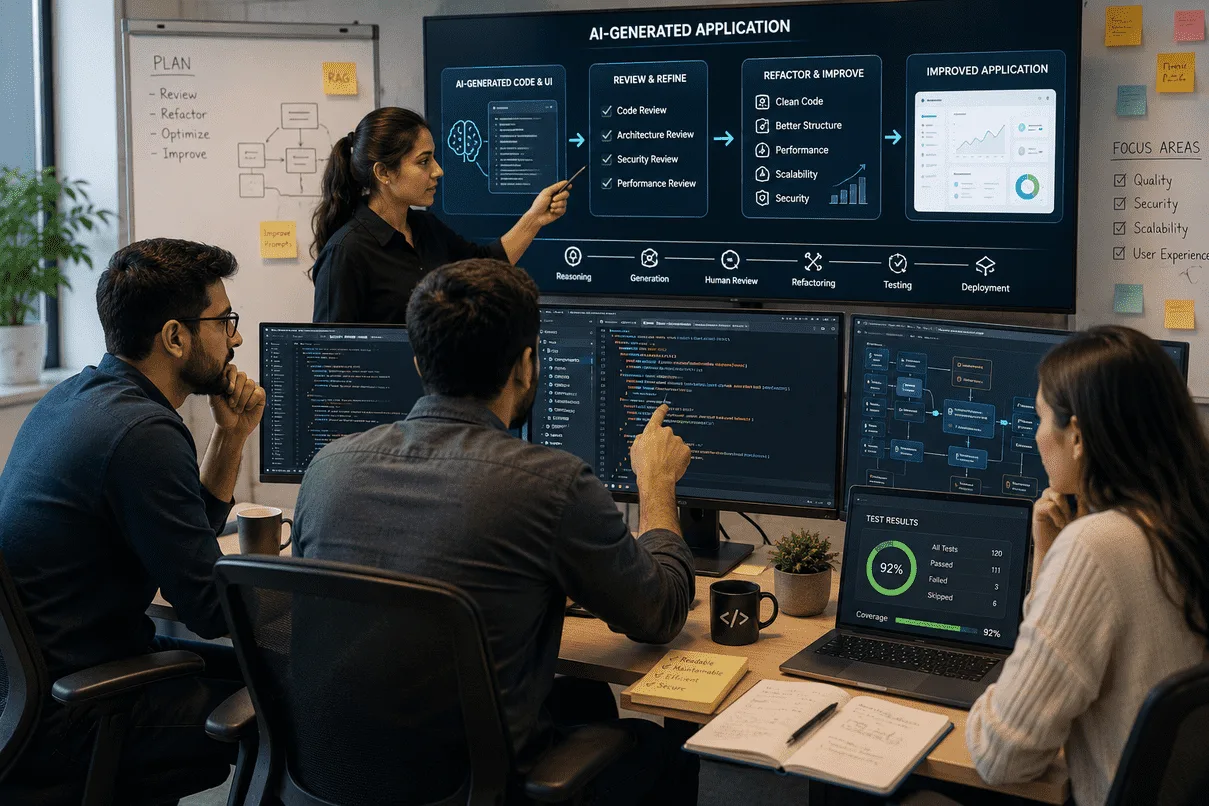
Idea → Discovery → Use-Case Prioritization → Data Assessment → POC → Development → Testing → Deployment → Optimization
Each stage reduces a different type of risk.
Discovery reduces business risk. Data assessment reduces technical risk. A POC reduces feasibility risk. Testing reduces quality and security risk. Monitoring reduces operational risk after launch.
AI Launch Checklist for SaaS Teams
Before launching an AI-powered SaaS feature, confirm that:
- The business problem is clearly defined
- Target users and workflows are identified
- AI is the appropriate solution
- Data availability and quality have been assessed
- The AI architecture has been selected
- A proof of concept has been validated
- Performance and accuracy have been evaluated
- Security and privacy requirements have been addressed
- AI operating costs have been estimated
- Monitoring has been implemented
- Failure and fallback scenarios have been defined
- User feedback mechanisms are available
- Success metrics have been established
Conclusion
For SaaS companies, AI adoption is no longer simply a technology experiment. It is becoming part of product strategy, customer experience, and operational efficiency.
However, successful AI implementation for SaaS requires more than selecting a powerful model. Teams need to identify the right problem, validate the opportunity, prepare their data, choose an appropriate architecture, build and evaluate the solution, and continuously improve it after launch.
That is where AI consulting for SaaS product development can provide value.
With the right approach, an AI consulting partner can help transform an initial product idea into a practical, scalable AI capability—from the first discovery session through proof of concept, development, deployment, and ongoing optimization.
The goal isn't to add AI for the sake of AI. The goal is to build an AI-powered SaaS product that solves real problems, creates measurable value, and can scale with the business.
FAQs
1.What does an AI consultant do for a SaaS company?
An AI consultant helps a SaaS company identify valuable AI use cases, assess data readiness, select appropriate technologies, develop prototypes, integrate AI into the product, and support production deployment and optimization.
2. When should a SaaS startup hire an AI consulting firm?
A SaaS company may benefit from AI consulting when it has a promising AI use case but lacks specialized AI expertise, needs to accelerate development, or wants to validate an idea before making a significant investment.
3. How much does AI consulting cost for a SaaS product?
AI consulting costs depend on factors such as project complexity, data requirements, integrations, team size, security requirements, and ongoing support. A discovery or POC engagement generally requires less investment than building a complex production AI platform.
4. Should SaaS companies build or buy AI solutions?
It depends on the use case. Off-the-shelf solutions can be effective for common requirements, while custom development may be preferable when AI is a core product differentiator or requires specialized workflows.
5. How long does it take to develop an AI-powered SaaS feature?
The timeline varies based on complexity. A simple AI integration may be completed relatively quickly, while a sophisticated AI feature involving proprietary data, multiple integrations, custom workflows, and extensive evaluation can take considerably longer.