Most conversations about AI in business start and end in the same place: efficiency. Cut costs here. Automate that process there. Reduce headcount in this department.
And look, that is not wrong. Efficiency matters. But if your entire AI strategy is built around doing the same things faster, you are missing the bigger shift happening right now.
The companies that are actually pulling ahead are not just automating. They are reinventing. New revenue streams. New ways of serving customers. New decision-making structures that would not have been possible five years ago.
That is the real meaning of AI business transformation. And it looks very different from what most teams are currently building toward.
Automation Is the Starting Line, Not the Finish Line
There is a natural temptation to treat automation as the destination. You map out a process, find the repetitive parts, hand them over to software, and declare victory. And yes, that creates value. Faster invoice processing, quicker customer responses, fewer manual errors. All of it counts.
But here is the limitation. Automation, on its own, does not change your business model. It does not help you find customers you have been missing. It does not tell you what your next product should be or which markets are ready to open up.
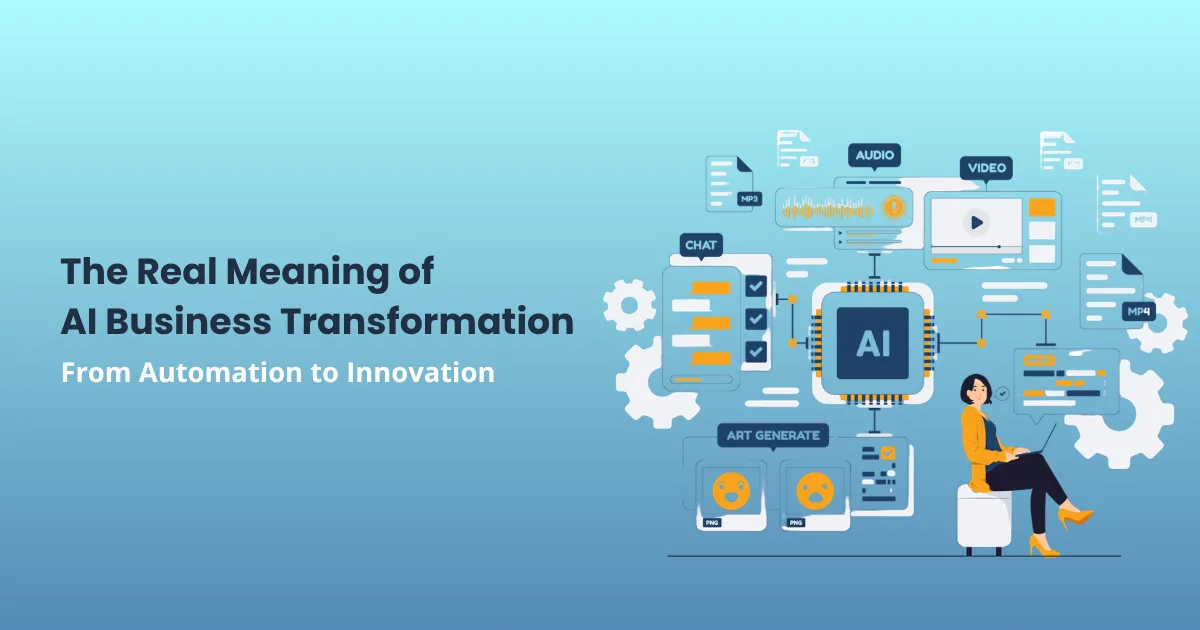
Traditional automation is about process efficiency. AI-driven transformation is about reshaping how a business competes and delivers value entirely.
That distinction matters more than most leaders currently acknowledge.
What Moves Beyond Automation
When AI is applied at a deeper level, the scope of change expands significantly. You start to see things like:
- Predictive intelligence that tells you what a customer needs before they ask for it
- Dynamic decision-making where systems adjust in real time based on incoming data rather than waiting for a quarterly review
- New product and service categories that only became viable because of what AI can now process and generate
- Hyper-personalized experiences delivered at a scale that human teams alone could never manage
This is the jump from automation to innovation. It is not a small one, and it does not happen by accident.
The Three Shifts That Actually Define AI Transformation
If you want to understand what genuine AI transformation looks like in practice, it helps to look at where the meaningful changes are actually happening. Based on what is working across industries right now, three shifts stand out more than anything else.
1. From Reactive to Proactive Operations
Most businesses today are still fundamentally reactive. Something goes wrong and the team responds. A customer churns and the retention playbook kicks in. Supply runs short and procurement scrambles.
AI changes this dynamic. When machine learning models are trained on the right operational data, they start surfacing problems before they become problems. A manufacturing plant gets an alert that a machine component is likely to fail in the next two weeks, not after it breaks down mid-production. A financial services company identifies a lending risk in a customer segment before defaults start climbing.
This shift from reactive to proactive is not just operationally better. It is a competitive advantage that compounds over time. The longer your models run, the more accurate they get. The more accurate they get, the further ahead you can see.
2. From Generic to Genuinely Personalized Customer Experiences
For years, personalization in marketing meant putting someone's first name in an email subject line and maybe recommending a product based on their last purchase. Customers saw through it immediately because it was thin.
AI makes real personalization possible. Not personalization as a gimmick, but as a genuine shift in how a business relates to each customer based on behavior, context, preferences, and history, all processed in real time.
Retailers are using this to build shopping experiences that feel individually curated. Healthcare providers are using it to guide patient journeys in ways that account for the whole person rather than a single diagnosis. Telecom companies are using sentiment analysis to understand when a customer is close to leaving and intervening with something actually relevant to that specific person.
The through-line in all of these cases is the same. AI enables a level of customer understanding that human teams, no matter how talented, simply cannot maintain at scale. And customers notice when they are actually being understood versus when they are just being targeted.
3. From Data Stockpiling to Real Decision Intelligence
A lot of organizations have spent the last decade collecting data. CRM records, customer feedback, operational metrics, market data, web analytics. The problem is that collecting data and actually using it to make better decisions are two very different things.
AI closes that gap. Not by generating more reports for someone to read, but by turning data into active intelligence that informs decisions as they are being made.
Leaders stop asking "what happened last quarter" and start asking "what should we do right now given what the data is showing." That shift in framing changes how organizations allocate resources, enter markets, price products, and respond to competitive pressure.
What Gets in the Way
None of this is automatic, and it is worth being honest about the obstacles that slow organizations down. Many of these challenges stem from a deeper confusion between simply implementing AI tools and driving real change, a distinction often misunderstood without clarity on AI business transformation vs AI deployment.
- Starting with the technology instead of the problem. Teams that begin by asking "how do we use AI" often end up building things that do not map to real business needs. The better starting point is always: what decisions do we wish we could make better, and what would we need to know to make them?
- Underestimating the data foundation. AI models are only as good as the data they are trained on. Incomplete, inconsistent, or siloed data is one of the most common reasons transformation initiatives stall.
- Skipping change management. The technology is rarely the hard part. Getting teams to actually work differently, trust new systems, and build new habits around AI-generated insights is where most of the friction lives.
- Treating transformation as a one-time project. AI transformation is not a rollout with a finish line. It is an ongoing capability that needs to be maintained, refined, and expanded as both the technology and the market evolve.
Where to Actually Start
If you are early in this process, the most practical advice is to pick one area where better intelligence would directly change a business outcome, and build there first.
Not a proof of concept that sits in a slide deck. An actual use case with real data, clear success metrics, and a team that has both the technical skills and the organizational buy-in to see it through.
The wins from that first real application build credibility. Credibility opens doors to the next use case. That is how genuine transformation actually gets built, one grounded step at a time, not through a sweeping strategy document that never touches reality.
The Bigger Shift
AI business transformation is not a technology upgrade. It is a rethinking of how your organization sees, decides, and acts.
The companies that treat it as purely an efficiency play will capture some value and then plateau. The ones that push further, into innovation, into new business models, into genuinely different ways of competing, are the ones that will look back in five years and realize the gap they opened up.