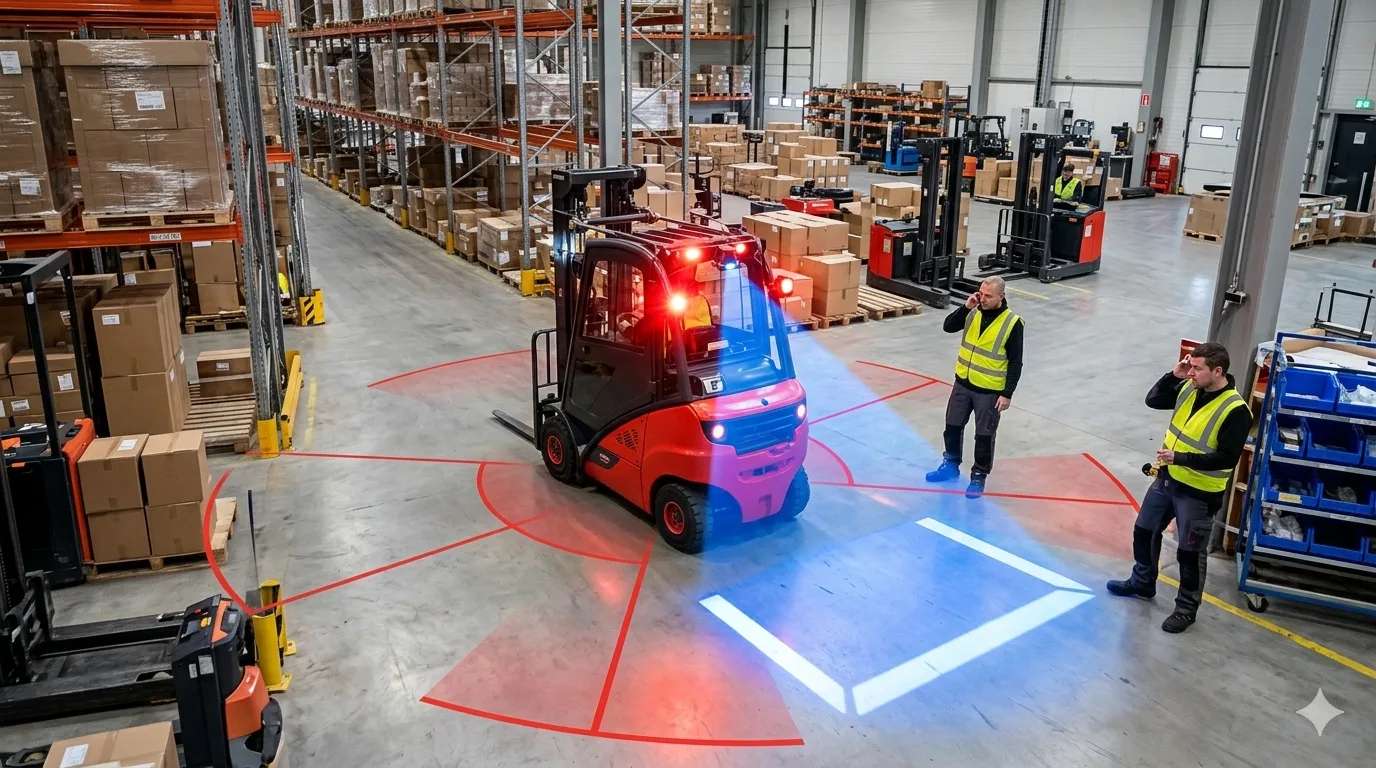
A forklift striking a chemical IBC is not a rare event—it is a predictable failure mode. Under COMAH, predictable failures demand engineered controls. In UK chemical manufacturing facilities, where large volumes of hazardous substances are handled daily, even a minor collision can escalate into a major accident scenario. Forklifts are central to these operations, yet their visibility limitations are often underestimated in safety cases. For COMAH operators, this is no longer acceptable. Visibility systems on forklifts are increasingly scrutinised as part of the evidence base for major accident prevention, particularly where loss of containment risks are involved.

Forklift Blind Spots as a COMAH Risk Factor
The Control of Major Accident Hazards Regulations 2015 require you to identify and control scenarios that could lead to significant harm. In chemical manufacturing, this includes loss of containment events involving drums, IBCs, and process materials.
Forklift operations intersect directly with these risks. Common scenarios include:
- Impact with IBCs during transport or stacking
- Contact with drum storage areas during manoeuvring
- Collisions in congested loading or decanting zones
These are not edge cases. They are foreseeable events in busy facilities.
A 360 degree camera for forklift becomes relevant not just as a safety aid, but as a control measure within your COMAH risk assessment. It addresses the root cause of many of these incidents: limited operator visibility.
From a regulatory perspective, if a control can reasonably reduce the likelihood of a major accident, it must be considered. Visibility technology now falls into that category.

The DSEAR Overlay: ATEX Is Not Optional
Most COMAH sites are also subject to the Dangerous Substances and Explosive Atmospheres Regulations (DSEAR). This introduces an additional requirement: equipment used in hazardous zones must not present an ignition risk.
Forklifts operating in or near Zone 1 and Zone 2 areas must therefore be equipped with ATEX-certified components. This includes visibility systems.
A Forklift Safety Camera System installed without appropriate certification creates a compliance gap. Even if it improves operational safety, it may still be unsuitable for use in classified zones.
You need to ensure that:
- Cameras, monitors, and cabling are ATEX-certified
- Certification aligns with the specific zone classification
- Installation meets manufacturer and regulatory requirements
This dual compliance—COMAH and DSEAR—defines the specification standard for forklift-mounted technology in chemical manufacturing environments.
Reframing 360° Visibility as a Major Accident Prevention Control
In many facilities, camera systems are still viewed as optional enhancements. Under COMAH, that perspective is shifting.
A forklift bird-eye view 360 degree camera system should be considered in the context of major accident prevention. It provides a continuous, real-time view of the forklift’s surroundings, eliminating blind spots that contribute to collision risk.
This is particularly relevant in:
- High-density storage areas
- Chemical transfer and decanting zones
- Outdoor tank farms and drum storage yards
By reducing the likelihood of impact with hazardous materials, the system directly supports your safety case.
When presenting your COMAH Safety Report to the Competent Authority, you are required to demonstrate that all reasonable measures have been taken to prevent major accidents. Visibility systems that materially reduce risk strengthen that argument.
Using Camera Data to Strengthen COMAH Safety Reports
COMAH is not only about prevention—it also requires robust incident investigation and continuous improvement.
Camera systems contribute to this in a tangible way. A forklift 360° bird eye view camera system with recording capability provides:
- Footage of near-misses involving chemical handling
- Evidence of operator behaviour and environmental conditions
- Data to support root cause analysis following incidents
This information feeds directly into your Safety Report. It allows you to demonstrate:
- How risks are monitored in real time
- How incidents are investigated and lessons applied
- How control measures are reviewed and updated
For safety managers, this creates a stronger, evidence-based approach to compliance. You move beyond assumptions and rely on documented operational data.

Specifying Camera Systems for Chemical Environments
Chemical manufacturing environments place additional demands on equipment beyond standard industrial conditions.
When specifying forklift camera systems, you should consider:
- ATEX certification — aligned with your site’s zone classifications
- Chemical resistance — housings that can withstand exposure to vapours and splashes
- UV resistance — essential for outdoor storage and handling areas
- IP69K rating — for wash-down environments and contamination control
- Temperature tolerance — ensuring consistent performance in varying conditions
These factors determine whether the system will remain reliable over time.
Procurement teams must also verify documentation, including ATEX certificates and declarations of conformity. This ensures that the system is not only technically suitable but also compliant with regulatory requirements.
A Practical Decision Framework for COMAH Operators
Selecting the right visibility system requires a structured approach. You should align your decision-making with your existing risk assessment processes.
A practical framework includes:
- Mapping forklift routes against hazardous zones
- Identifying high-risk interaction points with chemical storage
- Assessing current visibility limitations and incident history
- Matching camera system specifications to operational and regulatory needs
This approach ensures that your investment is targeted. You are not implementing technology for its own sake—you are addressing specific, documented risks.
It also creates a clear link between your control measures and your COMAH obligations, which is essential during regulatory review.
Conclusion
For COMAH operators in UK chemical manufacturing, forklift visibility is no longer a secondary concern. It sits at the intersection of operational safety, regulatory compliance, and major accident prevention. Blind-spot incidents involving hazardous materials are foreseeable—and therefore preventable with the right controls.
By integrating ATEX-certified camera systems into your forklift fleet, you strengthen both your safety performance and your compliance position. More importantly, you create a measurable reduction in the likelihood of loss of containment events.
For a deeper technical understanding of system capabilities and deployment considerations, see the recommended read: Forklift 360-degree Bird Eye View Camera system- All you need to know