
Why most "float switch" pages online say almost nothing useful — and what you actually need to know before buying one
Search float switch Singapore and most results give you a product listing with a price and a spec sheet — no explanation of which float switch fits which application, why one costs more than another, or why the wrong one fails within months. This guide fills that gap, covering everything from basic mechanics to correct wiring, so the float switch you buy is the one your system actually needs.
What a Float Switch Is, in Plain Terms
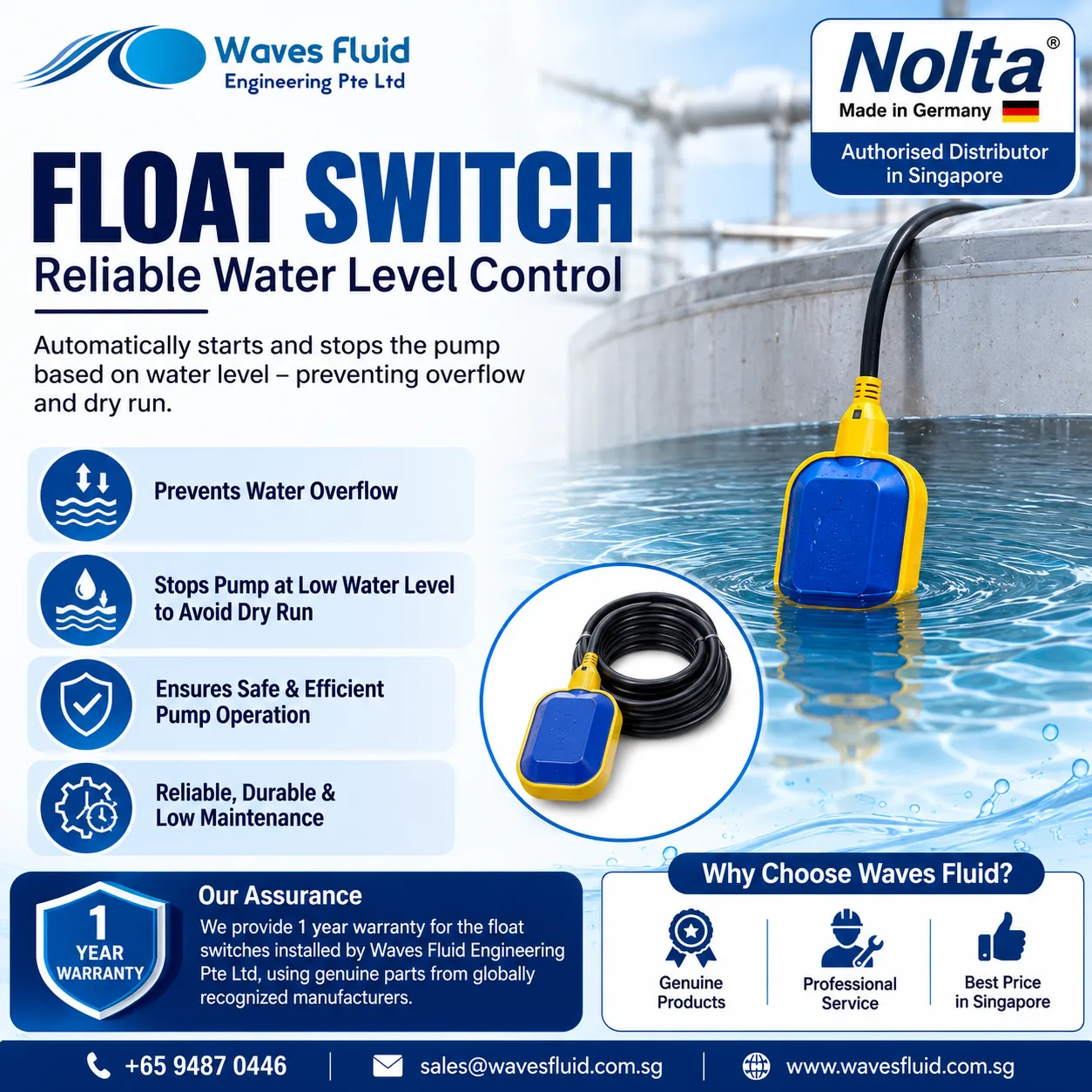
A float switch is a mechanical device that floats on a liquid surface and triggers an electrical switch as the level rises or falls. No sensors, no electronics inside the float itself — just a weighted body and an internal tilt-activated switch that flips a circuit open or closed at a set angle.
That simplicity is exactly why float switches remain one of the most reliable, lowest-maintenance components in any water system — there's very little inside them that can fail, provided the housing and cable are built to a decent standard.
Water Tank Float Switch: The Most Common Application
A water tank float switch is installed inside a storage or rooftop tank to automatically control the pump filling it. As the tank empties, the float drops and triggers the pump to start; as the tank fills, the float rises and triggers the pump to stop — preventing both a dry tank and an overflowing one, without anyone needing to check manually.
This single component solves two expensive problems at once: an overflowing tank wastes water continuously (often for weeks before anyone notices), and a tank that's allowed to run dry can cause the connected pump to run without water — one of the fastest ways to burn out a pump motor.
Sizing and Placement Matter More Than the Brand
A water tank float switch has to be matched to the tank's depth and mounted at the correct height for both the "start" and "stop" trigger points. Installed at the wrong height, even a high-quality float switch will trigger too early or too late — wasting tank capacity or risking dry-running regardless of the device's build quality.
Liquid Level Float Switch: Beyond Just Water Tanks
The term liquid level float switch covers a broader category than tank-filling alone. The same core mechanism is used across:
Sump pits — draining duty, activating a pump as groundwater rises
Ejector pits — waste-water applications requiring solids-rated models
Process tanks — industrial applications where level control is part of a larger automated system
Chemical or non-potable liquid tanks — requiring housings and cables rated for the specific liquid involved
Choosing a liquid level float switch means matching the model not just to the liquid (potable water vs. waste water vs. chemical) but to the ingress protection rating needed for how deep and how long the switch will be submerged.
Pump Float Switch: Direct Control vs. Relay-Controlled
A pump float switch specifically refers to a float switch wired to control a pump's operation — and here's where a real technical distinction matters that most buying guides skip entirely:
Direct pump-duty switches can switch a pump's full load current on their own, with no separate relay or contactor needed. This works for smaller pumps but has a maximum current rating that must not be exceeded.
Pilot/control-duty switches are wired through a relay or control panel rather than switching the pump directly — necessary for larger pumps where the float switch's internal contacts can't safely handle the full load current.
Using a direct-duty float switch on a pump that draws more current than it's rated for is a common installation mistake, and it leads to burnt contacts and switch failure — often mistaken for a "cheap" or "faulty" float switch when the real issue was mismatched current rating.
Filling Duty vs. Draining Duty: The Wiring That Changes Everything
The same physical float switch can be wired for two opposite functions, and this is worth understanding before installation rather than after something goes wrong:
Duty Type Behavior Common Application
Filling duty Pump ON at low level, OFF at high level Storage tanks, rooftop tanks
Draining duty Pump ON at high level, OFF at low level Sump pits, drainage systems
The direction depends entirely on which cable cores are connected at the control panel — not on buying a different product. If a pump is running dry despite having a float switch installed, or a sump isn't draining properly, incorrect wiring for the intended duty is one of the first things worth checking.
What Determines Float Switch Quality (And Why Price Varies So Much)
Not every float switch sold in Singapore is built to the same standard, and the differences explain the price range you'll see:
Housing material — sealed polypropylene resists most water conditions; cheaper plastics degrade faster
IP rating — IP68-rated switches handle continuous submersion at depth; lower-rated switches are only splash-resistant
Cable quality — chemically resistant cable holds up to years of submersion without the insulation breaking down
Waste-water rating — a standard float switch will clog or fail quickly in sewage or waste-water applications; solids-rated models are built specifically for this
Waves Fluid Engineering supplies and installs Nolta float switches, manufactured in Germany, across this full range — from compact models for narrow shafts and small tanks, to direct pump-duty switches for straightforward installs, to waste-water rated models for ejector and sump applications.
Common Float Switch Problems and What They Usually Mean
Symptom Likely Cause
Pump won't turn on Float stuck, or wired for wrong duty type
Pump runs dry despite float switch Wired for filling duty on a draining application (or vice versa)
Tank still overflows Float switch not triggering — check for physical obstruction or worn tilt mechanism
Switch failed after a few months Current rating exceeded, or unsuitable model used for waste water
Erratic on/off cycling Float has insufficient clearance to move freely, or is set too close to trigger threshold
Getting the Right Float Switch, Installed Correctly
The float switch itself is a small, inexpensive part of a water system — but getting the wrong one, or wiring it incorrectly, causes some of the most common (and most preventable) pump failures. A correctly specified and installed float switch, matched to the application and pump current rating, typically runs reliably for years with no attention needed.
Need a water tank, sump, or pump float switch supplied and installed correctly? Waves Fluid Engineering assesses the application, specifies the right Nolta model, and wires it for the correct duty — with a warranty on installation.
📞 +65 9487 0446 | 📧 [email protected] 🌐 Float Switch – Full Range