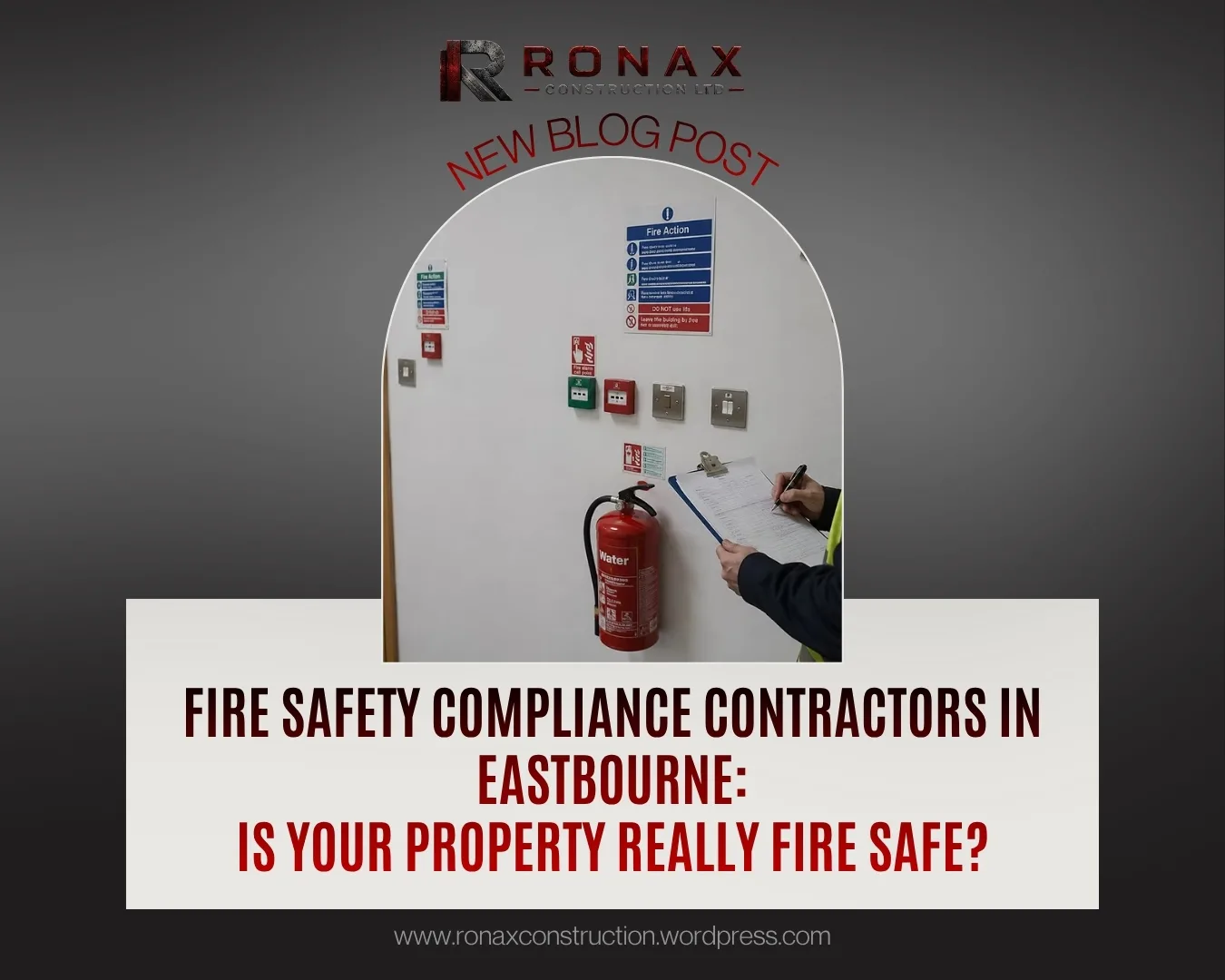
A building can look perfectly safe on the surface while hiding fire safety issues that aren’t immediately obvious.
A poorly fitted fire door, gaps around pipework, damaged fire-resistant walls or alterations to an escape route can all affect how a building performs during a fire.
That’s where Fire Safety Compliance Contractors come in.
For landlords, property managers, homeowners and commercial property owners in Eastbourne and East Sussex, fire safety isn’t simply about installing alarms and extinguishers. The building itself also plays an important role in protecting occupants and limiting the spread of fire.
Whether you’re refurbishing an HMO, converting a property into flats or addressing issues identified during a fire risk assessment, understanding fire safety compliance can help you make informed decisions.
What Do Fire Safety Compliance Contractors Do?
Fire Safety Compliance Contractors carry out building improvements and corrective works designed to address identified fire safety deficiencies.
Their work often focuses on passive fire protection — features built into a property that help resist the spread of fire and smoke.
Depending on the building and the findings of a competent assessment, services may include:
- Fire door installation, replacement and repairs
- Fire risk assessment corrective works
- Fire stopping around pipes, cables and service penetrations
- Fire-resistant walls, ceilings and partitioning
- Fire compartmentation improvements
- Repairs to damaged fire-resistant construction
- Improvements to protected escape routes
- Building alterations required for fire safety compliance
Unlike fire alarm systems, which detect and warn occupants of a potential fire, passive fire protection helps contain fire and smoke for a specified period when correctly designed, installed and maintained.
Both are important parts of a building’s overall fire safety arrangements.
Fire Risk Assessment Corrective Works: What Happens After an Inspection?
A fire risk assessment helps identify fire hazards, evaluate risks and determine whether existing precautions are suitable.
For many workplaces, commercial premises and common parts of blocks of flats, the responsible person must ensure that an appropriate fire risk assessment is carried out and kept under review.
However, identifying a problem is only the beginning.
If an assessment highlights deficiencies in the building’s fire protection, corrective construction work may be required.
Common examples include:
Damaged fire-resistant walls: Openings, cracks or poorly completed alterations may compromise fire separation.
Missing fire stopping: Gaps around cables, pipes and ducts can allow smoke and fire to spread between compartments.
Unsuitable fire doors: Missing seals, damaged frames or doors that fail to close properly may affect their performance.
Compromised escape routes: Building alterations or unsuitable construction may reduce the protection provided to escape routes.
Fire Safety Compliance Contractors can carry out the specified remedial work, while specialist assessment, design and verification should be undertaken by appropriately competent professionals.
The aim isn’t simply to complete a list of repairs. It’s to ensure that the work addresses the identified risks.
Fire Door Installation: More Than Just Fitting a Door
A fire door may look similar to an ordinary internal door, but its purpose is very different.
When properly specified and installed, a fire door assembly helps resist the passage of fire and smoke, supporting compartmentation and protecting escape routes.
Professional Fire Door Installation Contractors must consider more than the door leaf itself.
Important components include:
- Suitable fire-rated door assemblies and frames
- Compatible hinges, seals and ironmongery
- Appropriate self-closing devices where required
- Correct installation gaps and clearances
- Installation in accordance with the tested specification
A fire door that’s incorrectly installed may not provide the intended protection, even if the door itself carries a fire-resistance rating.
For HMOs, blocks of flats and commercial buildings in Eastbourne, the required fire door specification depends on the building’s design, use and applicable fire safety requirements.
Fire Safety Compliance During Property Refurbishments and Conversions
Fire safety becomes particularly important when a property’s layout or intended use changes.
For example, a House to Flats Conversion may introduce new requirements for fire separation, protected escape routes, fire doors and detection systems.
Similarly, converting a commercial building into an HMO can involve substantial alterations to its internal layout and fire protection measures.
Experienced Property Conversion Contractors, Property Refurbishment Contractors and General Building Contractors may coordinate works involving:
- Internal walls and fire-resistant partitioning
- Structural alterations and compartmentation
- Fire door installation
- Electrical, plumbing and heating alterations
- Fire stopping around new services
- Renovations and interior finishing
- Improvements to communal areas and escape routes
These projects may also involve extensions and structural work, kitchens and bathrooms, and roofing and external works.
Where electrical installations or fire detection systems need attention, appropriately competent electrical contractors such as M and M Electrical Services can undertake relevant specialist work.
Fire safety requirements should be considered during the planning stage rather than left until construction is nearly complete.

Do All Properties Need Fire Safety Compliance Work?
Not necessarily.
The work required depends on the property’s use, construction, occupancy and existing fire protection measures.
For example, a typical single-family home has different legal requirements from an HMO, a block of flats or commercial premises.
Under the Regulatory Reform (Fire Safety) Order 2005, fire safety duties apply to most non-domestic premises and the common parts of multi-occupied residential buildings in England.
Other requirements, including Building Regulations and housing legislation, may also apply depending on the property.
An older building doesn’t automatically require every fire safety feature to be replaced. Equally, a recently refurbished property isn’t necessarily compliant simply because it looks modern.
A competent assessment helps establish what is actually needed.
Fire Safety Compliance Across Eastbourne and East Sussex
Properties across East Sussex vary considerably, from older residential buildings and converted houses to commercial premises and modern developments.
An HMO in Eastbourne may require fire door improvements, while a commercial building in Hailsham or Polegate might need fire stopping or compartmentation repairs.
Property owners in Seaford, Pevensey Bay, Stones Cross, Normans Bay, Willingdon and Westham may face different requirements depending on their building’s layout and intended use.
Regardless of location, the priority is the same: ensuring that identified fire safety deficiencies are addressed through suitable, properly specified building work.
Frequently Asked Questions About Fire Safety Compliance Contractors
What is a Fire Safety Compliance Contractor?
A Fire Safety Compliance Contractor carries out building-related improvements and corrective works to address identified fire safety deficiencies. This may include fire door installation, fire stopping, compartmentation repairs and alterations to protected escape routes.
What are fire risk assessment corrective works?
These are measures recommended following a fire risk assessment to address identified risks. They may involve repairing fire-resistant construction, improving fire doors or correcting gaps in fire compartmentation.
Do I need fire doors in an HMO?
Fire doors are commonly required in HMOs, but the exact specification depends on the property’s layout, fire risk assessment, licensing conditions and applicable regulations.
Can building contractors carry out fire safety compliance work?
Yes, provided they have the appropriate competence for the work involved. Specialist fire protection systems must be installed according to suitable specifications, with relevant evidence and certification where required.
Is a fire alarm enough to make a building fire safe?
No. Fire alarms provide detection and warning, but they don’t replace the need for suitable escape routes, fire-resistant construction, fire doors and other appropriate fire precautions.
Fire Safety Compliance Contractors in Eastbourne: Getting the Building Work Right
Fire safety compliance isn’t just about meeting legal requirements. It’s about making sure a building has appropriate measures in place to help protect the people who use it.
From fire door installation and compartmentation repairs to fire risk assessment corrective works, properly planned construction work can make an important difference.
Ronax Construction Ltd is a building contractor company serving Eastbourne and surrounding areas of East Sussex, providing building, refurbishment and property conversion services, including specified fire safety corrective works.
Whether you’re managing an HMO, planning a property conversion or addressing fire safety issues identified during an assessment, Ronax Construction Ltd can discuss the building work required and help plan suitable improvements.
Need fire safety corrective works in Eastbourne or East Sussex? Contact Ronax Construction Ltd to discuss your project and request a quotation.