Modern buildings depend on their facades for much more than appearance. A well-designed facade protects occupants from rain, wind, heat, air infiltration, moisture and other external conditions while supporting the overall energy efficiency and durability of the building. However, even a professionally designed facade can develop weaknesses because of material defects, installation errors, poor sealing, inadequate joints or unexpected environmental stresses. This is why facade testing has become an important part of quality assurance in modern construction.
Facade testing involves systematic evaluation of a building envelope to determine whether its components perform according to project specifications, applicable standards and expected environmental conditions. It can cover curtain walls, windows, doors, cladding, joints, glazing systems and other envelope components. Cornerstone Middle East provides specialized building facade and envelope services designed to evaluate performance, identify deficiencies and provide reliable technical information for corrective action.
Why Facade Performance Matters in Modern Buildings
A facade is continuously exposed to changing environmental conditions. In the UAE and wider GCC region, intense solar radiation, high temperatures, humidity, dust and occasional heavy rainfall can place significant demands on exterior building systems. A small weakness around a window frame or joint may eventually allow air or water to enter the building.
Poor facade performance can result in several problems, including uncomfortable indoor conditions, higher cooling requirements, moisture-related deterioration and damage to internal finishes. If defects remain undetected, repair costs can increase significantly after project completion.
Professional facade testing helps identify these weaknesses before they become major problems. Instead of relying only on visual inspections, testing introduces controlled conditions that allow engineers and inspectors to evaluate how the facade actually performs.
What Does Facade Testing Evaluate?
The exact scope depends on the building design, materials, project requirements and performance criteria. A comprehensive assessment can examine different aspects of the building envelope, including air, water, structural and thermal performance.
Some important areas that may be evaluated include:
- Air leakage through windows, doors, curtain walls and joints
- Water penetration through facade assemblies
- Structural response to pressure and environmental loads
- Performance of seals, gaskets and connections
- Thermal behaviour and potential thermal bridging
- Installation quality and workmanship
- Performance of facade mock-ups before large-scale installation
These assessments provide measurable information that can be compared with specifications and relevant standards. Cornerstone Middle East offers services covering curtain wall testing, enclosure integrity, pressure chamber testing, smoke testing, water infiltration studies, mock-up testing and other building-envelope assessments.
Water Penetration Assessment for Facades
Water ingress is one of the most common concerns associated with building envelope performance. Rainwater can enter through poorly sealed joints, glazing connections, drainage paths, cracks or defective interfaces. Once moisture enters an assembly, it can affect insulation, finishes and other building components.
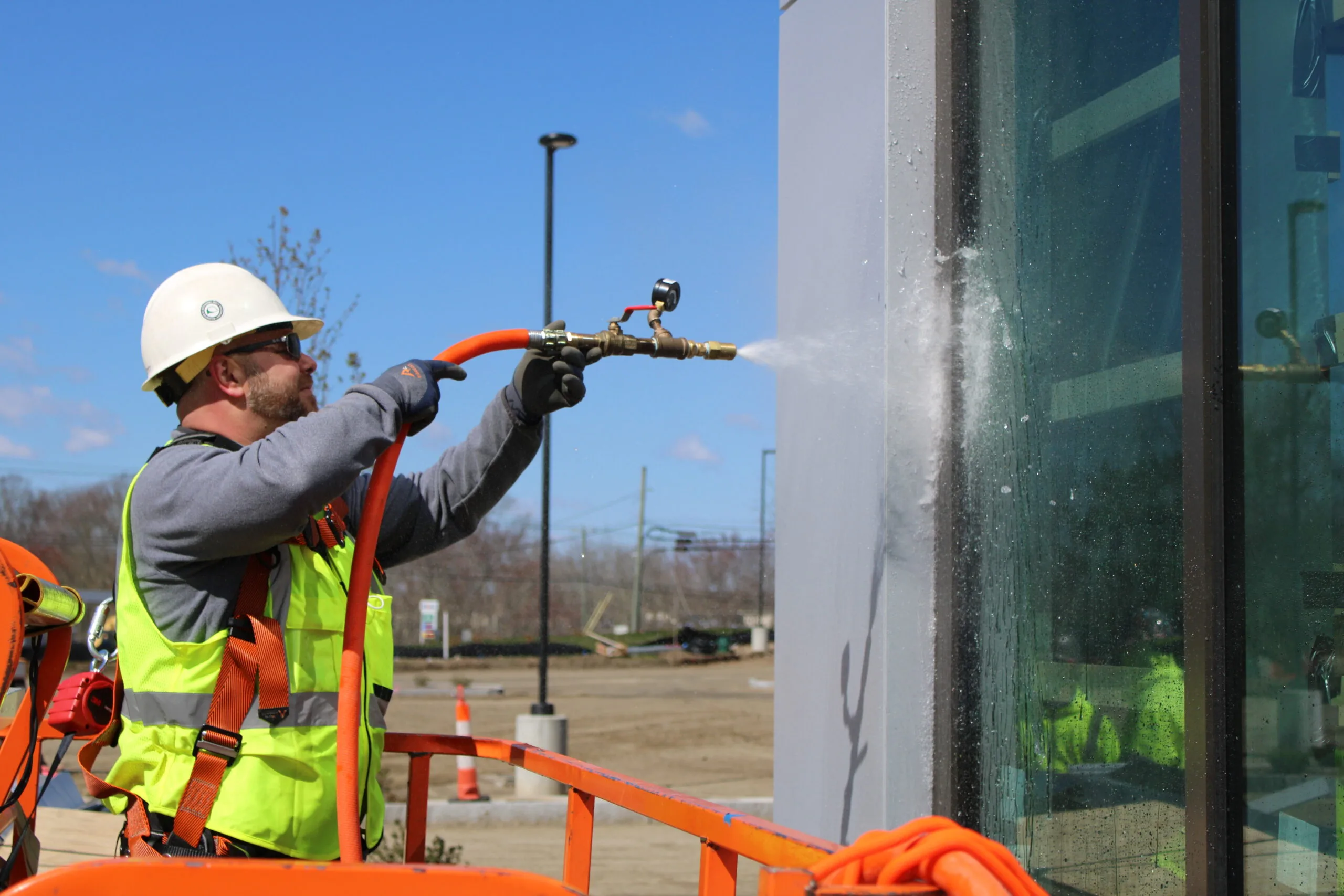
Water penetration assessment can simulate rain exposure and help identify vulnerable locations. Site hose testing, for example, can be used to evaluate the water resistance of facade areas and locate leakage points. Cornerstone Middle East conducts site hose testing using established methodologies, with reference to standards such as AAMA 501.2, ASTM E331 and ASTM E1105 where applicable to project requirements.
The purpose is not simply to determine whether water is present. A properly conducted assessment helps identify where water is entering, document the observed condition and provide information that can support appropriate remedial work.
Air Tightness and Air Leakage Assessment
Air leakage can have a direct effect on building comfort and energy performance. Uncontrolled air movement through facade joints, windows, doors and curtain wall systems can make it more difficult for HVAC systems to maintain desired indoor conditions.
Air leakage assessment uses controlled pressure differences to identify and quantify unwanted air movement. Pressure chamber testing is one method used for evaluating facade components such as curtain walls, windows and doors. Cornerstone Middle East states that its site chamber testing services can assess air leakage performance and verify the effectiveness of seals, joints and barriers.
Smoke testing can also support leak detection by making air movement visible around potential leakage points. This combination of measurement and visual investigation can help engineers understand the location and nature of envelope deficiencies.
Curtain Wall Testing and Performance Verification
Curtain walls are widely used in commercial towers, offices, hotels and other modern developments. Because these systems often contain extensive areas of glass, aluminium framing, seals and connections, their performance needs to be carefully evaluated.
Curtain wall testing can assess several important characteristics:
- Structural performance: Determines whether the system responds appropriately to simulated pressure and environmental loads.
- Air infiltration: Measures air leakage through the installed assembly under specified pressure differences.
- Water penetration: Evaluates resistance to water entering through the facade system.
- Thermal performance: Examines insulation and heat-transfer characteristics.
- Impact resistance: Assesses the ability of selected facade components to withstand external impacts.
Cornerstone Middle East identifies ASTM E283 for air leakage and ASTM E331 for water penetration among the standards relevant to its curtain wall testing services.
The Importance of Testing Before Handover
One of the most effective times to conduct facade testing is during construction and before final handover. Finding a defective seal, joint or installation detail at this stage generally makes corrective work easier than discovering the same problem after occupants have moved into the building.
Testing can also be performed on facade mock-ups before full-scale installation. A mock-up allows project teams to evaluate representative construction details and identify weaknesses before they are repeated across a large building.
This approach supports quality assurance because lessons from early testing can be incorporated into subsequent installation work. It can reduce the risk of widespread defects and provide greater confidence in the completed facade.
How Professional Inspection Supports Facade Testing
Testing should not be considered an isolated activity. Effective facade assessment combines field observation, appropriate test procedures, measurements, documentation and technical interpretation.
During a professional assessment, inspectors may review drawings and specifications, examine installed components, identify areas requiring investigation, conduct the appropriate test and document the results. Where a deficiency is identified, the findings can help contractors and consultants determine the next corrective action.
Cornerstone Middle East emphasizes comprehensive reporting and technical recommendations as part of its facade and building-envelope services. This documentation provides project stakeholders with an evidence-based record of observed performance rather than relying solely on visual assumptions.
Role of Standards in Facade Assessment
Standards provide consistent procedures for carrying out many types of facade evaluations. Depending on the system and project requirements, specifications may refer to ASTM, AAMA, EN, CWCT or other applicable standards.
For example, water penetration assessments may use ASTM E331, ASTM E1105 or AAMA-related procedures, while air leakage evaluations can involve standards such as ASTM E283. The correct procedure should always be selected according to the facade system, project specification, required performance criteria and applicable regulations.
Using an appropriate standard helps make test conditions repeatable and results easier to evaluate. It also gives project stakeholders a common technical basis for discussing performance and corrective requirements.
Benefits of a Properly Tested Building Facade
A systematic facade assessment can provide long-term benefits for developers, contractors, consultants, building owners and facility managers.
Key benefits include:
- Early defect identification: Problems can be discovered before they develop into expensive building-envelope failures.
- Improved occupant comfort: Better control of unwanted air and water infiltration can contribute to a more stable indoor environment.
- Protection against moisture damage: Identifying water entry points helps reduce the risk of deterioration and internal damage.
- Quality assurance: Testing provides objective evidence about installation and system performance.
- Better energy performance: Reducing uncontrolled air movement and identifying thermal weaknesses can support more efficient building operation.
- Documented compliance: Detailed reports provide useful records for project closeout and future maintenance.
These benefits make facade testing valuable not only for new construction but also for existing buildings experiencing leakage, comfort problems or other envelope-related concerns.
Why Choose Cornerstone Middle East?
Cornerstone Middle East provides building performance services focused on the integrity, efficiency and reliability of building facades and envelopes. Its services extend beyond a single test and include enclosure integrity assessment, pressure chamber testing, smoke and air infiltration testing, water infiltration studies, building envelope commissioning, mock-up testing and spray testing.
The company also emphasizes calibrated equipment, qualified professionals, comprehensive reporting and customized testing approaches. This is particularly valuable because every facade has different materials, configurations, environmental exposures and project requirements.
A professional assessment can therefore help transform hidden building-envelope concerns into measurable findings that contractors, consultants and owners can act upon.
Conclusion
A building facade is a critical part of a property's overall performance. Its ability to control air, water, heat and external environmental conditions directly affects durability, occupant comfort, energy efficiency and long-term maintenance requirements. For this reason, facade testing should be considered an important component of construction quality assurance and building performance evaluation.
From water penetration and air leakage assessments to curtain wall evaluation, pressure chamber testing and thermal investigation, the right testing approach can reveal defects that may not be visible during a conventional inspection. Conducting these assessments at appropriate stages also gives project teams an opportunity to correct problems before they become costly.
With its comprehensive building-envelope capabilities, Cornerstone Middle East supports developers, contractors, consultants and building owners in evaluating facade performance through structured testing and technical inspection services. A properly evaluated facade provides more than visual appeal—it provides measurable confidence that the building envelope can perform as intended.