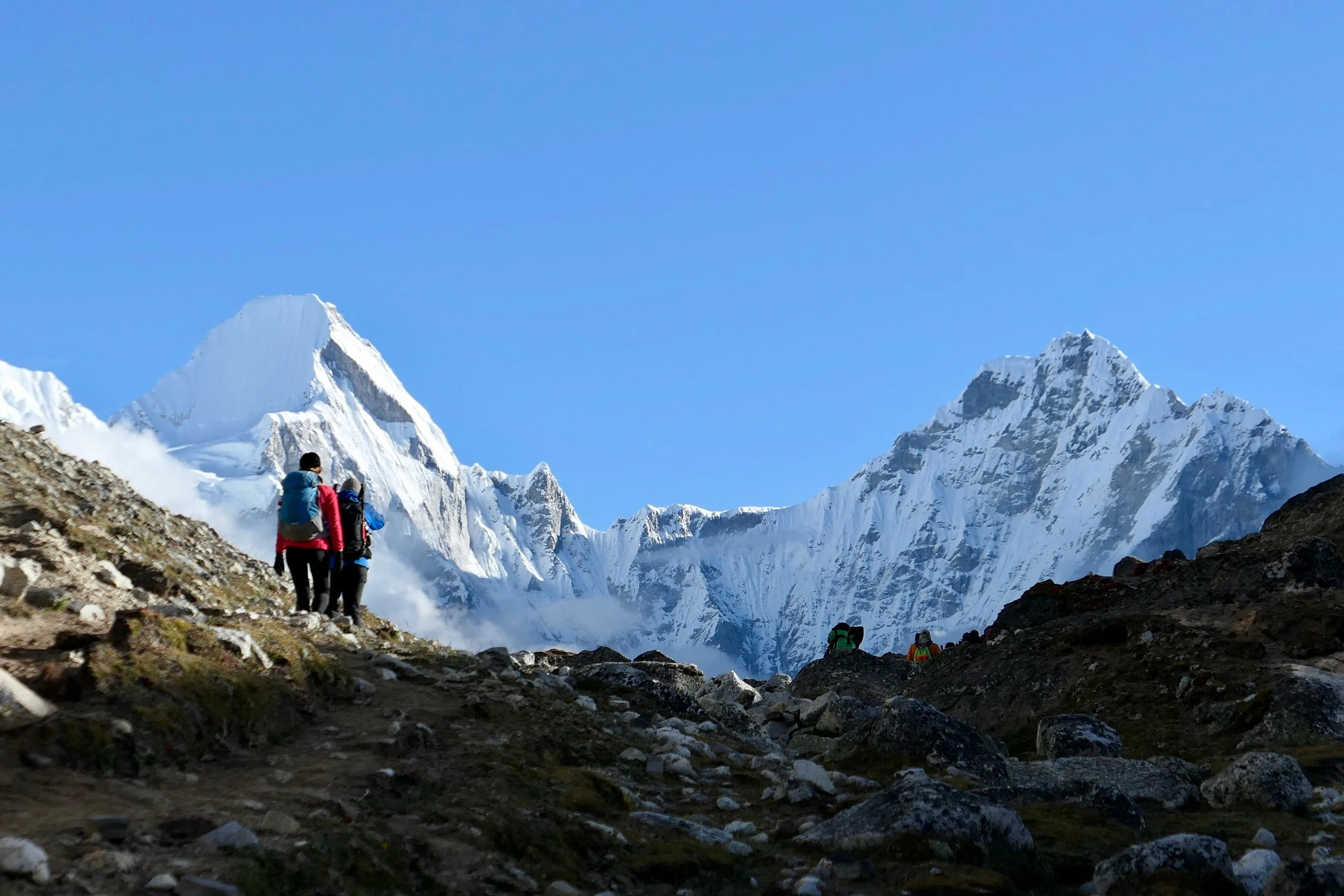
The Everest Base Camp trek for 2026 and 2027 is still the most sought-after trekking adventure in Nepal. Over 14 days, this EBC trek takes you through the Khumbu region, past Sherpa villages and old monasteries, to the foot of the world’s highest mountain at 5,364 m. It is a demanding walk, and most people who finish it say the effort was worth it.
The route
The trek begins with a 30-minute flight from Kathmandu to Lukla, the gateway to the Everest region. During the busy spring and autumn seasons, flights often leave from Manthali Airport in Ramechhap instead, which means a 4 to 5 hour road transfer beforehand.
From Lukla you walk through pine and rhododendron forest to Phakding, a quiet village beside the Dudh Koshi River. The next stop is Namche Bazaar at 3,440 m, the main Sherpa town of the region. The climb there is steep and crosses several high suspension bridges, and the mountains look larger with every bend in the trail.
Beyond Namche, the path leads to Tengboche Monastery at 3,867 m, then up to Dingboche at 4,410 m. Forest gives way to bare, rocky hills along the way. You pass through Sagarmatha National Park, a UNESCO World Heritage Site that is home to the Himalayan tahr and the snow leopard. After Dingboche comes Lobuche, where the lodges are basic, and then Gorakshep and the walk along the Khumbu Glacier to Base Camp itself.
Acclimatization days
The 14-day schedule includes two rest days, one at Namche Bazaar and one at Dingboche. They are there for your body, and they are the main reason the itinerary works. With two acclimatization days, the success rate for this trek is over 95%. Shorter 10 to 12 day versions raise the risk of altitude sickness and lower the chance of reaching Base Camp.
On the Namche rest day you hike up to the Everest View Hotel and visit the village of Khumjung. At Dingboche, the usual outing is the climb to Nangkartshang Peak (5,083 m), which takes about three hours. From the top you can see Ama Dablam up close, along with Lhotse, Pumori, Makalu, Island Peak and Everest.
Kala Patthar
Everest Base Camp is at 5,364 m, but it is not the highest point of the trek. That is Kala Patthar, at 5,644.5 m. You climb it from Gorakshep for the best panoramic view of Everest, and it is the furthest point of the journey. After that you head back to Lukla by the same route and fly to Kathmandu.
Best time to go
Spring (March to May) and autumn (September to November) are the two good seasons. Spring is the stable pre-monsoon period, with rhododendrons in bloom, though the trail is busier. Autumn brings clear post-monsoon skies and some of the best views of Everest, Lhotse and Ama Dablam, with fewer people on the path. Daytime temperatures in Namche usually reach about 15 degrees Celsius, while spring afternoons at Base Camp can reach 5 to 10 degrees.
Permits, guide and insurance
Two local permits are required for the EBC trek: the Sagarmatha National Park entry permit and the Khumbu Pasang Lhamu Rural Municipality entry permit. TIMS is not needed for treks that stay within the Khumbu region. A licensed guide is mandatory for foreign trekkers in the area. Your travel insurance must cover high-altitude trekking and helicopter evacuation from above 5,500 m.
Preparing for the trek
The walking days are long, usually 6 to 9 hours, and the total distance is about 130 km round trip from Lukla. Daily stages run roughly 10 to 15 km. Training that builds steady endurance helps most: brisk uphill walking, cycling, swimming and stair climbing, plus squats, lunges and step-ups for the legs. The best preparation is to trek, so if you have trails nearby, use them with a loaded daypack. Mental preparation counts as much. Expect cold nights in teahouses, simple toilets at altitude and plenty of dal bhat, and take the trek one village at a time.
What a guided package covers
A good guided package handles the logistics so you can focus on the trail. Look for an English-speaking guide, porters (one for every two trekkers), domestic flights, airport transfers, park and municipality permits, meals and lodging during the trek, hotel nights in Kathmandu and daily health and oxygen saturation checks. Extras such as a single room, an extra porter or a helicopter exit are usually available as add-ons.