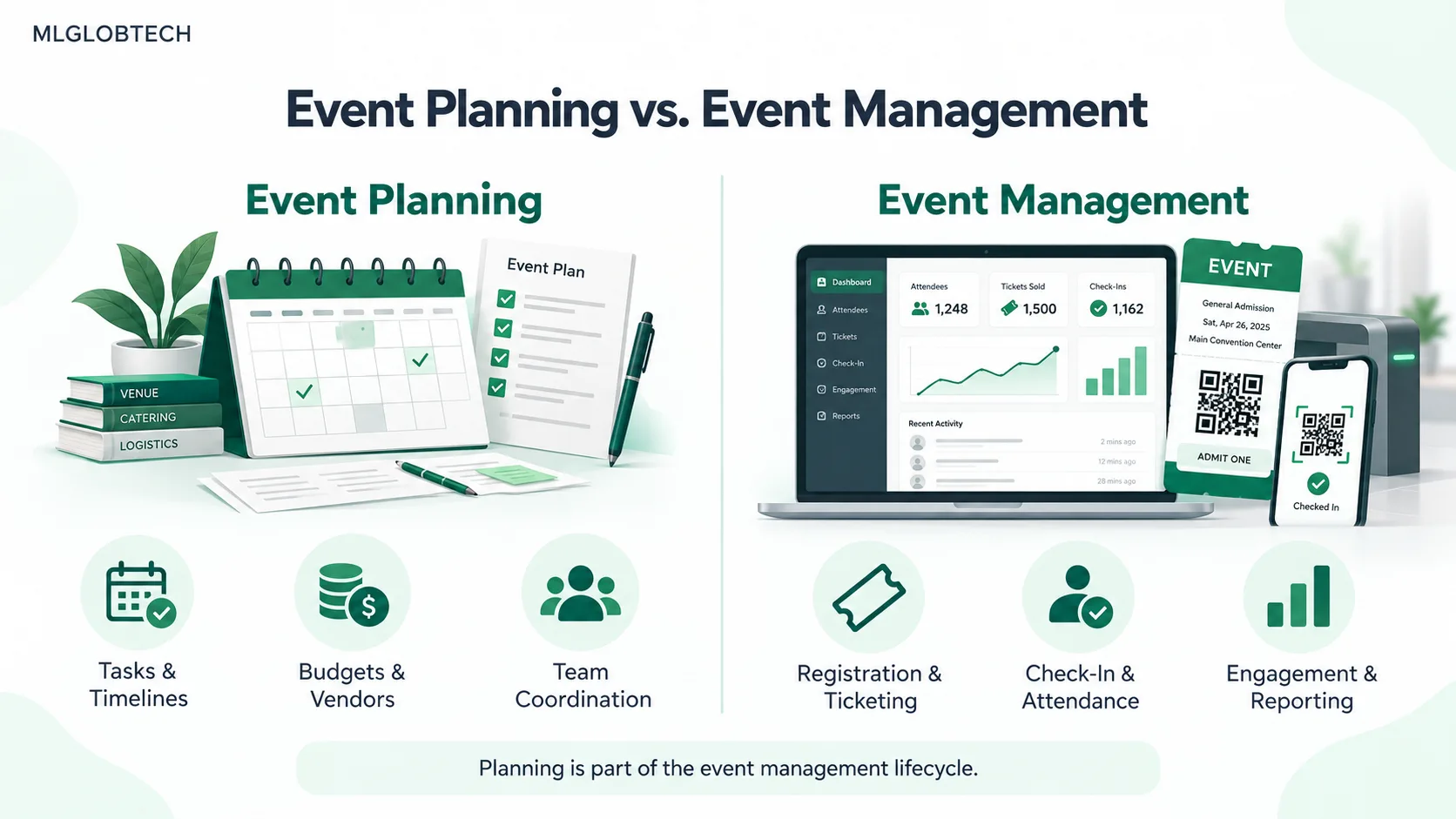
Planning an event involves more than choosing a venue and sending invitations. Teams must coordinate budgets, suppliers, schedules, registrations, attendee communications, and follow-up activities.
Software can bring these moving parts together. But when researching solutions, you will often see two similar terms: event planning software and event management software.
Event planning software generally helps teams organize preparation and internal tasks. Event management software usually supports a broader lifecycle, including registration, event delivery, attendee engagement, and reporting. Understanding this difference helps you choose software based on your actual requirements.
What Is Event Planning Software
Event planning software helps organizers coordinate the work required to prepare an event. It gives teams a shared place to manage responsibilities, deadlines, budgets, and resources.
Consider a company preparing an annual conference. Before registration opens, the team must confirm speakers, shortlist venues, approve catering, and organize equipment. Planning software helps keep those activities visible and connected.
Common features of event planning software
- Task management: Assign responsibilities, priorities, and deadlines.
- Budget tracking: Monitor estimated, committed, and actual spending.
- Vendor coordination: Maintain supplier details, proposals, and deliverables.
- Scheduling: Organize preparation timelines and event agendas.
- Team collaboration: Share documents, updates, and approval requests.
- Resource allocation: Coordinate staff, rooms, equipment, and materials.
Reusable templates: Repeat established processes for recurring events.
Its main benefit is better coordination. Teams can see what is complete, what is delayed, and who needs to take action. However, not every planning tool includes ticketing, payment collection, or attendee check-in.
What Is Event Management Software
Event management software typically supports activities before, during, and after an event. Alongside planning, it may help organizers publish event pages, collect registrations, communicate with attendees, manage entry, and evaluate results.
For example, a conference organizer could use an event management platform to collect participant information, send confirmations, scan attendees at the entrance, and gather feedback afterward. Features may depend on the package or additional modules.
Common features of event management software
- Event websites and registration forms.
- Ticket categories and payment collection.
- Attendee records and automated communications.
- Speaker, sponsor, and exhibitor coordination.
- Session scheduling and capacity management.
- QR code check-in and badge printing.
- Surveys, announcements, and networking tools.
- Attendance reports and business-system integrations.
The goal is continuity: information collected during registration should remain useful during event delivery and follow-up.
Event Planning Software vs. Event Management Software: Key Differences
Both types of software help organizers coordinate events, but their scope and priorities often differ.
1. Main Focus
Event planning software concentrates on preparation, including tasks, timelines, budgets, and suppliers.
Event management software usually supports a broader lifecycle, from planning and registration to event delivery and reporting.
2. Tasks, Budgets, and Vendors
Planning tools often emphasize assigning responsibilities, tracking spending, and coordinating vendor deadlines.
Event management platforms may include these capabilities, but their depth varies. Check whether budgeting and vendor management are included or require additional modules.
3. Registration and Ticketing
Some planning tools require a separate registration or ticketing service.
Event management platforms commonly offer registration forms, ticket categories, confirmations, and payment collection. Availability depends on the product and package.
4. Event-Day Operations
Planning software may help teams organize staff schedules, equipment, and operational checklists.
Event management software often adds attendee check-in, badge printing, attendance tracking, and event updates.
5. Attendee Engagement
Planning tools generally focus on internal coordination, so attendee engagement features may be limited.
Event management platforms may provide surveys, event apps, announcements, and networking tools.
6. Reporting and Results
Planning software typically tracks task completion, deadlines, resources, and costs.
Event management software often reports on registrations, attendance, engagement, and other event results. Measuring business outcomes may also require connections with CRM or marketing systems.
Which Type Fits Your Event
Internal workshops and team meetings
For an internal workshop, the main requirements may be confirming participants, booking a room, arranging equipment, and distributing materials. A planning-focused tool may be sufficient if invitations and attendance responses are already handled effectively elsewhere.
Public conferences and paid events
A public conference may involve multiple ticket categories, payments, registration changes, parallel sessions, and attendee check-in. These requirements usually call for broader event management capabilities.
Agencies managing several clients
An agency might already have reliable ticketing software but struggle with supplier deadlines, client approvals, and staff allocation. Its biggest need could be stronger planning functionality rather than another registration platform. Complexity, existing systems, and reporting needs matter alongside event size.
Event Software Options to Evaluate
The following options represent different approaches rather than a ranking of software providers.
1 MLGLOBTECH Event Management Platform
Organizations exploring an event software solution can include the MLGLOBTECH Event Management Platform in their evaluation. Start by discussing your event format, registration process, team responsibilities, and reporting needs. Request a demonstration that follows your actual workflow, from event setup to post-event reporting.
If you are considering a customized or white-label arrangement, clarify branding options, integrations, deployment, maintenance, licensing, and source code access. Confirm the agreed scope in the proposal rather than assuming these are standard inclusions.
2 Subscription Based Event Management Platforms
Established subscription platforms can suit teams looking for an existing product with defined packages and support arrangements. Compare included features carefully. Registration, onsite tools, engagement functions, and advanced reporting may be sold separately.
3 Project Management Software with Registration Tools
Some organizations combine a project management application with a separate registration or ticketing service. This can work when existing tools meet most requirements. Check how attendee records, schedule changes, and reports move between systems.
Current Insights for Event Software Buyers in 2026
Practical AI matters more than an AI label
Cvent’s 2026 trends coverage emphasizes practical AI implementation, while Bizzabo’s industry reporting discusses growing adoption alongside accuracy and data-governance concerns. Ask whether AI helps with work you actually perform, such as drafting communications, analyzing feedback, or suggesting sessions. Check whether staff can review outputs and control the information used. AI-generated schedules and messages still need human oversight.
Connected information reduces operational gaps
Disconnected systems can create conflicting records. A cancelled registration might remain active at check-in, or an agenda change might fail to reach attendees. Ask which information moves between systems, how quickly updates appear, how duplicates are handled, and what happens when a transfer fails. A listed integration is only useful if it supports your process.
Measurement should reflect the event purpose
Bizzabo’s 2026 research highlights registration conversion, engagement, sponsorship performance, and event ROI as areas of focus. Choose metrics that match your objectives. A training workshop may measure attendance and learning feedback. A business conference may track qualified conversations and follow-up opportunities. Registration totals alone do not demonstrate business value.
Attendee experience starts before event day
Clear forms, useful confirmations, relevant reminders, and accurate session information all contribute to the experience. Current industry coverage also emphasizes personalization and meaningful networking. Start with features that help your audience register, prepare, participate, and find information easily.
How to Choose the Right Software
Identify your three biggest problems
List the issues creating the most work, such as missed deadlines, duplicate records, registration errors, check-in queues, or slow reporting. Use them to define essential requirements.
Test a realistic workflow
Ask providers to demonstrate event setup, task assignment, registration changes, attendee notifications, check-in, and report exports. Include the staff who will use the software. Their feedback can reveal practical limitations.
Compare the full cost
Look beyond the subscription or development fee. Check setup, training, extra users, transaction charges, integrations, equipment, hosting, maintenance, and support. Compare providers against the same expected usage.
Confirm data access and ownership
Ask which records you can export and in what format. Check custom fields, attendance information, and feedback. For customized software, document responsibilities for hosting, updates, backups, and maintenance.
Conclusion
Event planning software typically organizes preparation. Event management software usually extends into registration, event delivery, attendee engagement, and reporting. Because the categories overlap, choose according to your workflow rather than the product label.
Identify your operational gaps, test essential tasks, and compare the complete cost. Whether you evaluate MLGLOBTECH or another provider, the right solution should help your team coordinate work and deliver a smoother attendee experience.