
Market Overview
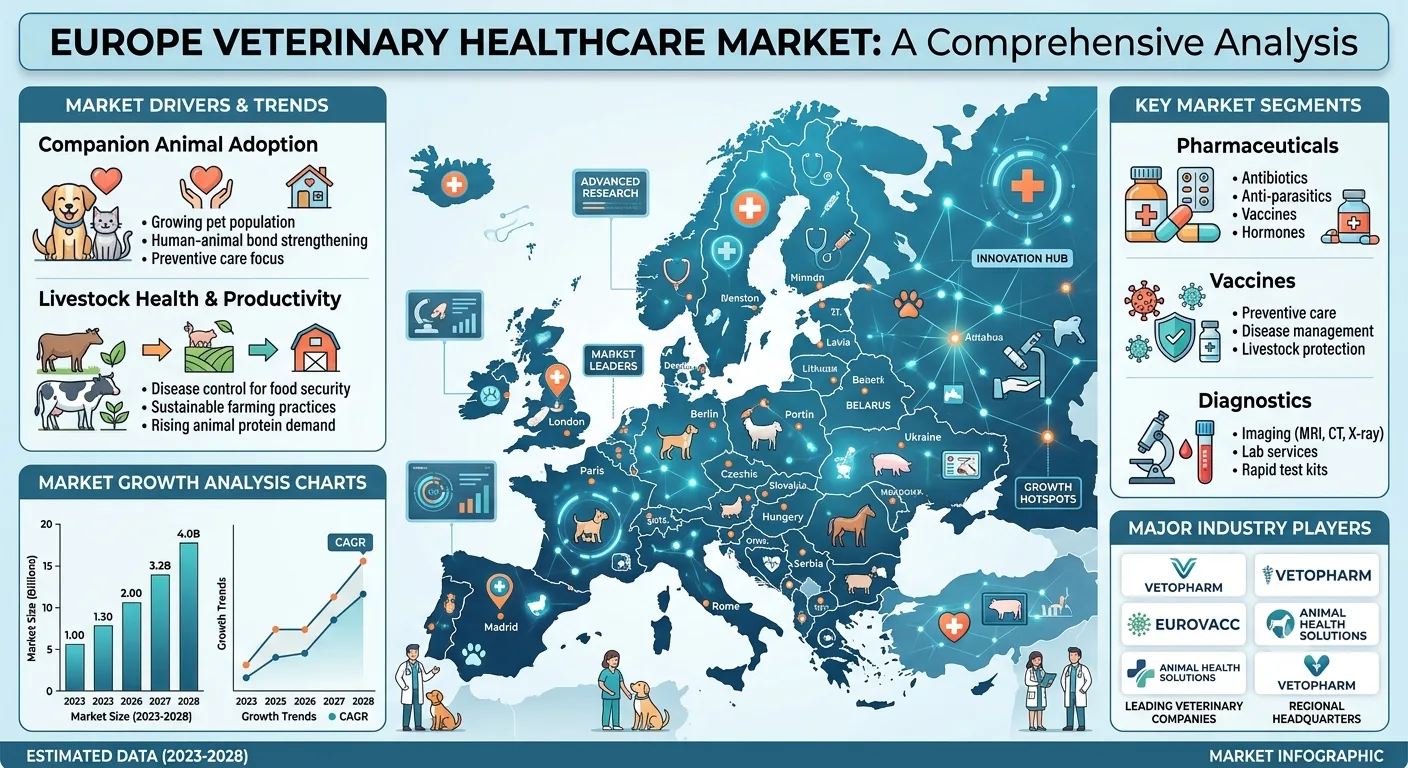
The Europe veterinary healthcare market grew from USD 2.20 Billion in 2025 to USD 2.34 Billion in 2026 and is projected to reach USD 3.90 Billion by 2034, exhibiting a CAGR of 6.57% during 2026-2034. Rising companion animal adoption, expanding livestock disease-prevention needs, and continuous innovation in diagnostics and biologics are the primary drivers shaping the market growth. Therapeutics leads the product segment at 71.8%, dogs and cats hold 42.6% of the animal type segment, and Germany commands 24.6% country-wise share.
This market is strategically important to Europe's animal health and agricultural economy, supporting the health and productivity of companion animals and livestock across the region. The Europe veterinary healthcare market encompasses therapeutics (vaccines, parasiticides, anti-infectives, medical feed additives, others) and diagnostics (immunodiagnostic tests, molecular diagnostics, diagnostic imaging, clinical chemistry, others) across dogs and cats, horses, ruminants, swine, poultry, and other animal types in Germany, France, United Kingdom, Italy, Spain, and other European countries.
The Europe veterinary healthcare market is poised for sustained expansion, underpinned by pet humanization, livestock disease prevention, and diagnostic innovation. With a projected CAGR of 6.57% through 2034, the market presents significant opportunities for providers focusing on point-of-care diagnostics, biologics and next-generation vaccines, digital and telehealth-enabled consultations, and specialty care.
EUROPE VETERINARY HEALTHCARE MARKET SUMMARY
The Europe veterinary healthcare market encompasses the provision of medical products and services designed to diagnose, treat, and prevent disease in companion and production animals, spanning pharmaceuticals, vaccines, parasiticides, diagnostic imaging, laboratory testing, and related clinical services.
The ecosystem spans animal health manufacturers, veterinary clinics and hospitals, diagnostic laboratories, distributors and wholesalers, national and EU-level regulatory authorities, research institutions, and end users including pet parents and livestock farmers throughout Europe.
By Product, the market serves Therapeutics (dominating at 71.8% share in 2025) including Vaccines, Parasiticides, Anti-Infectives, Medical Feed Additives, and Others; and Diagnostics (28.2%, fastest-growing) including Immunodiagnostic Tests, Molecular Diagnostics, Diagnostic Imaging, Clinical Chemistry, and Others.
By Animal Type, the market serves Dogs and Cats (dominating at 42.6% share in 2025), Horses, Ruminants (19.4%), Swine, Poultry, and Others.
By Country, the market serves Germany (dominating at 24.6% share in 2025), United Kingdom (20.9%), France (18.1%), Italy (13.9%), Spain (11.2%), and Others (11.3%).
Key trends shaping the market include growth of preventive and weight-management therapeutics, expansion of point-of-care and molecular diagnostics, digital and telehealth-enabled veterinary consultations, and biologics and next-generation vaccine development.
PORTER'S FIVE FORCES ANALYSIS – EUROPE VETERINARY HEALTHCARE MARKET
Competitive Rivalry: Moderate. The market is moderately consolidated, with a group of globally diversified animal health companies leading therapeutics supply while specialized players anchor the diagnostics segment. Product portfolio breadth, veterinary relationships, and regulatory approval capacity form the key competitive moats. Business implication: Companies must differentiate through product innovation, portfolio breadth, and veterinary relationships.
Supplier Power (API and Biologics Providers): Moderate. Manufacturers rely on suppliers of active pharmaceutical ingredients, biologics inputs, and specialty chemicals. The shift toward biologics and next-generation vaccines is increasing dependency on specialized suppliers. Business implication: Strategic partnerships and vertical integration can reduce supplier dependency and ensure supply chain resilience.
Buyer Power (Veterinarians and Pet Owners): High. Veterinarians influence product selection through prescribing decisions, while pet owners and livestock farmers make purchasing decisions based on efficacy, safety, and cost. Insurance coverage and out-of-pocket costs influence treatment decisions. Business implication: Providers must demonstrate value through clinical efficacy, safety, and cost-effectiveness.
Threat of Substitutes: Low to Moderate. Alternative treatments, traditional remedies, and preventive care approaches represent partial substitutes. However, veterinary pharmaceuticals and diagnostics remain essential for animal health management with limited practical substitutes. Business implication: Demonstrating superior efficacy, safety, and clinical outcomes is essential.
Threat of New Entrants: Low to Moderate. Significant capital requirements for R&D, regulatory approval, and manufacturing create barriers. However, the growth of diagnostics and digital health segments has enabled new entrants focused on specialized products and services. Business implication: Incumbents must leverage scale, regulatory expertise, and veterinary relationships while monitoring emerging competitors.
KEY ASPECTS REQUIRED FOR THE EUROPE VETERINARY HEALTHCARE MARKET
Market Performance: USD 2.20 Billion in 2025, projected to reach USD 3.90 Billion by 2034, driven by companion animal adoption, livestock disease prevention, and diagnostic innovation.
Market Outlook: A 6.57% CAGR through 2034 reflects steady growth led by therapeutics, dogs and cats, and German market dominance.
Growth Drivers: Rising companion animal adoption and spend; livestock disease prevention needs; growth in pet insurance and preventive care; advances in diagnostics and precision medicine; expansion of point-of-care and molecular diagnostics; digital and telehealth-enabled consultations; biologics and next-generation vaccine development.
Competitive Landscape: A moderately consolidated market with global animal health companies and specialized diagnostics players. Key players include Zoetis Inc., Boehringer Ingelheim International GmbH, Merck & Co., Inc., Elanco, and Virbac.
Value Chain Analysis: From raw material and API supply through R&D, manufacturing, diagnostics and laboratory services, distribution and wholesale, veterinary clinics and hospitals, and end users across companion and production animal segments.
Industry Trends: Preventive and weight-management therapeutics; point-of-care and molecular diagnostics; digital and telehealth-enabled consultations; biologics and next-generation vaccines; AI-assisted diagnostics interpretation; pet insurance expansion.
Strategic Recommendations: Invest in point-of-care diagnostics and AI-assisted interpretation; expand biologics and next-generation vaccine portfolios; develop digital and telehealth platforms; target companion animal oncology and specialty care; pursue pet insurance partnerships in under-penetrated markets; strengthen livestock disease prevention offerings; address antimicrobial use restrictions with alternative therapies; expand presence in Spain and Italy as growth markets.
Request for Sample Report: https://www.imarcgroup.com/europe-veterinary-healthcare-market/requestsample
MARKET GROWTH DRIVERS
Rising Companion Animal Adoption and Spend
Deepening pet humanization across Western and Northern Europe is lifting per-pet healthcare spending on wellness visits, vaccination, and chronic disease management, sustaining demand for both therapeutics and diagnostics. Pet adoption across Europe rose considerably from roughly 4.2 Million in 2010 to more than 7 Million by 2025. This trend is driving demand for veterinary healthcare products and services, as pet owners increasingly prioritize preventive care and advanced treatment options for their companion animals. The humanization of pets is also driving demand for premium products, specialized treatments, and chronic disease management, supporting market value growth.
Livestock Disease Prevention Needs
Commercial farmers continue to prioritize herd and flock health management to protect productivity, sustaining consistent demand for vaccines, parasiticides, and veterinary diagnostic services across production animal categories. Disease prevention is essential for maintaining livestock productivity and profitability, driving demand for vaccines, parasiticides, and veterinary diagnostics. The ruminants segment, supported by dairy and beef herd health management requirements across major producing countries, represents a significant market opportunity for animal health companies.
Growth in Pet Insurance and Preventive Care
Expanding insurance coverage is easing the cost barrier to veterinary visits. Greater willingness among pet parents to invest in routine checkups, vaccinations, and preventive treatments is supporting sustained demand for veterinary healthcare services and products. The growth of pet insurance in markets including the United Kingdom and Sweden, and its expansion in under-penetrated markets including Spain and Italy, is driving increased veterinary visits and treatment volumes. This trend is particularly significant for diagnostics and specialty care, which can be cost-prohibitive for uninsured pet owners.
Advances in Diagnostics and Precision Medicine
Growing availability of in-clinic analyzers, point-of-care testing platforms, and molecular diagnostics is enabling earlier disease detection and more targeted treatment protocols across companion animal practices. The diagnostics segment is expanding faster than therapeutics as veterinarians adopt point-of-care testing to support earlier and more precise diagnosis. Advances in diagnostic imaging, laboratory testing, and molecular diagnostics are driving market growth, particularly in companion animal medicine where early detection can significantly improve treatment outcomes.
Expansion of Point-of-Care and Molecular Diagnostics
In-clinic analyzers capable of rapid blood chemistry, hematology, and infectious disease testing are becoming standard equipment in general practice, reducing turnaround time and supporting the shift toward earlier, more precise diagnosis across companion animal medicine. Point-of-care diagnostics enable veterinarians to make immediate clinical decisions, improving patient outcomes and practice efficiency. This trend is driving demand for diagnostic equipment and consumables, supporting the fastest-growing product segment in the market.
Digital and Telehealth-Enabled Veterinary Consultations
Remote triage, video consultations, and app-based medication reminders are gaining traction among pet parents, particularly for routine follow-ups and chronic condition management, easing pressure on in-clinic appointment capacity. Telehealth platforms are expanding access to veterinary care, particularly in rural and underserved areas, and improving continuity of care between clinic visits. This trend is expected to continue shaping the market, particularly for chronic condition management and preventive care.
Biologics and Next-Generation Vaccine Development
Manufacturers are expanding monoclonal antibody therapies and next-generation vaccine platforms for both companion and production animals, targeting chronic conditions such as osteoarthritis and allergic dermatitis alongside traditional infectious disease prevention. This trend is driving investment in biologics manufacturing capacity, particularly for cell-based vaccine platforms and monoclonal antibody production. The expansion of biologics portfolios is expected to drive market growth, particularly in companion animal specialty care.
EUROPE VETERINARY HEALTHCARE MARKET SEGMENTATION
Segmentation analysis provides a detailed view of the Europe veterinary healthcare market by category:
Product Insights: Therapeutics commands a 71.8% majority share in 2025, spanning vaccines, parasiticides, anti-infectives, and other pharmaceutical categories used across companion and production animals. The segment benefits from recurring prescription cycles, broad manufacturer portfolios, and established veterinary distribution networks across the region. Vaccines represent a significant sub-segment, driven by disease prevention requirements in both companion and production animals. Parasiticides constitute a growing sub-segment, with products addressing fleas, ticks, and internal parasites. Anti-infectives represent a declining sub-segment due to antimicrobial use restrictions, though demand remains for treating bacterial infections. Medical feed additives and other therapeutics represent significant sub-segments. Diagnostics, at 28.2% in 2025, covers in-clinic analyzers, imaging equipment, and reference laboratory services. The segment is expanding faster than therapeutics as veterinarians adopt point-of-care testing to support earlier and more precise diagnosis. Immunodiagnostic tests, molecular diagnostics, diagnostic imaging, and clinical chemistry represent significant sub-segments.
Animal Type Insights: Dogs and cats lead the animal type segment with 42.6% share in 2025, reflecting dense companion animal adoption and high per-pet healthcare spending. Growing awareness of preventive healthcare, routine vaccinations, and chronic disease management continues to support sustained demand across the segment. Ruminants follow at 19.4%, supported by dairy and beef herd health management requirements across major producing countries. Horses represent a significant segment, with specialized veterinary services and products for equine health. Swine and poultry represent significant segments, with disease prevention and productivity requirements driving demand. Other animal types include aquaculture and exotic pets.
Country Insights: Germany at 24.6% in 2025 leads the regional landscape, anchored by a large veterinary clinic base, substantial livestock density, and high companion animal adoption. Strong manufacturer presence and well-developed distribution infrastructure support sustained leadership across both therapeutics and diagnostics. United Kingdom, at 20.9%, is the second largest market, supported by a well-established veterinary care network, high companion animal adoption, and strong spending on preventive animal healthcare. France at 18.1% features a large companion animal population, established distribution channels, and robust regulatory support. Italy at 13.9% benefits from growing pet adoption, expanding veterinary services, and rising healthcare awareness. Spain at 11.2% represents the fastest-growing market, driven by rising disposable incomes, expanding insurance uptake, and growing livestock production. Other markets at 11.3% include gradual veterinary infrastructure development and increasing animal healthcare awareness.
COMPETITIVE LANDSCAPE
The Europe veterinary healthcare market is moderately consolidated, with a group of globally diversified animal health companies leading therapeutics supply while a specialized player anchors the diagnostics segment. Product portfolio breadth, veterinary relationships, and regulatory approval capacity form the key competitive moats across the region. Barriers to entry include the high cost of regulatory approval across EU member states, the need for established veterinary relationships, and significant investment required for vaccine and biologics manufacturing capacity.
Zoetis Inc. is a global animal health company, with an established presence across companion animal and livestock health products in Europe. Product portfolio includes parasiticides, vaccines, and dermatology treatments for companion and production animals. The company continues to strengthen its animal health portfolio through ongoing product enhancements, research initiatives, and expansion of veterinary healthcare solutions across key markets. Strategic focus includes maintaining broad-portfolio leadership across companion animal and livestock segments through continued product innovation.
Boehringer Ingelheim International GmbH is a privately held pharmaceutical group headquartered in Germany, with an established presence across companion animal and livestock health products in Europe. Product portfolio includes NexGard; parasiticides and vaccines for companion and production animals. The company has been expanding its animal health portfolio and manufacturing capacity across European markets. Strategic focus includes strengthening its integrated companion animal and livestock health offering through continued portfolio expansion.
Merck & Co., Inc. is a global pharmaceutical company, with a well-established animal health business serving companion animal and livestock healthcare markets across Europe. Product portfolio includes vaccines and digital health tools for companion and production animals. The company continues to expand its animal health portfolio through ongoing product development, strategic collaborations, and enhanced veterinary healthcare offerings across global markets. Strategic focus includes advancing integrated animal health solutions across pharmaceuticals, vaccines, and digital technology.
Elanco is an animal health company expanding companion animal and farm animal product portfolio with products including Seresto.
Virbac is a France-based specialist with focus on companion animal and livestock therapeutics with products including Effipro.
Recent Developments:
2026: The Europe veterinary healthcare market continued its growth trajectory from USD 2.20 Billion in 2025 to USD 2.34 Billion in 2026 toward USD 3.90 Billion by 2034 at a CAGR of 6.57%.
2025: Continued expansion of point-of-care diagnostics and biologics portfolios across European markets.
2025: Growing adoption of digital and telehealth platforms for veterinary consultations.
Investment opportunities exist in point-of-care diagnostics, biologics and next-generation vaccines, digital veterinary platforms, and specialty care.
REGIONAL ANALYSIS
Germany at 24.6% in 2025 leads the regional landscape, anchored by a large veterinary clinic base, substantial livestock density, and high companion animal adoption. Strong manufacturer presence and well-developed distribution infrastructure support sustained leadership across both therapeutics and diagnostics. The country benefits from a large veterinary infrastructure base, high livestock density, and strong companion animal adoption.
United Kingdom at 20.9% is the second largest market, supported by a well-established veterinary care network, high companion animal adoption, and strong spending on preventive animal healthcare. Continued investment in veterinary services and pet health awareness further supports market growth across the country. High pet insurance penetration and mature clinic networks drive demand for diagnostics and specialty care.
France at 18.1% features a large companion animal population, established distribution channels, and robust regulatory support. The French market benefits from strong veterinary infrastructure and growing demand for preventive care and diagnostics.
Italy at 13.9% benefits from growing pet adoption, expanding veterinary services, and rising healthcare awareness. The Italian market represents significant growth potential, with expanding insurance uptake and increasing veterinary infrastructure investment.
Spain at 11.2% represents the fastest-growing market, driven by rising disposable incomes, expanding insurance uptake, and growing livestock production. Increasing awareness of preventive animal healthcare and ongoing modernization of veterinary clinics support long-term market expansion.
Other markets at 11.3% include gradual veterinary infrastructure development and increasing animal healthcare awareness across Nordic, Benelux, and Central European countries.
RECENT INDUSTRY DEVELOPMENTS
2026 Activity: The Europe veterinary healthcare market continued its growth trajectory from USD 2.20 Billion in 2025 to USD 2.34 Billion in 2026 toward USD 3.90 Billion by 2034 at a CAGR of 6.57%.
2025: Continued expansion of point-of-care diagnostics and biologics portfolios across European markets.
2025: Growing adoption of digital and telehealth platforms for veterinary consultations.
FREQUENTLY ASKED QUESTIONS
Q1: What is the current size of the Europe veterinary healthcare market?
A: The Europe veterinary healthcare market grew from USD 2.20 Billion in 2025 to USD 2.34 Billion in 2026 and is projected to reach USD 3.90 Billion by 2034, exhibiting a CAGR of 6.57% from 2026-2034.
Q2: What are the key drivers of the Europe veterinary healthcare market?
A: The market is driven by: (i) rising companion animal adoption and spend; (ii) livestock disease prevention needs; (iii) growth in pet insurance and preventive care; (iv) advances in diagnostics and precision medicine; (v) expansion of point-of-care and molecular diagnostics; (vi) digital and telehealth-enabled consultations; and (vii) biologics and next-generation vaccine development.
Q3: What are the major products in the Europe veterinary healthcare market?
A: Major products include Therapeutics (dominating at 71.8% share in 2025) and Diagnostics (28.2%, fastest-growing). Therapeutics include Vaccines, Parasiticides, Anti-Infectives, Medical Feed Additives, and Others. Diagnostics include Immunodiagnostic Tests, Molecular Diagnostics, Diagnostic Imaging, Clinical Chemistry, and Others.
Q4: What are the major animal types in the Europe veterinary healthcare market?
A: Major animal types include Dogs and Cats (dominating at 42.6% share in 2025), Horses, Ruminants (19.4%), Swine, Poultry, and Others.
Q5: Which country leads the Europe veterinary healthcare market?
A: Germany leads with 24.6% share in 2025, anchored by a large veterinary clinic base, substantial livestock density, and high companion animal adoption.
Q6: Who are the major players in the Europe veterinary healthcare market?
A: Major players include Zoetis Inc., Boehringer Ingelheim International GmbH, Merck & Co., Inc., Elanco, and Virbac.
Q7: What are the challenges facing the Europe veterinary healthcare market?
A: Key challenges include antimicrobial use restrictions, high cost of veterinary treatment and diagnostics, shortage of skilled veterinary professionals, fragmented regulatory approval pathways, and counterfeit and parallel-traded veterinary medicines.
Q8: What is the outlook for the Europe veterinary healthcare market?
A: The market is projected to grow at a 6.57% CAGR through 2034, with growth driven by pet humanization, livestock disease prevention, and diagnostic innovation. The shift toward point-of-care diagnostics, biologics and next-generation vaccines, digital and telehealth-enabled consultations, and specialty care are expected to shape the market's evolution.
Note: If you need any specific information that is not covered currently within the scope of the report, we will provide the same as a part of customization.
https://www.imarcgroup.com/request?type=report&id=31444&flag=E
Report Format, Delivery, and Customization Details
Report Format Mode: PPT, PDF, and Excel
Report Delivery Mode: Online Delivery, Physical Delivery
Report Delivery Time: Report Delivered Over Email within 24 to 48 hours. If requested by the client, a physical copy will be delivered within three to ten days.
Report Confirmation Mode: Yes via Email
Report Customization Mode: Yes via Email / Call
Report Table of Content: Yes
Report List of Figures: Yes
Report Methodology Mode: Yes
Request For Sample Report: Yes