
Market Overview
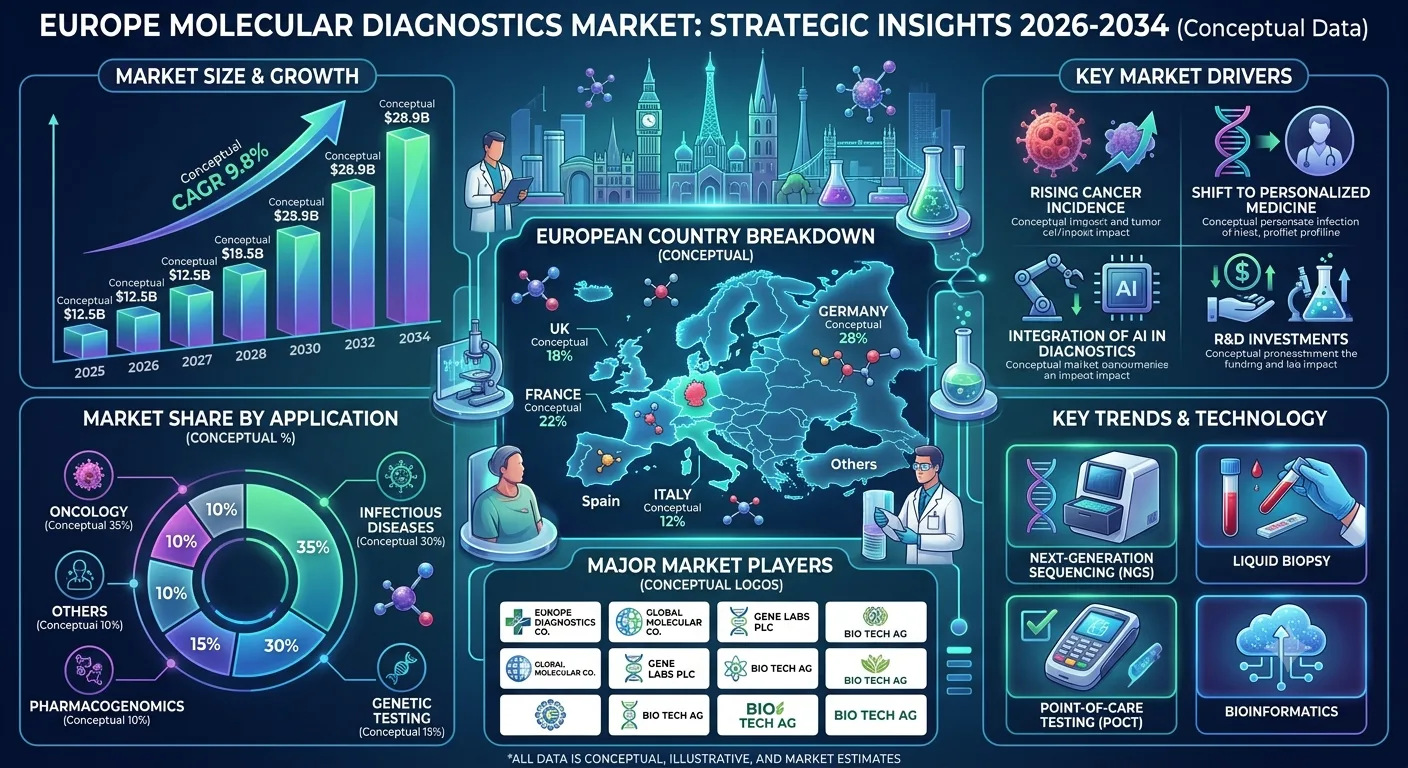
The Europe molecular diagnostics market size was valued at USD 5.6 Billion in 2025 and is projected to reach USD 8.7 Billion by 2034, growing at a compound annual growth rate (CAGR) of 5.04% from 2026 to 2034. Rising demand for infectious disease testing, expanding cancer screening and precision medicine, advances in PCR and next-generation sequencing, decentralised and near-patient testing, and public health investment are shaping the Europe molecular diagnostics market share and outlook through 2034. Regulatory change under the EU In Vitro Diagnostic Regulation is also influencing how manufacturers launch and maintain tests in the region.
Market Summary
- Reagents and kits lead. In IMARC's analysis, reagents and kits hold a 55% share by product, PCR holds 38% by technology, infectious disease diagnostics holds 46% by application, and hospitals hold 42% by end user.
- Competition is intense. IMARC describes an intensely competitive landscape, with leading multinational diagnostics corporations investing in product innovation, strategic acquisitions, and decentralized testing capabilities.
- Syndromic PCR testing is growing. bioMérieux recorded €1.73 billion in molecular biology sales in 2025, with its BIOFIRE non-respiratory panels generating €598 million, representing 10% organic growth, while QIAGEN's QIAstat-Dx system generated $139 million in sales, an increase of 27%.
- Screening needs are rising. Industry groups note that testing volumes and screening programmes are increasing, with prevention and early detection through diagnostics such as cervical cancer and colorectal cancer screening.
- Regulation is in transition. The European Commission published a proposal for a targeted revision of the EU medical device and in vitro diagnostic rules in December 2025, aiming to simplify rules and reduce administrative burden on manufacturers.
- Technology is broadening. PCR, next-generation sequencing, and liquid biopsy are expanding applications across infectious diseases, oncology, inherited disorders, and precision medicine.
- The market is segmented by product (reagents and kits, instruments, software and services), technology, application, end user (hospitals, laboratories, others), and country, with forecasts for 2026-2034.
Market Growth Drivers
Infectious Disease Testing and Syndromic Panels
Infectious disease diagnostics is the largest application, accounting for 46% of the market in IMARC's analysis. Laboratories and hospitals use molecular tests to identify pathogens quickly and accurately, guide antibiotic use, and support infection control. Syndromic panels that test for many pathogens at once are gaining ground, particularly in emergency and intensive care settings where fast results change treatment decisions. Concerns about antimicrobial resistance, hospital-acquired infections, and seasonal respiratory illness keep demand for PCR-based testing strong, and the same instruments can be used across multiple disease areas, which supports utilisation.
Cancer Screening, Precision Medicine, and Sequencing
Oncology and genetic testing are expanding as health systems adopt biomarker-guided therapy and early detection programs. Molecular tests are used to identify mutations, guide targeted treatments, monitor disease, and assess hereditary risk. Next-generation sequencing and liquid biopsy are widening the range of testable markers, and decreasing costs are making multi-gene panels more accessible. Public health priorities such as cervical and colorectal cancer screening are adding volume for HPV and related molecular assays. As evidence builds, laboratories are investing in sequencing capacity and bioinformatics, which supports higher-value testing.
Decentralised Testing, Automation, and Regulatory Clarity
Manufacturers are developing compact, automated systems that bring molecular testing closer to patients, such as hospital wards, clinics, and emergency departments. Automation also helps laboratories handle higher volumes with fewer staff. Regulation is a key factor. Under the In Vitro Diagnostic Regulation, developers of existing high-risk in vitro diagnostics have until December 2027 to obtain a renewed CE mark, and manufacturers of class C devices can use an extended transition period until 31 December 2028 if they submitted formal applications to a notified body by 26 May 2026. Clearer timelines and the planned revision are expected to reduce uncertainty and support product launches over the forecast period.
Request a Sample Report for In-Depth Market Insights: https://www.imarcgroup.com/europe-molecular-diagnostics-market/requestsample
Porter's Five Forces Analysis
Competitive Rivalry: High
- Global diagnostics groups, specialist molecular companies, and sequencing and laboratory technology providers compete on test menus, instrument platforms, and cost per result.
- Large players such as Roche, Danaher, Abbott, Thermo Fisher, QIAGEN, bioMérieux, and Illumina compete for hospital and laboratory contracts.
- Menu breadth, automation, turnaround time, evidence, and regulatory compliance are key points of differentiation.
Supplier Power: Moderate
- Enzymes, reagents, plastics, and electronics are supplied by a limited group of specialists, and supply disruptions can affect production.
- Large manufacturers use scale and in-house manufacturing to manage supply risk.
- Regulatory requirements on materials and quality add costs for suppliers.
Buyer Power: High
- Hospitals, laboratory networks, and public health systems buy through tenders and negotiate firmly on price, reagent rental, and service terms.
- Consolidation of laboratories increases buying scale and bargaining power.
- Reimbursement rules strongly influence which tests are adopted.
Threat of Substitutes: Moderate
- Conventional culture, immunoassays, and imaging can substitute for molecular tests in some situations.
- Rapid antigen tests compete on speed and cost for some infectious disease uses.
- Molecular tests retain advantages in sensitivity, specificity, and ability to detect genetic markers.
Threat of New Entrants: Low to Moderate
- Regulatory approval, clinical evidence, and laboratory relationships create significant barriers, and compliance with the in vitro diagnostic rules is demanding.
- Specialist start-ups can enter niches such as liquid biopsy, sequencing analytics, or point-of-care molecular tests.
- Established companies hold advantages in installed instrument bases and reagent contracts.
Market Segmentation
Product Insights
- Reagents and Kits
- Instruments
- Software and Services
Technology Insights
- Polymerase Chain Reaction (PCR)
- Hybridization
- DNA Sequencing
- Microarray
- Isothermal Nucleic Acid Amplification Technology
- Others
Application Insights
- Infectious Diseases Diagnostics
- Oncology
- Genetic Testing
- Blood Screening
- Others
End User Insights
- Hospitals
- Laboratories
- Others
Country Insights
- Germany
- France
- United Kingdom
- Italy
- Spain
- Others
Regional Analysis
Germany: Germany is a leading market, with a large population, a strong laboratory sector, and a major role for hospitals and private laboratory networks. Demand is supported by infectious disease testing, oncology, and a strong base of diagnostics manufacturers.
France: France has a well-developed healthcare system and an important diagnostics industry, including homegrown molecular diagnostics companies. Hospital laboratories and national screening programs support steady demand for molecular tests.
United Kingdom: The United Kingdom has strong genomic medicine initiatives and a large public laboratory network. Demand is supported by cancer diagnostics, infectious disease testing, and national programs, and regulatory alignment with EU rules remains a consideration for manufacturers.
Italy: Italy has a large ageing population and regionally organised health services. Molecular testing is expanding in oncology and infectious disease, and hospitals and public laboratories are the main buyers.
Spain: Spain is modernising diagnostic capabilities and expanding genomic and molecular testing in public hospitals. Regional health systems drive procurement, with growth supported by oncology and infectious disease applications.
Others: Other European markets include the Netherlands, Belgium, Switzerland, the Nordic countries, and Central and Eastern Europe. Western and Northern countries lead in advanced sequencing adoption, while Eastern markets are expanding from a lower base.
Competitive Landscape
The Europe molecular diagnostics market features global diagnostics corporations, specialist molecular and sequencing companies, laboratory networks, and a growing number of start-ups. Competition is shaped by product innovation, acquisitions, decentralised testing capabilities, test menu breadth, automation, evidence generation, and compliance with the In Vitro Diagnostic Regulation. Companies are also positioning for growth in syndromic testing, oncology, and sequencing. The report covers market structure, key player positioning, top winning strategies, competitive dashboard, and company evaluation quadrant, along with detailed profiles of all major companies.
Key players include:
- Roche Diagnostics
- Danaher (Cepheid)
- Abbott Laboratories
- Thermo Fisher Scientific
- QIAGEN
- bioMérieux
- Illumina
- Hologic
Recent Industry Developments
October 2026: Industry analysis highlighted expanding PCR-based syndromic testing, with bioMérieux's BIOFIRE non-respiratory panels and QIAGEN's QIAstat-Dx system both growing strongly in 2025. The data show demand for multi-pathogen testing and instrument platforms with broad test menus.
September 2026: A regulatory update noted that the Commission's consultation on its December 2025 proposal to revise the MDR and IVDR had attracted 293 valid feedback instances as of 1 September 2026. The level of response shows the importance of the proposed changes to the diagnostics industry.
June 2026: MedTech Europe published a paper on 3 June supporting proportionate oversight for low-risk devices under the Commission's revision proposal while calling for further strengthening in some areas. Stakeholders also met at the EAPM 2026 Presidency Conference on 30 June and 1 July to discuss the implementation gap of the in vitro diagnostic regulation.
May 2026: The deadline of 26 May 2026 passed for class C in vitro diagnostic manufacturers to submit formal applications to a notified body to benefit from the extended transition period until the end of 2028. The deadline shaped product portfolio decisions for tests such as oncology panels and genetic tests.
Key Aspects Required for the Europe Molecular Diagnostics Market
- Market Performance: The market was valued at USD 5.6 Billion in 2025 and is projected to reach USD 8.7 Billion by 2034, driven by infectious disease testing, cancer screening, and technology advances.
- Market Outlook: A 5.04% CAGR during 2026-2034 reflects steady expansion supported by screening programs, sequencing adoption, and regulatory clarity.
- Growth Drivers: Infectious disease testing and syndromic panels; cancer screening, precision medicine, and sequencing; and decentralised testing, automation, and regulatory clarity.
- Competitive Landscape: Roche, Danaher, Abbott, Thermo Fisher, QIAGEN, bioMérieux, Illumina, and Hologic compete on menu breadth, automation, evidence, and compliance.
- Value Chain Analysis: The value chain runs from reagent and component suppliers through test and instrument manufacturers, to distributors and laboratory networks, before reaching hospitals, clinicians, and patients across European countries.
- Industry Trends: Growth of syndromic PCR panels; wider use of sequencing and liquid biopsy; decentralised and automated platforms; IVDR transition and proposed revision; and expansion of screening programs.
- Strategic Recommendations: Plan IVDR transition early and track the revision; invest in syndromic and oncology test menus; develop automated and near-patient platforms; strengthen partnerships with hospitals and laboratory networks; and build evidence for reimbursement.
Note: If you need any specific information that is not covered currently within the scope of the report, we will provide the same as a part of customization.
Speak to an analyst: https://www.imarcgroup.com/request?type=report&id=11051&flag=E
Frequently Asked Questions
1. What is the size of the Europe molecular diagnostics market?
The market was valued at USD 5.6 Billion in 2025 and is projected to reach USD 8.7 Billion by 2034.
2. What is the expected growth rate of the Europe molecular diagnostics market?
The market is projected to grow at a CAGR of 5.04% during 2026-2034.
3. What is driving the growth of the Europe molecular diagnostics market?
Growth is driven by infectious disease testing and syndromic panels, cancer screening, precision medicine, and sequencing, and decentralised testing, automation, and regulatory clarity.
About Us
IMARC Group is a global management consulting firm that helps the world's most ambitious changemakers to create a lasting impact. The company provides a comprehensive suite of market entry and expansion services. IMARC offerings include thorough market assessment, feasibility studies, company incorporation assistance, factory setup support, regulatory approvals and licensing navigation, branding, marketing and sales strategies, competitive landscape and benchmarking analyses, pricing and cost research, and procurement research.
Contact Us
IMARC Group
134 N 4th St., Brooklyn, NY 11249, USA
Email: sales@imarcgroup.com
Tel No: (D) +91 120 433 0800
United States: +1-631-791-1145