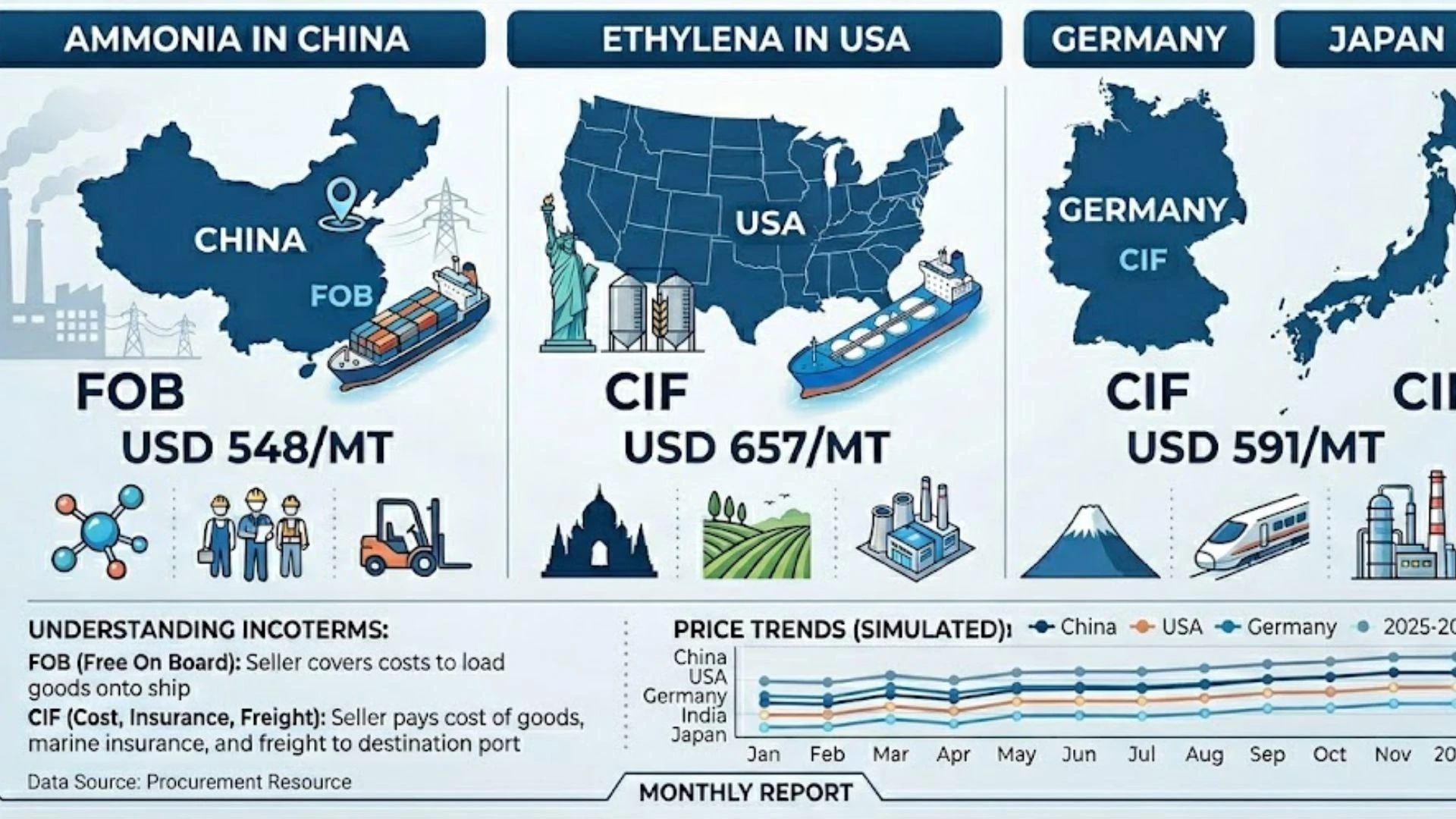
The Ethylene Glycol price trend in early 2026 indicates a moderately stable to slightly firm market, supported by steady downstream demand and balanced supply conditions. In January 2026, prices were observed at USD 548/MT (FOB China), USD 634/MT (CIF USA), and USD 670/MT (CIF Germany), reflecting regional variations driven by logistics costs and local demand strength. The market direction is influenced by demand from the polyester and automotive antifreeze sectors, while feedstock ethylene price fluctuations and operating rates of petrochemical plants continue to shape global supply. Overall, the global Ethylene Glycol market trend suggests cautious stability with periodic volatility linked to energy markets and industrial consumption cycles.
2. Market Snapshot
Market Snapshot
- Market Direction: Stable to Slightly Rising
- Primary Demand Sector: Polyester Fiber & PET Resin Industry
- Key Feedstock: Ethylene
- Major Supply Region: China, Middle East
- Short-Term Outlook: Stable
3. Key Drivers Affecting Ethylene Glycol Prices
The Ethylene Glycol supply demand analysis highlights several critical price drivers:
- Feedstock Cost Volatility: Changes in ethylene prices directly impact production costs
- Polyester Industry Demand: Strong consumption in textiles and packaging supports prices
- Global Production Capacity: Expansion in Asia increases supply pressure
- Energy Prices: Crude oil and natural gas trends influence petrochemical margins
- Export-Import Dynamics: Trade flows between Asia, Europe, and North America affect regional pricing
4. Why Prices Increased or Decreased Recently
Recent Ethylene Glycol price movements have been shaped by a mix of supply-side adjustments and demand fluctuations:
- Prices remained stable to slightly firm due to balanced supply-demand conditions
- Improved downstream polyester demand in Asia supported market sentiment
- Inventory normalization after previous oversupply phases helped stabilize prices
- However, ample production capacity in China limited significant upward momentum
- In Western markets, higher logistics and import costs contributed to elevated CIF prices
Overall, the absence of major disruptions kept the market relatively stable in January 2026.
5. Real Global Events Affecting the Market
Several global developments have influenced the global Ethylene Glycol market trend:
- Energy market fluctuations impacted feedstock ethylene production costs
- Geopolitical tensions in energy-exporting regions affected petrochemical supply chains
- New petrochemical plant expansions in Asia increased global supply availability
- Environmental regulations in Europe raised production compliance costs
- Shipping and freight rate volatility influenced CIF pricing in the USA and Germany
These factors collectively contributed to regional price disparities and moderate market volatility.
6. Regional Market Analysis
North America
The North American market showed stable demand from the automotive and packaging sectors. Prices in the USA stood at USD 634/MT (CIF), supported by steady imports and moderate domestic production. Supply remained sufficient, preventing sharp price spikes.
Asia Pacific
Asia Pacific, particularly China, remained the largest production hub, with prices at USD 548/MT (FOB). The region experienced balanced demand from polyester manufacturers, though excess capacity continued to cap price growth.
Europe
European prices reached USD 670/MT (CIF Germany), reflecting higher import dependency and stricter environmental regulations. Demand from industrial and automotive sectors remained stable, supporting pricing levels.
Middle East & Africa
The Middle East continued to act as a key export region, benefiting from feedstock availability. Competitive production costs supported global supply, while demand in Africa remained relatively moderate.
7. Industry Expert Insight
Industry analysts indicate that while global production capacity expansion continues to exert downward pressure, steady demand from polyester and packaging industries is maintaining price stability across major regions.
8. Market Outlook
The Ethylene Glycol price forecast suggests:
- Short-Term: Prices likely to remain stable due to balanced supply-demand dynamics
- Seasonal demand from textiles and packaging may provide mild support
- Medium-Term: Capacity expansions in Asia could create oversupply risks
- Growing PET and polyester demand may offset supply pressure
- Feedstock ethylene price trends will remain a key influencing factor
Overall, the Ethylene Glycol market outlook points toward moderate stability with occasional fluctuations driven by energy and industrial cycles.
Request For Sample: https://www.procurementresource.com/resource-center/ethylene-glycol-price-trends/pricerequest
9. Voice Search Optimization Section
What drives Ethylene Glycol prices globally?
Ethylene Glycol prices are driven by feedstock ethylene costs, polyester industry demand, and global supply-demand balance.
Why did Ethylene Glycol prices change recently?
Prices remained stable due to balanced supply, improved downstream demand, and normalized inventory levels.
Which industries consume Ethylene Glycol the most?
The polyester fiber, PET resin, and automotive antifreeze industries are the largest consumers.
10. FAQ Section
What affects Ethylene Glycol prices?
Feedstock prices, demand from polyester industries, and global supply levels are key factors.
Why did Ethylene Glycol prices remain stable recently?
Balanced supply-demand conditions and steady industrial consumption kept prices stable.
What industries use Ethylene Glycol?
It is widely used in textiles, packaging (PET), and automotive antifreeze applications.
Which region produces the most Ethylene Glycol?
Asia Pacific, especially China, is the largest producer globally.
What is the future outlook for Ethylene Glycol prices?
Prices are expected to remain stable with slight fluctuations based on energy costs and demand trends.
For detailed Ethylene Glycol price insights, regional data, and long-term forecasts, industry stakeholders often rely on specialized chemical market intelligence reports to support strategic decision-making and procurement planning.