
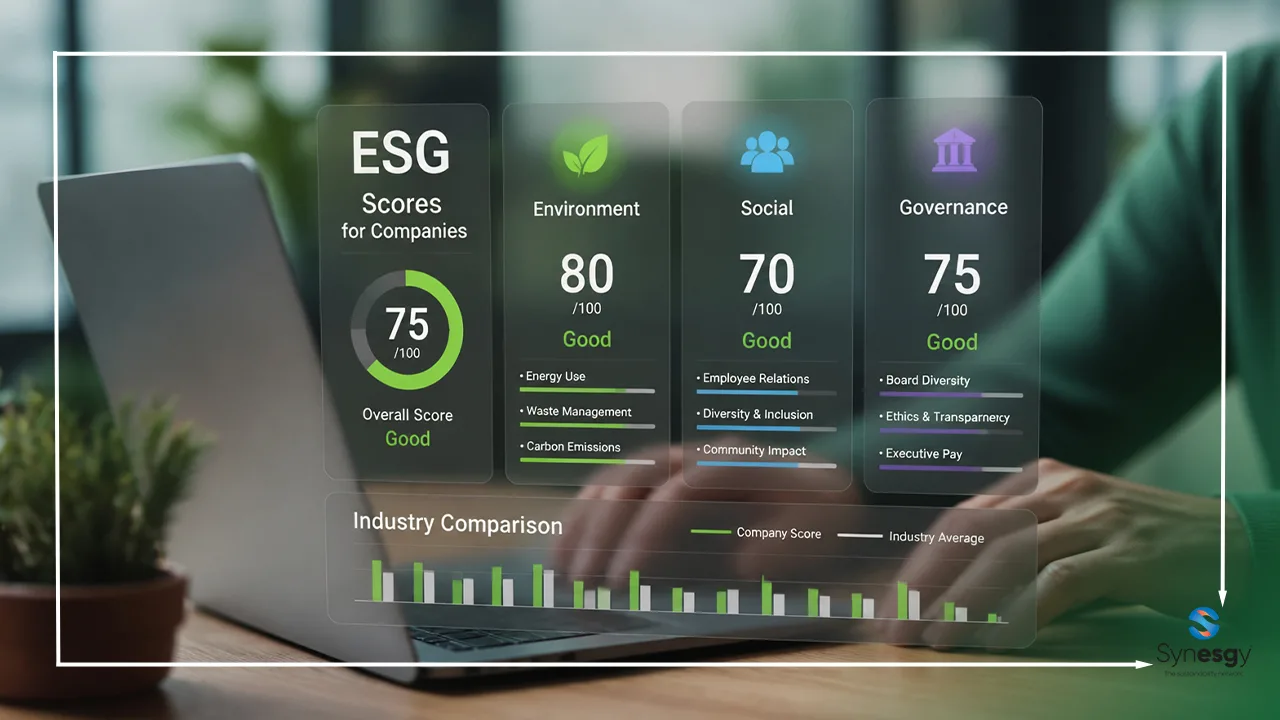
Sustainability is no longer a side conversation handled only by corporate social responsibility teams. It has become a board-level priority linked to risk management, investor confidence, regulatory readiness, supply chain resilience, and long-term business value. As leadership teams face increasing pressure to prove environmental, social, and governance performance, the ESG score for companies is becoming an important tool for strategic decision-making.
An ESG score gives boards and senior executives a structured view of how well a company performs across key sustainability and governance areas. It helps leaders move beyond broad commitments and understand whether the organisation is actually progressing on measurable ESG priorities. For boards, this score can support oversight, guide strategy, and strengthen accountability.
Why ESG Scores Matter at the Board Level
Boards are responsible for protecting long-term business value. This means they must understand not only financial performance, but also the non-financial risks that can affect reputation, operations, compliance, capital access, and stakeholder trust. ESG factors now sit directly within this responsibility.
A weak environmental record can increase operational and regulatory risk. Poor labour practices can damage employee trust and brand reputation. Weak governance can expose the business to compliance failures, ethical issues, and investor concern. These are not isolated sustainability matters. They are business risks.
An ESG score for companies gives directors and leadership teams a clearer way to assess these risks. It translates complex sustainability data into a structured score that can be reviewed, monitored, and improved over time. This makes ESG more visible in board discussions and helps leadership move from general awareness to informed action.
From ESG Reporting to ESG Strategy
Many companies begin their ESG journey with reporting. They collect data, prepare disclosures, and respond to stakeholder questions. While reporting is important, it is only one part of ESG maturity. Boards need to ensure that ESG data is not treated as a year-end compliance exercise, but as a strategic input.
An ESG score can help connect reporting with strategy. It shows where the company is performing well and where improvement is needed. For example, the score may highlight gaps in emissions tracking, supplier assessment, health and safety policies, board diversity, business ethics, or governance documentation.
This insight allows leadership teams to prioritise action. Instead of launching disconnected sustainability initiatives, the company can focus on areas that have the greatest impact on business risk, operational performance, and stakeholder expectations.
ESG Score as a Risk Management Tool
For boards, one of the strongest uses of an ESG score is risk visibility. ESG risks can emerge across multiple parts of the business, including operations, workforce management, procurement, compliance, finance, and supply chain relationships.
Without a structured scoring system, these risks may remain scattered across departments. The board may receive separate updates from sustainability, compliance, procurement, HR, and operations teams, but still lack a unified view of the company’s ESG position.
An ESG score for companies helps bring these signals together. It allows boards to identify whether the business has strong policies, measurable practices, reliable data, and improvement plans. It also helps compare performance over time, making it easier to track whether ESG risk is increasing, reducing, or remaining unchanged.
This is especially important for companies operating in sectors with complex supply chains, high resource use, regulatory exposure, or public stakeholder scrutiny. A structured ESG score can help leadership detect weaknesses before they become larger business problems.
Supporting Investor and Stakeholder Confidence
Investors, lenders, enterprise customers, regulators, and business partners are paying closer attention to sustainability performance. They want to understand whether companies are managing ESG risks responsibly and whether their commitments are backed by data.
A clear ESG score helps companies communicate performance with greater confidence. It gives stakeholders a more structured view of sustainability maturity and can support conversations around financing, partnerships, tenders, procurement, and corporate governance.
For boards, this is valuable because stakeholder trust is now closely linked to transparency. Companies that can demonstrate measurable ESG progress are better positioned to build credibility. Companies that rely only on broad statements may face questions around greenwashing, weak governance, or lack of accountability.
ESG Scores and Corporate Governance
Governance is central to ESG performance. A company cannot build a strong sustainability strategy without clear accountability, ethical leadership, risk controls, and decision-making structures. This is why the ESG score for companies is not only an environmental or social measurement. It is also a governance tool.
Boards can use ESG scores to ask stronger questions. Who owns ESG performance internally? Are ESG risks included in enterprise risk management? Are sustainability goals linked to business planning? Is supplier ESG performance being monitored? Are policies documented and implemented? Is ESG data reliable enough for external reporting?
These questions help move ESG from a communications topic to a governance discipline. They also encourage management teams to create stronger systems, not just stronger statements.
Using ESG Scores to Guide Capital and Resource Allocation
Sustainability priorities often compete with other business investments. Leadership teams may need to decide whether to invest in energy efficiency, supplier assessments, employee programmes, reporting systems, governance improvements, or compliance processes.
An ESG score can help guide these decisions. By identifying priority gaps, the score allows boards and executives to allocate resources more effectively. If the company scores low on environmental data management, investment may be needed in measurement systems. If supplier ESG visibility is weak, procurement processes may need to change. If governance policies are incomplete, board oversight and internal controls may need strengthening.
This helps companies avoid random ESG spending and instead build a focused sustainability roadmap.
Tracking Progress Over Time
One of the main advantages of ESG scoring is continuity. A single assessment gives a snapshot, but repeated scoring gives a performance trend. Boards can use this trend to evaluate whether the company is improving and whether management actions are producing results.
This makes ESG more measurable. Leadership teams can set targets, monitor improvement, and report progress with greater confidence. Over time, the ESG score becomes a management tool that supports accountability across departments.
It also helps boards review performance at the right level. Instead of focusing only on individual initiatives, directors can assess overall ESG maturity and ask whether the company is moving in the right direction.
Why Companies Need a Structured ESG Scoring Approach
Not all ESG data is equally useful. For an ESG score to support board-level strategy, it must be based on a structured methodology, reliable data, relevant indicators, and clear assessment criteria. The score should be understandable enough for leadership teams, but detailed enough to support real improvement.
A strong ESG scoring approach should help companies assess environmental performance, social practices, governance strength, supplier responsibility, documentation quality, and improvement readiness. It should also provide actionable insights, not just a final number.
For boards, the value lies in clarity. A well-structured ESG score helps simplify complex information without hiding important risks. It gives leadership teams a practical way to evaluate sustainability performance and convert ESG insight into business action.
Conclusion
The ESG score for companies is becoming more than a reporting metric. It is a board-level tool for strategy, governance, risk management, and stakeholder trust. As sustainability expectations continue to influence business decisions, boards need structured insight into how their organisations are performing and where improvement is required.
Companies that use ESG scores effectively can make better decisions, strengthen governance, reduce risk, and build a more credible sustainability strategy. For leadership teams, the question is no longer whether ESG matters. The real question is whether the company has the right tools to measure it, manage it, and turn it into long-term business value.